Kirjojen hintavertailu. Mukana 12 595 353 kirjaa ja 12 kauppaa.

Kirjailija

Harold Kushner

Kirjat ja teokset yhdessä paikassa: 13 kirjaa, julkaisuja vuosilta 1990-2021, suosituimpien joukossa Weak Convergence Methods and Singularly Perturbed Stochastic Control and Filtering Problems. Vertaile teosten hintoja ja tarkista saatavuus suomalaisista kirjakaupoista.

13 kirjaa

Kirjojen julkaisuhaarukka 1990-2021.

When Bad Things Happen to Good People
The #1 bestselling inspirational classic from the internationally known spiritual leader; a source of solace and hope for over 4 million readers.Since its original publication in 1981, When Bad Things Happen to Good People has brought solace and hope to millions. In the preface to this edition, Rabbi Kushner relates the heartwarming responses he has received over the years from people who have found inspiration and comfort within these pages.When Harold Kushner’s three-year-old son was diagnosed with a degenerative disease that meant the boy would only live until his early teens, he was faced with one of life’s most difficult questions: Why, God? Years later, Rabbi Kushner wrote this straightforward, elegant contemplation of the doubts and fears that arise when tragedy strikes. In these pages, Kushner shares his wisdom as a rabbi, a parent, a reader, and a human being. Often imitated but never superseded, When Bad Things Happen to Good People is a classic that offers clear thinking and consolation in times of sorrow.
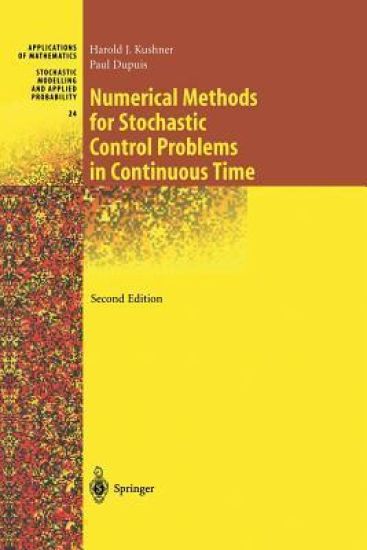
Numerical Methods for Stochastic Control Problems in Continuous Time

Numerical Methods for Stochastic Control Problems in Continuous Time

Harold Kushner; Paul G. Dupuis

Springer-Verlag New York Inc.
2013
nidottu
Changes in the second edition. The second edition differs from the first in that there is a full development of problems where the variance of the diffusion term and the jump distribution can be controlled. Also, a great deal of new material concerning deterministic problems has been added, including very efficient algorithms for a class of problems of wide current interest. This book is concerned with numerical methods for stochastic control and optimal stochastic control problems. The random process models of the controlled or uncontrolled stochastic systems are either diffusions or jump diffusions. Stochastic control is a very active area of research and new problem formulations and sometimes surprising applications appear regu­ larly. We have chosen forms of the models which cover the great bulk of the formulations of the continuous time stochastic control problems which have appeared to date. The standard formats are covered, but much emphasis is given to the newer and less well known formulations. The controlled process might be either stopped or absorbed on leaving a constraint set or upon first hitting a target set, or it might be reflected or "projected" from the boundary of a constraining set. In some of the more recent applications of the reflecting boundary problem, for example the so-called heavy traffic approximation problems, the directions of reflection are actually discontin­ uous. In general, the control might be representable as a bounded function or it might be of the so-called impulsive or singular control types.
Heavy Traffic Analysis of Controlled Queueing and Communication Networks
The aim of this book is the development of the heavy traffic approach to the modeling and analysis of queueing networks, both controlled and uncontrolled, and many applications to computer, communications, and manufacturing systems. The methods exploit the multiscale structure of the physical problem to get approximating models that have the form of reflected diffusion processes, either controlled or uncontrolled. These ap­ proximating models have the basic structure of the original problem, but are significantly simpler. Much of inessential detail is eliminated (or "av­ eraged out"). They greatly simplify analysis, design, and optimization and yield good approximations to problems that would otherwise be intractable, under broad conditions. Queueing-type processes are ubiquitous occurrences in operations re­ search, and in communications and computer systems. Indeed, it is hard to avoid them in modern technology. The subject is now about 100 years old. and there is an enormous literature. Impressive techniques, many based on Markov chain and ergodic theory, have been developed to han­ dle a great variety of models. A sampling of the numerous books includes [6, 8, 18, 27, 33, 46, 81, 86, 132, 133, 220, 243]. But the models of interest are growing fast in the face of the demands of new applications, particularly in communications and computer systems.
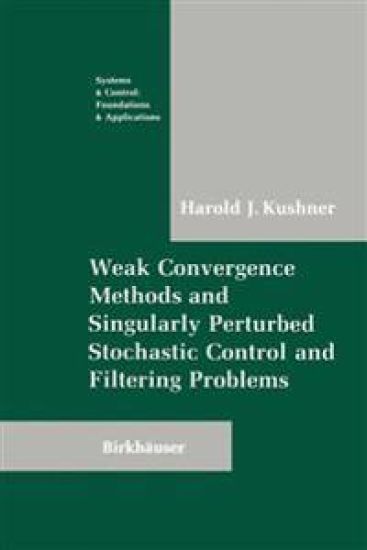
Weak Convergence Methods and Singularly Perturbed Stochastic Control and Filtering Problems
The book deals with several closely related topics concerning approxima­ tions and perturbations of random processes and their applications to some important and fascinating classes of problems in the analysis and design of stochastic control systems and nonlinear filters. The basic mathematical methods which are used and developed are those of the theory of weak con­ vergence. The techniques are quite powerful for getting weak convergence or functional limit theorems for broad classes of problems and many of the techniques are new. The original need for some of the techniques which are developed here arose in connection with our study of the particular applica­ tions in this book, and related problems of approximation in control theory, but it will be clear that they have numerous applications elsewhere in weak convergence and process approximation theory. The book is a continuation of the author's long term interest in problems of the approximation of stochastic processes and its applications to problems arising in control and communication theory and related areas. In fact, the techniques used here can be fruitfully applied to many other areas. The basic random processes of interest can be described by solutions to either (multiple time scale) Ito differential equations driven by wide band or state dependent wide band noise or which are singularly perturbed. They might be controlled or not, and their state values might be fully observable or not (e. g. , as in the nonlinear filtering problem).
Stochastic Approximation and Recursive Algorithms and Applications

Stochastic Approximation and Recursive Algorithms and Applications

Harold Kushner; G. George Yin

Springer-Verlag New York Inc.
2010
nidottu
The basic stochastic approximation algorithms introduced by Robbins and MonroandbyKieferandWolfowitzintheearly1950shavebeenthesubject of an enormous literature, both theoretical and applied. This is due to the large number of applications and the interesting theoretical issues in the analysis of “dynamically de?ned” stochastic processes. The basic paradigm is a stochastic di?erence equation such as ? = ? + Y , where ? takes n+1 n n n n its values in some Euclidean space, Y is a random variable, and the “step n size” > 0 is small and might go to zero as n??. In its simplest form, n ? is a parameter of a system, and the random vector Y is a function of n “noise-corrupted” observations taken on the system when the parameter is set to ? . One recursively adjusts the parameter so that some goal is met n asymptotically. Thisbookisconcernedwiththequalitativeandasymptotic properties of such recursive algorithms in the diverse forms in which they arise in applications. There are analogous continuous time algorithms, but the conditions and proofs are generally very close to those for the discrete time case. The original work was motivated by the problem of ?nding a root of a continuous function g ¯(?), where the function is not known but the - perimenter is able to take “noisy” measurements at any desired value of ?. Recursive methods for root ?nding are common in classical numerical analysis, and it is reasonable to expect that appropriate stochastic analogs would also perform well.
Numerical Methods for Controlled Stochastic Delay Systems
The Markov chain approximation methods are widely used for the numerical solution of nonlinear stochastic control problems in continuous time. This book extends the methods to stochastic systems with delays. The book is the first on the subject and will be of great interest to all those who work with stochastic delay equations and whose main interest is either in the use of the algorithms or in the mathematics. An excellent resource for graduate students, researchers, and practitioners, the work may be used as a graduate-level textbook for a special topics course or seminar on numerical methods in stochastic control.
Cuando a la gente buena le pasan cosas malas / When Bad Things Happen to Good Pe ople
Cuando su hijo fue diagnosticado a los tres a os de edad con una enfermedad degenerativa que acortar a su vida en la adolescencia, Harold Kushner se enfrent a una de las preguntas m s angustiantes en la vida: Por qu , Dios? A os m s tarde, el rabino Kushner escribi esta contemplaci n sencilla y elegante de las dudas y temores que surgen cuando una tragedia nos golpea la puerta. Kushner comparte su sabidur a como rabino, como padre, como lector y como ser humano. Con m ltiples imitaciones que no han logrado superar este original, Cuando a la gente buena le pasan cosas malas es un cl sico que nos ofrece pensamientos claros y consolaci n en per odos de dolor y tristeza. ENGLISH DESCRIPTION The #1 bestselling inspirational classic from the nationally known spiritual leader; a source of solace and hope for over 4 million readers. When Harold Kushner's three-year-old son was diagnosed with a degenerative disease that meant the boy would only live until his early teens, he was faced with one of life's most difficult questions: Why, God? Years later, Rabbi Kushner wrote this straightforward, elegant contemplation of the doubts and fears that arise when tragedy strikes. In these pages, Kushner shares his wisdom as a rabbi, a parent, a reader, and a human being. Often imitated but never superseded, When Bad Things Happen to Good People is a classic that offers clear thinking and consolation in times of sorrow.
Stochastic Approximation and Recursive Algorithms and Applications

Stochastic Approximation and Recursive Algorithms and Applications

Harold Kushner; G. George Yin

Springer-Verlag New York Inc.
2003
sidottu
The basic stochastic approximation algorithms introduced by Robbins and MonroandbyKieferandWolfowitzintheearly1950shavebeenthesubject of an enormous literature, both theoretical and applied. This is due to the large number of applications and the interesting theoretical issues in the analysis of “dynamically de?ned” stochastic processes. The basic paradigm is a stochastic di?erence equation such as ? = ? + Y , where ? takes n+1 n n n n its values in some Euclidean space, Y is a random variable, and the “step n size” > 0 is small and might go to zero as n??. In its simplest form, n ? is a parameter of a system, and the random vector Y is a function of n “noise-corrupted” observations taken on the system when the parameter is set to ? . One recursively adjusts the parameter so that some goal is met n asymptotically. Thisbookisconcernedwiththequalitativeandasymptotic properties of such recursive algorithms in the diverse forms in which they arise in applications. There are analogous continuous time algorithms, but the conditions and proofs are generally very close to those for the discrete time case. The original work was motivated by the problem of ?nding a root of a continuous function g ¯(?), where the function is not known but the - perimenter is able to take “noisy” measurements at any desired value of ?. Recursive methods for root ?nding are common in classical numerical analysis, and it is reasonable to expect that appropriate stochastic analogs would also perform well.
Who Needs God

Who Needs God

Harold Kushner

Touchstone
2002
pokkari
Full of the ideas and affirmations on which bestselling author Harold Kushner has based his life, WHO NEEDS GOD will help readers bring depth and order to their lives through spirituality. It is a book for anyone who has ever stepped back and thought, 'there must be more to life than this?' Here Kushner looks at the nourishment our souls crave, in much the same way that our bodies need the right foods, sunshine and exercise. He maintains that without some kind of spiritual nourishment, our souls remain stunted and underdeveloped. The spiritual life that was so prominent for people in the past is less accessible to us today - because the world is so noisy and full of distractions, because we are so dazzled by our power and success and because in the new millennium religion is often represented by people we no longer trust. In this thought provoking book Kushner shows us that the presence of God in our lives can make a difference and that modern people are capable of pray.
When All You've Ever Wanted Isn't Enough

When All You've Ever Wanted Isn't Enough

Harold Kushner

Touchstone Books
2002
nidottu
Harold Kushner, rabbi for more than thirty years and bestselling author, returns with advice and guidance on your search for a meaningful life. With the same compassion and wisdom that powered his phenomenal bestseller When Bad Things Happen to Good People, Harold Kushner addresses a need that is universal and timeless -- the wish for a meaningful life. Why is it that, after attaining many of our goals, we are left with a sense that something vital is missing? In his deeply inspiring bestseller, Rabbi Kushner shows us how to live as human beings are meant to. He guides us to a heightened sense of joy, purpose, and meaning, and helps us to redirect our energies toward goals that will bring us lasting happiness and true fulfillment.
Heavy Traffic Analysis of Controlled Queueing and Communication Networks
The aim of this book is the development of the heavy traffic approach to the modeling and analysis of queueing networks, both controlled and uncontrolled, and many applications to computer, communications, and manufacturing systems. The methods exploit the multiscale structure of the physical problem to get approximating models that have the form of reflected diffusion processes, either controlled or uncontrolled. These ap­ proximating models have the basic structure of the original problem, but are significantly simpler. Much of inessential detail is eliminated (or "av­ eraged out"). They greatly simplify analysis, design, and optimization and yield good approximations to problems that would otherwise be intractable, under broad conditions. Queueing-type processes are ubiquitous occurrences in operations re­ search, and in communications and computer systems. Indeed, it is hard to avoid them in modern technology. The subject is now about 100 years old. and there is an enormous literature. Impressive techniques, many based on Markov chain and ergodic theory, have been developed to han­ dle a great variety of models. A sampling of the numerous books includes [6, 8, 18, 27, 33, 46, 81, 86, 132, 133, 220, 243]. But the models of interest are growing fast in the face of the demands of new applications, particularly in communications and computer systems.
Numerical Methods for Stochastic Control Problems in Continuous Time

Numerical Methods for Stochastic Control Problems in Continuous Time

Harold Kushner; Paul G. Dupuis

Springer-Verlag New York Inc.
2000
sidottu
Changes in the second edition. The second edition differs from the first in that there is a full development of problems where the variance of the diffusion term and the jump distribution can be controlled. Also, a great deal of new material concerning deterministic problems has been added, including very efficient algorithms for a class of problems of wide current interest. This book is concerned with numerical methods for stochastic control and optimal stochastic control problems. The random process models of the controlled or uncontrolled stochastic systems are either diffusions or jump diffusions. Stochastic control is a very active area of research and new problem formulations and sometimes surprising applications appear regu­ larly. We have chosen forms of the models which cover the great bulk of the formulations of the continuous time stochastic control problems which have appeared to date. The standard formats are covered, but much emphasis is given to the newer and less well known formulations. The controlled process might be either stopped or absorbed on leaving a constraint set or upon first hitting a target set, or it might be reflected or "projected" from the boundary of a constraining set. In some of the more recent applications of the reflecting boundary problem, for example the so-called heavy traffic approximation problems, the directions of reflection are actually discontin­ uous. In general, the control might be representable as a bounded function or it might be of the so-called impulsive or singular control types.
Weak Convergence Methods and Singularly Perturbed Stochastic Control and Filtering Problems
The book deals with several closely related topics concerning approxima­ tions and perturbations of random processes and their applications to some important and fascinating classes of problems in the analysis and design of stochastic control systems and nonlinear filters. The basic mathematical methods which are used and developed are those of the theory of weak con­ vergence. The techniques are quite powerful for getting weak convergence or functional limit theorems for broad classes of problems and many of the techniques are new. The original need for some of the techniques which are developed here arose in connection with our study of the particular applica­ tions in this book, and related problems of approximation in control theory, but it will be clear that they have numerous applications elsewhere in weak convergence and process approximation theory. The book is a continuation of the author's long term interest in problems of the approximation of stochastic processes and its applications to problems arising in control and communication theory and related areas. In fact, the techniques used here can be fruitfully applied to many other areas. The basic random processes of interest can be described by solutions to either (multiple time scale) Ito differential equations driven by wide band or state dependent wide band noise or which are singularly perturbed. They might be controlled or not, and their state values might be fully observable or not (e. g. , as in the nonlinear filtering problem).