Kirjojen hintavertailu. Mukana 12 191 929 kirjaa ja 12 kauppaa.

Kirjailija

Harry J. Thie

Kirjat ja teokset yhdessä paikassa: 27 kirjaa, julkaisuja vuosilta 1995-2012, suosituimpien joukossa A Strategic Approach to Joint Officer Management. Vertaile teosten hintoja ja tarkista saatavuus suomalaisista kirjakaupoista.

Mukana myös kirjoitusasut: Harry J Thie

27 kirjaa

Kirjojen julkaisuhaarukka 1995-2012.

A Strategic Approach to Joint Officer Management

A Strategic Approach to Joint Officer Management

Margaret C Harrell; Harry J Thie; Sheila Nataraj Kirby; Al Crego; Danielle M Varda

RAND
2009
pokkari
As part of a broader research effort examining officer education and development in joint matters, the authors use data analysis and complex modeling to identify billets that that provide and/or require joint experience; and determine whether there are sufficient numbers of officers with joint experience to fill such billets.
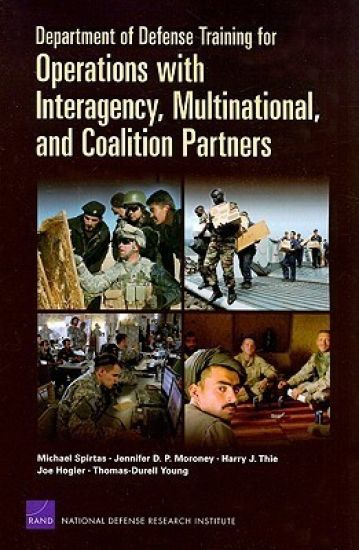
Department of Defense Training for Operations with Interagency, Multinational, and Coalition Partners

Department of Defense Training for Operations with Interagency, Multinational, and Coalition Partners

Michael Spirtas; Jennifer D. P. Moroney; Harry J. Thie; Joe Hogler; Thomas-Durell Young

RAND
2008
pokkari
The nature of recent challenges and the types of missions the U.S. Department of Defense has undertaken highlight the need for it to consider ways to help the military prepare to work with other government agencies, international organizations, private and non governmental organizations, and foreign militaries. Current training programs aimed at headquarters staffs need to be revamped to focus on high-priority tasks that are amenable to training.Integrated operations require the U.S. military to work with other government agencies, organizations, and foreign militaries. Current headquarter-staff training needs to be revamped to focus on high-priority tasks.
Factors to Consider in Blending Active and Reserve Manpower Within Military Units

Factors to Consider in Blending Active and Reserve Manpower Within Military Units

Harry J. Thie; Roland J. Yardley; Peter Schirmer; Rudolph H. Ehrenberg; Penelope Speed

RAND
2007
pokkari
The Department of Defense has suggested that "blending" active component and reserve component workforces in military units must be implemented more broadly for a more flexible, capable force. This report examines existing organizational designs that facilitate integration of the reserve and active workforces, to ascertain whether changed personnel management practices are needed to further implement these designs.
Expanding Enlisted Lateral Entry

Expanding Enlisted Lateral Entry

Dina G. Levy; Joy Moini; Jennifer Sharp; Harry J. Thie

RAND
2004
pokkari
Can the U.S. military better meet its personnel needs by allowing more recruits to enter laterally into military service from civilian life? The U.S. military constantly evaluates its personnel system to find optimal ways to obtain the types of personnel to execute its missions most efficiently. Will it get better results if it expands its program to allow civilians with appropriate education and experience to enter the military laterally? The authors analyzed occupations in the Army, Air Force, and Navy and concluded that pursuing a policy of large-scale lateral entry did not show promise. They recommended that the Army and Navy leave their lateral entry programs intact for possible expansion, should future conditions warrant it.
Information Systems Technician Rating Stakeholders

Information Systems Technician Rating Stakeholders

Margaret C. Harrell; Harry J. Thie; Roland J. Yardley; Maria C. Lytell

RAND
2011
pokkari
The relationships among stakeholders involved in manpower, personnel, and training processes for managing the U.S. Navy information systems technician rating are discussed. The authors examine the effects of these different stakeholders on efficiency and effectiveness measures for the information technician community in general and the Consolidated Afloat Networks and Enterprise Services program specifically.
Evaluating Navy's Funded Graduate Education Program

Evaluating Navy's Funded Graduate Education Program

Kristy N. Kamarck; Harry J. Thie; Marisa Aldeson; Heather Krull

RAND
2010
pokkari
Sending officers to graduate schools is costly to the services. While officers incur specific service requirements in return, does that recoup the investment? The authors found that, in the U.S. Navy, breaking even financially is not always realistic. But the skills and general knowledge that officers gain in the process extend the value of their degrees beyond their majors, particularly in careers leading to flag rank.
Diversity of Service Academy Entrants and Graduates

Diversity of Service Academy Entrants and Graduates

Sheila Nataraj Kirby; Harry J. Thie; Scott Naftel; Marisa Adelson

RAND
2010
pokkari
Analyses of data on service academy entrants show that, although the percentages of women and nonwhite entrants have increased, these groups tend to graduate and complete their initial service obligation at lower rates than their counterparts. However, in recent cohorts, these groups showed improved graduation rates. The study resulted in several recommendations for the U.S. Department of Defense to support service efforts to increase diversity.
Consolidated Afloat Networks and Enterprise Services (CANES)

Consolidated Afloat Networks and Enterprise Services (CANES)

Harry J Thie; Margaret C Harrell; Aine Seitz McCarthy; Joseph Jenkins

RAND
2010
pokkari
The computer networks, systems, and applications used on Navy ships are an amalgam of disparate hardware and software systems that were developed and introduced onboard largely independent from one another. This report assesses the manpower, personnel, and training implications associated with the introduction of the Consolidated Afloat Networks and Enterprise Services (CANES)--a common computing environment--to U.S. Navy ships.
Qualifying Military Health Care Officers as "Joint"

Qualifying Military Health Care Officers as "Joint"

Sheila Nataraj Kirby; Harry J Thie

RAND
2009
pokkari
This research, part of a larger project examining the preparation and support of leaders in the medical field, evaluates the need for and feasibility of qualifying health care officers as "joint" officers. An extensive policy review and assessment of data from the 2005 Joint Officer Management survey suggest that such officers are indeed serving in billets that need and provide joint duty experience for which they should receive credit.
Enhancing Interoperability Among Enlisted Medical Personnel

Enhancing Interoperability Among Enlisted Medical Personnel

Harry J Thie; Sheila Nataraj Kirby; Adam C Rresnick; Thomas Manacapilli; Daniel Gershwin

RAND
2009
pokkari
To reduce costs and increase interoperability of the military services, a joint medical education and training campus is being established at Fort Sam Houston, Texas with a view to consolidating training across the services. A methodology is outlined for defining and implementing a common standard of practice for a given specialty and its use illustrated through an application to the medical surgical technologist specialty.
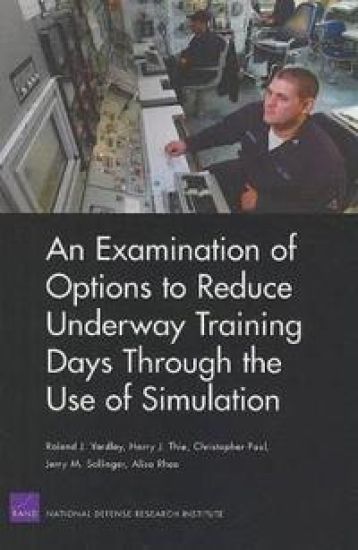
An Examination of Options to Reduce Underway Training Days Through the Use of Simulation

An Examination of Options to Reduce Underway Training Days Through the Use of Simulation

Roland J. Yardley; Harry J. Thie; Christopher Paul; Jerry M. Sollinger; Alisa Rhee

RAND
2008
pokkari
Constrained budgets and increasing costs have forced the U.S. Navy to search for ways to reduce the annual operating costs of the fleet. One expensive driver of those costs is underway training of surface combatant ship crews. Focusing on the DDG-51 Arleigh Burkeclass of surface combatants, RAND examines whether and how increased use of simulators could be substituted for underway training without any decrease in readiness.The U.S. Navy is looking for ways to reduce the annual operating costs of the fleet. RAND examines whether and how an increased use of simulators could reduce costly underway training days for DDG-51class ships while sustaining readiness.
Fiscally Informed Total Force Manpower

Fiscally Informed Total Force Manpower

Harry J. Thie; John Christian; Matthew Stafford; Roland J. Yardley; Peter Schirmer

RAND
2008
pokkari
This title presents the results of a short-term review of 27 publicly available manpower studies to discover methods that other organizations could use to make fiscally informed manpower decisions. The studies exhibit varying methods for determining manpower requirements; however, the method used may not be as important as other attributes, such as the direct involvement of a senior decision maker.
Framing a Strategic Approach for Reserve Component Joint Officer Management

Framing a Strategic Approach for Reserve Component Joint Officer Management

Harry J Thie; Margaret C Harrell; Sheila N Kirby; Al Crego; Roland J Yardley

RAND
2007
pokkari
Outlines a strategic approach to reserve joint officer management that addresses the requirements for, and the supply of, joint officers and also accounts for the unique constraints and challenges involved in joint officer management for reserve active status list officers. The authors estimate the supply of joint reserve officers and make several recommendations to help implement this strategic approach.
Challenging Time in Dopma

Challenging Time in Dopma

Peter Schirmer; Harry J. Thie; Margaret C. Harrell; Michael S. Tseng

RAND
2006
pokkari
Many of the laws and policies that govern officer career management (often referred to as "DOPMA," after the Defense Officer Personnel Management Act of 1980) may not meet the requirements of the future operating environment. One criticism of DOPMA is that it does not allow for much variety in career paths because it is time-driven. The authors demonstrate how a competency-based system could provide more flexibility in preparing officers for the wide-ranging roles and missions of the 21st century military.
Who is "Joint"?

Who is "Joint"?

Sheila Nataraj Kirby; Al Crego; Harry J Thie; Margaret C Harrell; Kimberly Curry

RAND
2006
pokkari
The Department of Defense has an identified need to update the practice, policy, and law applied to Joint Officer Management and Joint Professional Military Education. As a lead-in to this study, the 2005 Joint Officer Management Census survey polled officers serving in billets. The authors examine the extent to which officers believe their jobs provide them with joint experience or require joint education or experience and examine how respondents' answers differ across organizations.