Kirjojen hintavertailu. Mukana 12 390 323 kirjaa ja 12 kauppaa.

Kirjailija

Harry M. Markowitz

Kirjat ja teokset yhdessä paikassa: 10 kirjaa, julkaisuja vuosilta 1977-2021, suosituimpien joukossa Portfolio Selection. Vertaile teosten hintoja ja tarkista saatavuus suomalaisista kirjakaupoista.

10 kirjaa

Kirjojen julkaisuhaarukka 1977-2021.

Asset Allocation

Asset Allocation

William Kinlaw; Mark P. Kritzman; David Turkington; Harry M. Markowitz

John Wiley Sons Inc
2021
sidottu
Discover a masterful exploration of the fallacies and challenges of asset allocation In Asset Allocation: From Theory to Practice and Beyond—the newly and substantially revised Second Edition of A Practitioner’s Guide to Asset Allocation—accomplished finance professionals William Kinlaw, Mark P. Kritzman, and David Turkington deliver a robust and insightful exploration of the core tenets of asset allocation. Drawing on their experience working with hundreds of the world’s largest and most sophisticated investors, the authors review foundational concepts, debunk fallacies, and address cutting-edge themes like factor investing and scenario analysis. The new edition also includes references to related topics at the end of each chapter and a summary of key takeaways to help readers rapidly locate material of interest. The book also incorporates discussions of: The characteristics that define an asset class, including stability, investability, and similarityThe fundamentals of asset allocation, including definitions of expected return, portfolio risk, and diversificationAdvanced topics like factor investing, asymmetric diversification, fat tails, long-term investing, and enhanced scenario analysis as well as tools to address challenges such as liquidity, rebalancing, constraints, and within-horizon risk. Perfect for client-facing practitioners as well as scholars who seek to understand practical techniques, Asset Allocation: From Theory to Practice and Beyond is a must-read resource from an author team of distinguished finance experts and a forward by Nobel prize winner Harry Markowitz.
Risk-Return Analysis Volume 3

Risk-Return Analysis Volume 3

Harry M. Markowitz

McGraw-Hill Professional
2020
sidottu
The man who created investing as we know it provides critical insights, knowledge, and tools for generating steady profits in today’s economy.When Harry Markowitz introduced the concept of examining and purchasing a range of diverse stocks—in essence, the practice of creating a portfolio—he transformed the world of investing. The idea was novel, even radical, when he presented it in 1952 for his dissertation. Today, it’s second-nature to the majority of investors worldwide. Now, the legendary economist returns with the third volume of his groundbreaking four-volume Risk-Return Analysis series, where he corrects common misperceptions about Modern Portfolio Theory (MPT) and provides critical insight into the practice of MPT over the last 60 years. He guides you through process of making rational decisions in the face of uncertainty—making this a critical guide to investing in today’s economy. From the Laffer Curve to RDM Reasoning to Finite Ordinal Arithmetic to the ideas and concepts of some of history’s most influential thinkers, Markowitz provides a wealth and depth of financial knowledge, wisdom, and insights you would be hard pressed to find elsewhere. This deep dive into the theories and practices of the investing legend is what you need to master strategic portfolio management designed to generate profits in good times and bad.
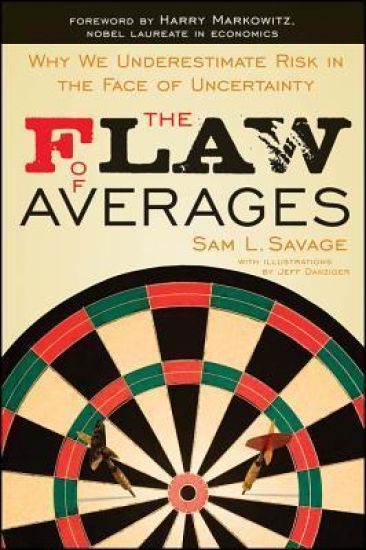
The Flaw of Averages

The Flaw of Averages

Sam L. Savage; Harry M. Markowitz

John Wiley Sons Inc
2012
nidottu
A must-read for anyone who makes business decisions that have a major financial impact. As the recent collapse on Wall Street shows, we are often ill-equipped to deal with uncertainty and risk. Yet every day we base our personal and business plans on uncertainties, whether they be next month’s sales, next year’s costs, or tomorrow’s stock price. In The Flaw of Averages, Sam Savage­known for his creative exposition of difficult subjects­ describes common avoidable mistakes in assessing risk in the face of uncertainty. Along the way, he shows why plans based on average assumptions are wrong, on average, in areas as diverse as healthcare, accounting, the War on Terror, and climate change. In his chapter on Sex and the Central Limit Theorem, he bravely grasps the literary third rail of gender differences. Instead of statistical jargon, Savage presents complex concepts in plain English. In addition, a tightly integrated web site contains numerous animations and simulations to further connect the seat of the reader’s intellect to the seat of their pants. The Flaw of Averages typically results when someone plugs a single number into a spreadsheet to represent an uncertain future quantity. Savage finishes the book with a discussion of the emerging field of Probability Management, which cures this problem though a new technology that can pack thousands of numbers into a single spreadsheet cell. Praise for The Flaw of Averages “Statistical uncertainties are pervasive in decisions we make every day in business, government, and our personal lives. Sam Savage’s lively and engaging book gives any interested reader the insight and the tools to deal effectively with those uncertainties. I highly recommend The Flaw of Averages.” —William J. Perry, Former U.S. Secretary of Defense “Enterprise analysis under uncertainty has long been an academic ideal. . . . In this profound and entertaining book, Professor Savage shows how to make all this practical, practicable, and comprehensible.” —­Harry Markowitz, Nobel Laureate in Economics
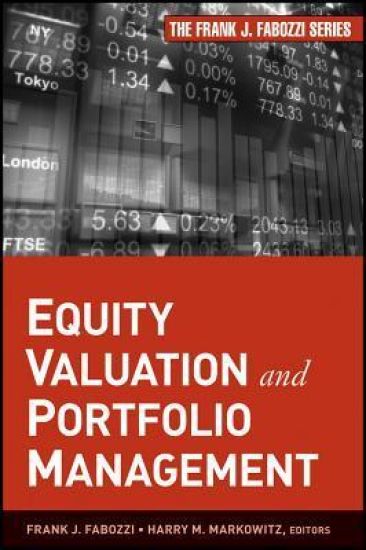
Equity Valuation and Portfolio Management

Equity Valuation and Portfolio Management

Frank J. Fabozzi; Harry M. Markowitz

John Wiley Sons Inc
2011
sidottu
A detailed look at equity valuation and portfolio management Equity valuation is a method of valuing stock prices using fundamental analysis to determine the worth of the business and discover investment opportunities. In Equity Valuation and Portfolio Management Frank J. Fabozzi and Harry M. Markowitz explain the process of equity valuation, provide the necessary mathematical background, and discuss classic and new portfolio strategies for investment managers. Divided into two comprehensive parts, this reliable resource focuses on valuation and portfolio strategies related to equities. Discusses both fundamental and new techniques for valuation and strategiesFabozzi and Markowitz are experts in the fields of investment management and economicsIncludes end of chapter bullet point summaries, key chapter take-aways, and study questions Filled with in-depth insights and practical advice, Equity Valuation and Portfolio Management will put you in a better position to excel at this challenging endeavor.
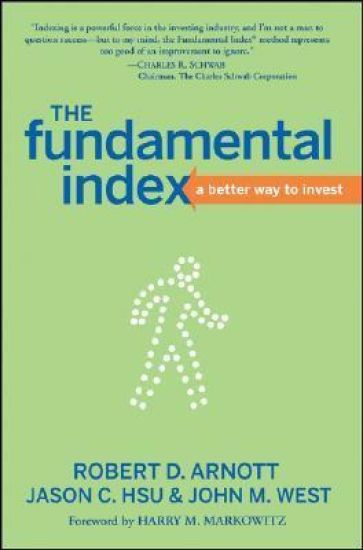
The Fundamental Index

The Fundamental Index

Robert D. Arnott; Jason C. Hsu; John M. West; Harry M. Markowitz

John Wiley Sons Inc
2008
sidottu
2008 American Publishers Awards for Professional and Scholarly Excellence (The PROSE Awards) Finalist/Honorable mention, Business, Finance & Management. The Fundamental Index examines a new approach to indexing that can overcome the structural return drag created by traditional capitalization-based indexing strategies, and in so doing, enhance the performance of your portfolio. Throughout this book, Robert Arnott and his colleagues outline this breakthrough strategy and explain how it can be used to improve investment returns, typically at lower risk and lower cost than most conventional investments.
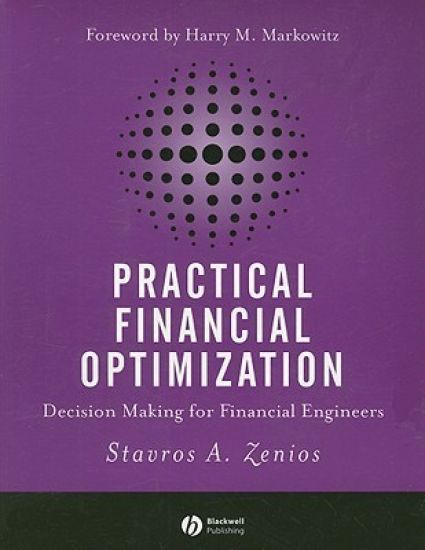
Practical Financial Optimization

Practical Financial Optimization

Stavros A. Zenios; Harry M. Markowitz

Wiley-Blackwell (an imprint of John Wiley Sons Ltd)
2008
nidottu
Practical Financial Optimization is a comprehensive guide to optimization techniques in financial decision making. This book illuminates the relationship between theory and practice, providing the readers with solid foundational knowledge. Focuses on classical static mean-variance analysis and portfolio immunization, scenario-based models, multi-period dynamic portfolio optimization, and the relationships between classes of modelsAnalyizes real world applications and implications for financial engineersIncludes a list of models and a section on notations that includes a glossary of symbols and abbreviations
Practical Financial Optimization

Practical Financial Optimization

Stavros A. Zenios; Harry M. Markowitz

Wiley-Blackwell (an imprint of John Wiley Sons Ltd)
2008
sidottu
Practical Financial Optimization is a comprehensive guide to optimization techniques in financial decision making. This book illuminates the relationship between theory and practice, providing the readers with solid foundational knowledge. Focuses on classical static mean-variance analysis and portfolio immunization, scenario-based models, multi-period dynamic portfolio optimization, and the relationships between classes of modelsAnalyizes real world applications and implications for financial engineersIncludes a list of models and a section on notations that includes a glossary of symbols and abbreviations
Mean-Variance Analysis in Portfolio Choice and Capital Markets

Mean-Variance Analysis in Portfolio Choice and Capital Markets

Harry M. Markowitz; G. Peter Todd; William F. Sharpe

Frank J. Fabozzi Associates
2000
sidottu
In 1952, Harry Markowitz published "Portfolio Selection," a paper which revolutionized modern investment theory and practice. The paper proposed that, in selecting investments, the investor should consider both expected return and variability of return on the portfolio as a whole. Portfolios that minimized variance for a given expected return were demonstrated to be the most efficient. Markowitz formulated the full solution of the general mean-variance efficient set problem in 1956 and presented it in the appendix to his 1959 book, Portfolio Selection. Though certain special cases of the general model have become widely known, both in academia and among managers of large institutional portfolios, the characteristics of the general solution were not presented in finance books for students at any level. And although the results of the general solution are used in a few advanced portfolio optimization programs, the solution to the general problem should not be seen merely as a computing procedure. It is a body of propositions and formulas concerning the shapes and properties of mean-variance efficient sets with implications for financial theory and practice beyond those of widely known cases. The purpose of the present book, originally published in 1987, is to present a comprehensive and accessible account of the general mean-variance portfolio analysis, and to illustrate its usefulness in the practice of portfolio management and the theory of capital markets. The portfolio selection program in Part IV of the 1987 edition has been updated and contains exercises and solutions.
Portfolio Selection

Portfolio Selection

Harry M. Markowitz

Blackwell Publishers
1991
sidottu
This is a classic book, representing the first major breakthrough in the field of modern financial theory. In effect, it created the mathematics of portfolio selection in a model which has turned out to be the indispensable building block from which the theory of the demand for risky securities is constructed.
Portfolio Selection

Portfolio Selection

Harry M. Markowitz

Yale University Press
1977
pokkari
Applies modern techniques of analysis and computation to the problem of finding combinations of securities that best meet the needs of the private institutional investor. Written primarily with the nonmathematician in mind, although it contains mathematical development of the subject in appendixes.