Kirjojen hintavertailu. Mukana 12 390 323 kirjaa ja 12 kauppaa.

Kirjailija

Helen B. Holmes

Kirjat ja teokset yhdessä paikassa: 6 kirjaa, julkaisuja vuosilta 1981-2026, suosituimpien joukossa Man-Made Women. Vertaile teosten hintoja ja tarkista saatavuus suomalaisista kirjakaupoista.

6 kirjaa

Kirjojen julkaisuhaarukka 1981-2026.

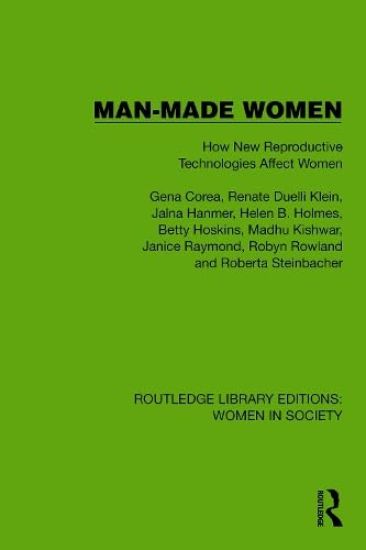
Man-Made Women

Man-Made Women

Gena Corea; Renate Duelli Klein; Jalna Hanmer; Helen B. Holmes; Betty Hoskins; Madhu Kishwar; Janice Raymond; Robyn Rowland; Roberta Steinbacher

TAYLOR FRANCIS LTD
2026
nidottu
In the early 1980s the new reproductive technologies available supposedly offered infertile women a chance to have children. However, there was growing concern that the determination of scientists to dominate nature, their disregard for women’s well-being, and the financial gains to be made from these technologies would together result in the increased modification of all women’s lives and the loss of even more control over our own bodies. Originally published in 1985, the essays in Man-Made Women describe the technologies being used and researched in the areas of in vitro fertilization (’test-tube babies’), sex-predetermination and embryo transfer at the time. They discuss the practical application of the technologies on an international scale and draw attention to the racist and classist assumptions on which they are based. There is also information about the international action that feminists had begun to counter these so-called benevolent and therapeutic technologies. Man-Made Women hoped to encourage women to start questioning the ‘miracle’ of these new reproductive technologies and to become involved in crucial decisions about their bodies and their lives.
Man-Made Women

Man-Made Women

Gena Corea; Renate Duelli Klein; Jalna Hanmer; Helen B. Holmes; Betty Hoskins; Madhu Kishwar; Janice Raymond; Robyn Rowland; Roberta Steinbacher

TAYLOR FRANCIS LTD
2024
sidottu
In the early 1980s the new reproductive technologies available supposedly offered infertile women a chance to have children. However, there was growing concern that the determination of scientists to dominate nature, their disregard for women’s well-being, and the financial gains to be made from these technologies would together result in the increased modification of all women’s lives and the loss of even more control over our own bodies.Originally published in 1985, the essays in Man-Made Women describe the technologies being used and researched in the areas of in vitro fertilization (’test-tube babies’), sex-predetermination and embryo transfer at the time. They discuss the practical application of the technologies on an international scale and draw attention to the racist and classist assumptions on which they are based. There is also information about the international action that feminists had begun to counter these so-called benevolent and therapeutic technologies.Man-Made Women hoped to encourage women to start questioning the ‘miracle’ of these new reproductive technologies and to become involved in crucial decisions about their bodies and their lives.
Issues in Reproductive Technology

Issues in Reproductive Technology

Helen B. Holmes; Joan Helmich

New York University Press
1994
pokkari
"A remarkable collection of scholarly essays, philosophical discussions, and ethical arguments concerning reproductive choices." ?Choice It seems as if every week there is a new case involving reproductive technologies that raises provocative, often painful questions: What policies should be followed by centers that preserve human embryos? Are such innovations as Norplant improvements over established methods of contraception? Should R.U. 486 be available in the U.S.? Is prenatal diagnosis an ethically acceptable step to limiting the number of disabled people? These are just some of the vital questions explored in this timely work which offers incisive analysis of the plethora of issues raised by advances in reproductive medicine. The book's major section cover abortion, contraception, cryopreservation of gametes and embryos, surrogate motherhood, and psychosocial issues of in-vitro fertilization. In each section, introductory essays by recognized authorities such as Elizabeth Bartholet and Andrea L. Bonnicksen are followed by critical articles by professionals in such fields as women's health, medicine, biology, sociology, politics, and philosophy. In assessing a technology, the authors present well-argued analyses of problems created by that technology, including views from advocates and practitioners that raise attendant ethical and practical issues.
The Custom-Made Child?

The Custom-Made Child?

Helen B. Holmes; Betty B. Hoskins; Michael Gross

Humana Press Inc.
1981
nidottu
Women most fully experience the consequences of human reproductive technologies. Men who convene to evaluate such technologies discuss "them": the women who must accept, avoid, or even resist these technologies; the women who consume technologies they did not devise; the women who are the objects of policies made by men. So often the input of women is neither sought nor listened to. The privileged insights and perspectives that women bring to the consideration of technologies in human reproduction are the subject of these volumes, which constitute the revised and edited record of a Workshop on "Ethical Issues in Human Reproduction Technology: Analysis by Women" (EIRTAW), held in June, 1979, at Hampshire College in Amherst, Massachusetts. Some 80 members of the workshop, 90 percent of them women (from 24 states), represented diverse occupations and personal histories, different races and classes, varied political commitments. They included doctors, nurses, and scientists, lay midwives, consumer advocates, historians, and sociologists, lawyers, policy analysts, and ethicists. Each session, however, made plain that ethics is an everyday concern for women in general, as well as an academic profession for some.
The Custom-Made Child?

The Custom-Made Child?

Helen B. Holmes; Betty B. Hoskins; Michael Gross

Humana Press Inc.
1981
sidottu
Women most fully experience the consequences of human reproductive technologies. Men who convene to evaluate such technologies discuss "them": the women who must accept, avoid, or even resist these technologies; the women who consume technologies they did not devise; the women who are the objects of policies made by men. So often the input of women is neither sought nor listened to. The privileged insights and perspectives that women bring to the consideration of technologies in human reproduction are the subject of these volumes, which constitute the revised and edited record of a Workshop on "Ethical Issues in Human Reproduction Technology: Analysis by Women" (EIRTAW), held in June, 1979, at Hampshire College in Amherst, Massachusetts. Some 80 members of the workshop, 90 percent of them women (from 24 states), represented diverse occupations and personal histories, different races and classes, varied political commitments. They included doctors, nurses, and scientists, lay midwives, consumer advocates, historians, and sociologists, lawyers, policy analysts, and ethicists. Each session, however, made plain that ethics is an everyday concern for women in general, as well as an academic profession for some.
Birth Control and Controlling Birth

Birth Control and Controlling Birth

Helen B. Holmes; Betty B. Hoskins; Michael Gross

Humana Press Inc.
1981
nidottu
Women most fully experience the consequences of human reproductive technologies. Men who convene to evaluate such technologies discuss Itthem ": the women who must accept, avoid, or even resist these technologies; the women who consume technologies they did not devise; the women who are the objects of policies made by of women is neither sought nor listened to. The men. So often the input and perspectives that women bring to the privileged insights consideration of technologies in human reproduction are the subject of these volumes, which constitute the revised and edited record of a Workshop on "Ethical Issues in Human Reproduction Technology: Analysis by W omen" (EIR TAW), held in June, 1979, at Hampshire College in Amherst, Massachusetts. Some 80 members of the workshop, 90 percent of them women (from 24 states), represented diverse occupations and personal histories, different races and classes, varied political commitments. They included doctors, nurses, and scientists, lay midwives, consumer advocates, historians, and sociologists, lawyers, policy analysts, and ethicists. Each session, however, made plain that ethics is an everyday concern for women in general, as well as an academic profession for some.