Kirjojen hintavertailu. Mukana 12 413 140 kirjaa ja 12 kauppaa.

Kirjailija

Helen F. Ladd

Kirjat ja teokset yhdessä paikassa: 8 kirjaa, julkaisuja vuosilta 1991-2018, suosituimpien joukossa Elusive Equity. Vertaile teosten hintoja ja tarkista saatavuus suomalaisista kirjakaupoista.

8 kirjaa

Kirjojen julkaisuhaarukka 1991-2018.

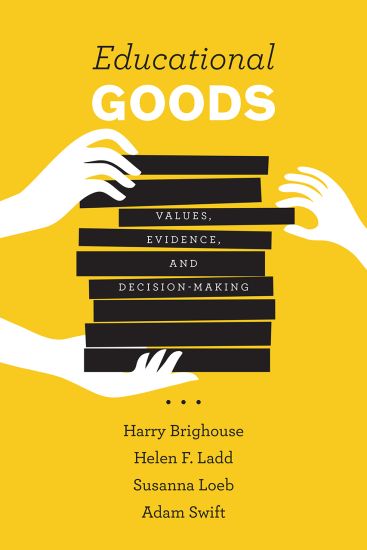
Educational Goods

Educational Goods

Harry Brighouse; Helen F. Ladd; Susanna Loeb; Adam Swift

University of Chicago Press
2018
nidottu
We spend a lot of time arguing about how schools might be improved. But we rarely take a step back to ask what we as a society should be looking for from education what exactly should those who make decisions be trying to achieve? In Educational Goods, two philosophers and two social scientists address this very question. They begin by broadening the language for talking about educational policy: "educational goods" are the knowledge, skills, and attitudes that children develop for their own benefit and that of others; "childhood goods" are the valuable experiences and freedoms that make childhood a distinct phase of life. Balancing those, and understanding that not all of them can be measured through traditional methods, is a key first step. From there, they show how to think clearly about how those goods are distributed and propose a method for combining values and evidence to reach decisions. They conclude by showing the method in action, offering detailed accounts of how it might be applied in school finance, accountability, and choice. The result is a reimagining of our decision making about schools, one that will sharpen our thinking on familiar debates and push us toward better outcomes.
Educational Goods

Educational Goods

Harry Brighouse; Helen F. Ladd; Susanna Loeb; Adam Swift

University of Chicago Press
2018
sidottu
We spend a lot of time arguing about how schools might be improved. But we rarely take a step back to ask what we as a society should be looking for from education what exactly should those who make decisions be trying to achieve? In Educational Goods, two philosophers and two social scientists address this very question. They begin by broadening the language for talking about educational policy: "educational goods" are the knowledge, skills, and attitudes that children develop for their own benefit and that of others; "childhood goods" are the valuable experiences and freedoms that make childhood a distinct phase of life. Balancing those, and understanding that not all of them can be measured through traditional methods, is a key first step. From there, they show how to think clearly about how those goods are distributed and propose a method for combining values and evidence to reach decisions. They conclude by showing the method in action, offering detailed accounts of how it might be applied in school finance, accountability, and choice. The result is a reimagining of our decision making about schools, one that will sharpen our thinking on familiar debates and push us toward better outcomes.

Elusive Equity

Elusive Equity

Edward B. Fiske; Helen F. Ladd

Brookings Institution
2004
sidottu
"Elusive Equity chronicles South Africa's efforts to fashion a racially equitable state education system from the ashes of apartheid. The policymakers who came to power with Nelson Mandela in 1994 inherited and education system designed to further the racist goals of apartheid. Their massive challenge was to transform that system, which lavished human and financial resources on schools serving white students while systematically starving those serving African, coloured, and Indian learners, into one that would offer quality education to all persons, regardless of their race.Edward Fiske and Helen Ladd describe and evaluate the strategies that South Africa pursued in its quest for racial equity. They draw on previously unpublished data, interviews with key officials, and visits to dozens of schools to describe the changes made in school finance, teacher assignment policies, governance, curriculum, higher education, and other areas. They conclude that the country has made remarkable progress toward equity in the sense of equal treatment of persons of all races. For several reasons, however, the country has been far less successful in promoting equal educational opportunity or educational adequacy. Thus equity has remained elusive.The book is unique in combining the perceptive observations of a skilled education journalist with the analytical skills of an academic policy expert. Richly textured descriptions of how South Africa's education reforms have affected schools at the grass-roots level are combined with careful analysis of enrollment, governance, and budget data at the school, provincial, and national levels. The result is a compelling and comprehensive study of South Africa's first decade of education reform in the post-apartheid period."
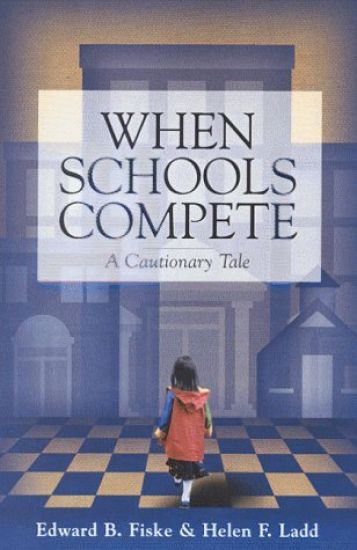
When Schools Compete

When Schools Compete

Edward B. Fiske; Helen F. Ladd

Brookings Institution
2000
sidottu
"In 1989 New Zealand embarked on what is arguably the most thorough and dramatic transformation of a compulsory state education system ever undertaken by an industrialized country. Under a plan known as Tomorrow's Schools this island nation of 3.8 million people abolished its national Department of Education and turned control of its nearly 2,700 primary and secondary schools over to locally elected boards of trustees. Virtually overnight, one of the world's most tightly controlled public education systems became one of the most decentralized. Two years later, in 1991, with a new government in power, New Zealand enacted further reforms that introduced full parental choice of schools and encouraged the development of a competitive culture in the state education system. Debate rages in the United States about whether similar reforms would improve the performance of the country's troubled public school system. Judgments about the potential benefits of these ideas, as well as the general relevance of economic models to educational systems, tap into deeply held values, and discussion in the U.S. has been hampered by the lack of practical experience with them. The extended and widespread experiences of New Zealand, whose school system functions much like our own, provide U.S. policy makers with a wide range of appropriate insights and implications to consider as they gauge the merits of bold education reform. When Schools Compete is the first book to provide detailed quantitative and qualitative analysis of the New Zealand experiment. Combining the perceptive observations of a prominent education journalist and the analytical skills of an academic policy analyst, this book will help supporters and critics of market-based education reforms better anticipate the potential long-term consequences of applying ideas of market competition to the delivery of education."
When Schools Compete

When Schools Compete

Edward B. Fiske; Helen F. Ladd

Brookings Institution
2000
nidottu
"In 1989 New Zealand embarked on what is arguably the most thorough and dramatic transformation of a compulsory state education system ever undertaken by an industrialized country. Under a plan known as Tomorrow's Schools this island nation of 3.8 million people abolished its national Department of Education and turned control of its nearly 2,700 primary and secondary schools over to locally elected boards of trustees. Virtually overnight, one of the world's most tightly controlled public education systems became one of the most decentralized. Two years later, in 1991, with a new government in power, New Zealand enacted further reforms that introduced full parental choice of schools and encouraged the development of a competitive culture in the state education system. Debate rages in the United States about whether similar reforms would improve the performance of the country's troubled public school system. Judgments about the potential benefits of these ideas, as well as the general relevance of economic models to educational systems, tap into deeply held values, and discussion in the U.S. has been hampered by the lack of practical experience with them. The extended and widespread experiences of New Zealand, whose school system functions much like our own, provide U.S. policy makers with a wide range of appropriate insights and implications to consider as they gauge the merits of bold education reform. When Schools Compete is the first book to provide detailed quantitative and qualitative analysis of the New Zealand experiment. Combining the perceptive observations of a prominent education journalist and the analytical skills of an academic policy analyst, this book will help supporters and critics of market-based education reforms better anticipate the potential long-term consequences of applying ideas of market competition to the delivery of education."
America's Ailing Cities

America's Ailing Cities

Helen F. Ladd; John Yinger

Johns Hopkins University Press
1991
pokkari
In the past two decades powerful economic, social, and fiscal forces have buffeted America's major cities. The urbanization of poverty, the shift in employment from manufacturing to services, middle-class flight to the suburbs and Sunbelt, the tax revolt, and cuts in federal aid have made it difficult for many cities to pay for such basic services as police and fire protection, sanitation, and roads. In "America's Ailing Cities" Helen F. Ladd and John Yinger identify and measure the impact of these broad national trends. Drawing on data from 86 major cities, they offer a rigorous and innovative analysis of urban fiscal conditions. Specifically, they determine the impact of a wide range of factors that lie outside municipal control, including a city's basic economic structure and state-determined fiscal institutions, on a city's underlying fiscal health-- the difference between potential revenue and the expenditure needed to finance public services of acceptable quality. Concluding that the fiscal health of America's cities has worsened since 1972, the authors call for new state and federal urban policies that direct assistance to the neediest cities.
Elusive Equity

Elusive Equity

Edward B. Fiske; Helen F. Ladd

Brookings Institution
2004
nidottu
Elusive Equity chronicles South Africa's efforts to fashion a racially equitable state education system from the ashes of apartheid. The policymakers who came to power with Nelson Mandela in 1994 inherited and education system designed to further the racist goals of apartheid. Their massive challenge was to transform that system, which lavished human and financial resources on schools serving white students while systematically starving those serving African, coloured, and Indian learners, into one that would offer quality education to all persons, regardless of their race.Edward Fiske and Helen Ladd describe and evaluate the strategies that South Africa pursued in its quest for racial equity. They draw on previously unpublished data, interviews with key officials, and visits to dozens of schools to describe the changes made in school finance, teacher assignment policies, governance, curriculum, higher education, and other areas. They conclude that the country has made remarkable progress toward equity in the sense of equal treatment of persons of all races. For several reasons, however, the country has been far less successful in promoting equal educational opportunity or educational adequacy. Thus equity has remained elusive.The book is unique in combining the perceptive observations of a skilled education journalist with the analytical skills of an academic policy expert. Richly textured descriptions of how South Africa's education reforms have affected schools at the grass-roots level are combined with careful analysis of enrollment, governance, and budget data at the school, provincial, and national levels. The result is a compelling and comprehensive study of South Africa's first decade of education reform in the post-apartheid period.
The Challenge of Fiscal Disparities for State and Local Governments
This outstanding selection of Helen Ladd's work provides an overview of the policy-oriented research she has conducted in the area of state and local public finance during the past twenty-five years.The volume is divided into four parts. The first addresses the concept and measurement of fiscal disparities across local jurisdictions and the design of intergovernmental aid programmes. The second part examines the design of taxes and tax structures, including chapters on the mix of taxes at state level and tax limitation measures. The third part deals with the interaction between taxes and land use, including the fiscal effects of rapid population growth and the use of tax subsidies to promote growth in declining urban areas. The final part focuses on education finance. This important collection will be of interest to public finance and urban economists and practitioners and policymakers in state and local government.