Kirjojen hintavertailu. Mukana 12 508 597 kirjaa ja 12 kauppaa.

Kirjailija

Helena Cobban

Kirjat ja teokset yhdessä paikassa: 11 kirjaa, julkaisuja vuosilta 1984-2024, suosituimpien joukossa Understanding Hamas. Vertaile teosten hintoja ja tarkista saatavuus suomalaisista kirjakaupoista.

11 kirjaa

Kirjojen julkaisuhaarukka 1984-2024.

The Making Of Modern Lebanon

The Making Of Modern Lebanon

Helena Cobban

TAYLOR FRANCIS LTD
2024
nidottu
This book provides a vivid and readable account of Lebanon's development since its first emergence in 1585, unravelling the intricacies of the sectarian/religious groups and the special kinds of communities which have sunk 900-year-old roots in the remote fastnesses of the Mount Lebanon interior.
Understanding Hamas

Understanding Hamas

Helena Cobban; Rami G. Khouri

OR Books
2024
pokkari
Both accessible and authoritative, Understanding Hamas provides much-needed insight into a widely misunderstood movement whose involvement in a just resolution of the Israel/Palestine conflict will be critical. Across Western mainstream discourse, the Palestinian resistance movement Hamas has been subjected to intense vilification. Branding it as “terrorist” or worse, this demonization intensified after the events in Southern Israel on October 7, 2023. This book does not advocate for or against Hamas. Rather, in a series of rich and probing conversations with leading experts, it aims to deepen understanding of a movement that is a key player in the current crisis. It looks at, among other things, Hamas’s critical shift from social and religious activism to national political engagement; the delicate balance between Hamas's political and military wings; and its transformation from early anti-Jewish tendencies to a stance that differentiates between Judaism and Zionism.
The Making Of Modern Lebanon

The Making Of Modern Lebanon

Helena Cobban

Routledge
2019
sidottu
This book provides a vivid and readable account of Lebanon's development since its first emergence in 1585, unravelling the intricacies of the sectarian/religious groups and the special kinds of communities which have sunk 900-year-old roots in the remote fastnesses of the Mount Lebanon interior.
Re-engage!

Re-engage!

Helena Cobban

Paradigm
2008
nidottu
A veteran international journalist gives us a concise, readable guide that provides a new vision for the United States in the global community. Since 9/11, the United States has pursued a foreign policy some have called a "control paradigm"-a unilateral domination of world affairs through military means that tries to keep the lid on insecurity without addressing root causes or protecting human rights. The Bush administration's energetic use of this approach has ripped the fabric of America's relationship with the rest of the world. In this concise guide, veteran journalist Helena Cobban proposes moving the United States away from the control paradigm to a policy of global inclusion. Global inclusion seeks to repair the U.S. relationship with other countries, recommit the United States to effective participation in the United Nations and other multilateral institutions, and ground U.S. foreign policy firmly in the principle of human equality. It also involves moving away from the language of threats and fear to a language of challenge and possibility. This book outlines how a global inclusion policy would address key challenges faced not only by Americans but by the 95 percent of humanity who are not Americans: - Challenges of terrorism and weapons proliferation. - Growing global inequality. - Rights abuses worldwide. - Climate change. - Shifting international power balances. Cobban reminds readers we do not need to do any of these things alone. Since 9/11, she has traveled to 18 foreign countries on four continents. She has heard how deep the desire is among people in China, sub-Saharan Africa, the Muslim world, Europe, and elsewhere for the United States to rejoin the world community on a sound and cooperative basis. In heartfelt, accessible prose with highly readable tables, graphics, websites, and other resources, she shows how we can re-engage as neighbors, as a country, and as a trusted international partner.
Re-engage!

Re-engage!

Helena Cobban

Paradigm
2008
sidottu
A veteran international journalist gives us a concise, readable guide that provides a new vision for the United States in the global community. Since 9/11, the United States has pursued a foreign policy some have called a "control paradigm"-a unilateral domination of world affairs through military means that tries to keep the lid on insecurity without addressing root causes or protecting human rights. The Bush administration's energetic use of this approach has ripped the fabric of America's relationship with the rest of the world. In this concise guide, veteran journalist Helena Cobban proposes moving the United States away from the control paradigm to a policy of global inclusion. Global inclusion seeks to repair the U.S. relationship with other countries, recommit the United States to effective participation in the United Nations and other multilateral institutions, and ground U.S. foreign policy firmly in the principle of human equality. It also involves moving away from the language of threats and fear to a language of challenge and possibility. This book outlines how a global inclusion policy would address key challenges faced not only by Americans but by the 95 percent of humanity who are not Americans: - Challenges of terrorism and weapons proliferation. - Growing global inequality. - Rights abuses worldwide. - Climate change. - Shifting international power balances. Cobban reminds readers we do not need to do any of these things alone. Since 9/11, she has traveled to 18 foreign countries on four continents. She has heard how deep the desire is among people in China, sub-Saharan Africa, the Muslim world, Europe, and elsewhere for the United States to rejoin the world community on a sound and cooperative basis. In heartfelt, accessible prose with highly readable tables, graphics, websites, and other resources, she shows how we can re-engage as neighbors, as a country, and as a trusted international partner.

Amnesty After Atrocity?

Amnesty After Atrocity?

Helena Cobban

Paradigm
2007
nidottu
"A compelling read." Richard J. Goldstone, former Chief Prosecutor of the UN tribunals for the former Yugoslavia and Rwanda "A very important contribution." Princeton N. Lyman, Council on Foreign Relations "A powerful reminder that dealing with the legacy of wartime atrocities is not simply a matter of bringing perpetrators to justice. It also means overcoming the divisions within the society and healing the victims." Marina Ottaway, Senior Associate, Democracy and Rule of Law Project, Carnegie Endowment for International Peace In Amnesty after Atrocity? veteran journalist Helena Cobban examines the effectiveness of different ways of dealing with the aftermath of genocide and violence committed during intergroup conflicts. She traveled to Rwanda, Mozambique, and South Africa to assess the various ways those nations tried to come to grips with their violent past: from war crimes trials to truth commissions to outright amnesties for perpetrators. She discovered that in terms of both moving forward and satisfying the needs of survivors, war crimes trials are not the most effective path. This book provides historical context and includes interviews with a cross-section of people: community leaders, victims, policymakers, teachers, rights activists, and even some former abusers. These first-person accounts create a rich, readable text, and Cobban's overall conclusions will surprise many readers in the West.
Amnesty After Atrocity?

Amnesty After Atrocity?

Helena Cobban

Paradigm
2006
sidottu
"A compelling read." Richard J. Goldstone, former Chief Prosecutor of the UN tribunals for the former Yugoslavia and Rwanda "A very important contribution." Princeton N. Lyman, Council on Foreign Relations "A powerful reminder that dealing with the legacy of wartime atrocities is not simply a matter of bringing perpetrators to justice. It also means overcoming the divisions within the society and healing the victims." Marina Ottaway, Senior Associate, Democracy and Rule of Law Project, Carnegie Endowment for International Peace In Amnesty after Atrocity? veteran journalist Helena Cobban examines the effectiveness of different ways of dealing with the aftermath of genocide and violence committed during intergroup conflicts. She traveled to Rwanda, Mozambique, and South Africa to assess the various ways those nations tried to come to grips with their violent past: from war crimes trials to truth commissions to outright amnesties for perpetrators. She discovered that in terms of both moving forward and satisfying the needs of survivors, war crimes trials are not the most effective path. This book provides historical context and includes interviews with a cross-section of people: community leaders, victims, policymakers, teachers, rights activists, and even some former abusers. These first-person accounts create a rich, readable text, and Cobban's overall conclusions will surprise many readers in the West.
The Moral Architecture of World Peace

The Moral Architecture of World Peace

Helena Cobban

University of Virginia Press
2000
sidottu
A prescient vision of our shared global future. It is taken from the speeches and exchanges of eight visionary recipients of the Nobel Peace Prize, who gathered at the University of Virginia in November 1998 for two days of extraordinary dialogue. From the words of His Holiness the Dalai Lamai to Archbishop Desmond Tutu's description of chairing South Africa's Truth and Reconciliation Commission, their conversation ranged from familiar international relations issues to areas traditionally excluded from such discourse, like the need for personal transformation and community organizing. The speakers also included Betty Williams, Jody Williams and Bobby Muller, Oscar Arias Sanchez, Rigoberta Menchu Tum, Jose Ramos-Horta and Harn Yawnghwe. As the author articulates, these leaders all seem to subscribe to a broader set of truths that are not necessarily self-evident - that human beings can easily become locked into self-perpetuating ""systems of suspicion and violence"" at any level, from the interpersonal through the international; that when one is inside such a system it can be hard to see it and to recognize one's role within it; but that each one of us has the capacity to make a leap from self-centredness toward greater understanding. But while the stories are primarily of personal and political triumph, they also tell of great sacrifice, conflict and pain.
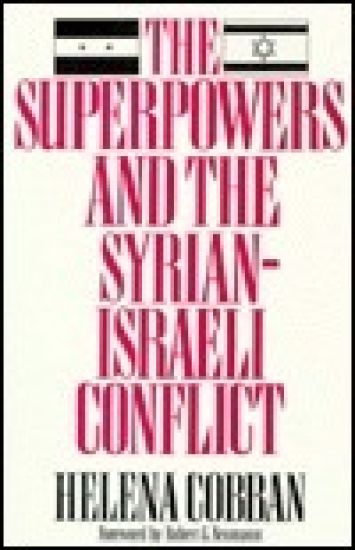
The Superpowers and the Syrian-Israeli Conflict

The Superpowers and the Syrian-Israeli Conflict

Helena Cobban

Praeger Publishers Inc
1991
sidottu
The Middle Eastern problem is suffused with emotion and ignorance. It is both good and important to have Cobban's perceptive and cool dissection of a truly complex issue. Zbigniew Brezezinski Counselor, Center for Strategic and International Studies Former National Security Adviser Middle East analyst Cobban's 'historical case study of how things were in the Israel-Syria theater during the years 1978-1989' was largely completed before Iraq's invasion of Kuwait, but the events of the past year make this book more, rather than less, relevant. . . . Cobban's focus, then, on these two heavily armed nations and their superpower relationships could hardly be more timely. BooklistIn the coalition war against Iraq following its invasion of Kuwait, the participation of Syria in the U.S.-led coalition and the restraint of Israel were important elements in the quick and successful conclusion of the war. The United States' diplomatic and military resolve, as well as the withdrawal of the Soviet Union from the international arena, helped put Syria and Israel on the same side in this effort. This was a surprising development in light of the strained state of Syrian-Israeli relations in the years leading up to 1990. Helena Cobban investigates the evolution of the military balance between Israel and Syria from 1978 through 1990, focusing on the effects of the close strategic ties that developed between these states and their respective superpower partners. The fighting in Lebanon in 1982 is closely examined, since it proved to be a key turning point for Israel and Syria--and for the superpowers parrying for influence in the Middle East region.After an up-to-the-minute preface analyzing the effects of the Persian Gulf War on the Syrian-Israeli relationship, Cobban explores the immunity this area showed in the late 1980s to diplomatic efforts that were resolving regional conflicts elsewhere in the world, as well as the surprising overall stability of this theatre even in the absence of effective diplomacy. The arsenals of Israel and Syria, now the preeminent military powers in the Middle East after the defanging of Iraq, are still formidable. Cobban presents a formula for careful diplomacy in the 1990s that could lead to a lasting peace. This book is essential reading for political scientists, students of military engagements, and others who have an interest in the worldwide consequences of the Arab-Israeli conflict.
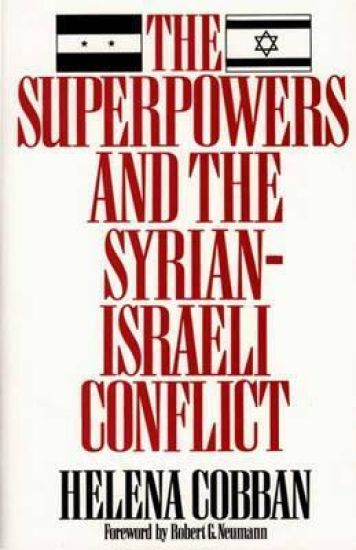
The Superpowers and the Syrian-Israeli Conflict

The Superpowers and the Syrian-Israeli Conflict

Helena Cobban

Praeger Publishers Inc
1991
nidottu
The Middle Eastern problem is suffused with emotion and ignorance. It is both good and important to have Cobban's perceptive and cool dissection of a truly complex issue. Zbigniew Brezezinski Counselor, Center for Strategic and International Studies Former National Security Adviser Middle East analyst Cobban's 'historical case study of how things were in the Israel-Syria theater during the years 1978-1989' was largely completed before Iraq's invasion of Kuwait, but the events of the past year make this book more, rather than less, relevant. . . . Cobban's focus, then, on these two heavily armed nations and their superpower relationships could hardly be more timely. BooklistIn the coalition war against Iraq following its invasion of Kuwait, the participation of Syria in the U.S.-led coalition and the restraint of Israel were important elements in the quick and successful conclusion of the war. The United States' diplomatic and military resolve, as well as the withdrawal of the Soviet Union from the international arena, helped put Syria and Israel on the same side in this effort. This was a surprising development in light of the strained state of Syrian-Israeli relations in the years leading up to 1990. Helena Cobban investigates the evolution of the military balance between Israel and Syria from 1978 through 1990, focusing on the effects of the close strategic ties that developed between these states and their respective superpower partners. The fighting in Lebanon in 1982 is closely examined, since it proved to be a key turning point for Israel and Syria--and for the superpowers parrying for influence in the Middle East region.After an up-to-the-minute preface analyzing the effects of the Persian Gulf War on the Syrian-Israeli relationship, Cobban explores the immunity this area showed in the late 1980s to diplomatic efforts that were resolving regional conflicts elsewhere in the world, as well as the surprising overall stability of this theatre even in the absence of effective diplomacy. The arsenals of Israel and Syria, now the preeminent military powers in the Middle East after the defanging of Iraq, are still formidable. Cobban presents a formula for careful diplomacy in the 1990s that could lead to a lasting peace. This book is essential reading for political scientists, students of military engagements, and others who have an interest in the worldwide consequences of the Arab-Israeli conflict.