Kirjojen hintavertailu. Mukana 12 595 353 kirjaa ja 12 kauppaa.
Kirjailija
Helena Mattsson
Kirjat ja teokset yhdessä paikassa: 5 kirjaa, julkaisuja vuosilta 2005-2024, suosituimpien joukossa Bostadspolitiken (RJ 2024: Misslyckat?). Vertaile teosten hintoja ja tarkista saatavuus suomalaisista kirjakaupoista.
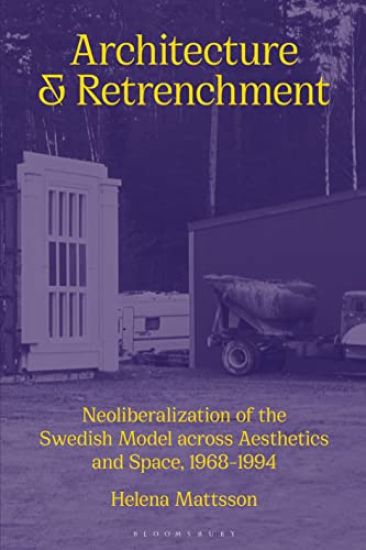
Shortlisted for the Architects Sweden Critic's Award 2023Architecture and Retrenchment explores the ‘neoliberal turn’ in architecture, through the rise and fall of the Swedish welfare state.There are few better case studies of architecture’s role in the retrenchment and dismantling of the welfare state than Sweden, the birthplace of the world-famous “Swedish Model” and now home to Europe's fastest-growing inequality. Through eight in-depth architectural case studies, Helena Mattsson analyzes how neoliberalism has created conditions for a new built environment which was once closely integral to the welfare system, examining how new architectural strategies and techniques were developed in order to protect the agency of architecture in a newly re-organised society, and revealing the role of architecture in creating new types of segregation, discrimination, and social stratification.With close feminist analysis running throughout – and drawing from oral histories, witness seminars, and participatory workshops – Architecture and Retrenchment provides an original interpretation of how architecture, space, aesthetics, and politics converged at the end of the twentieth century.
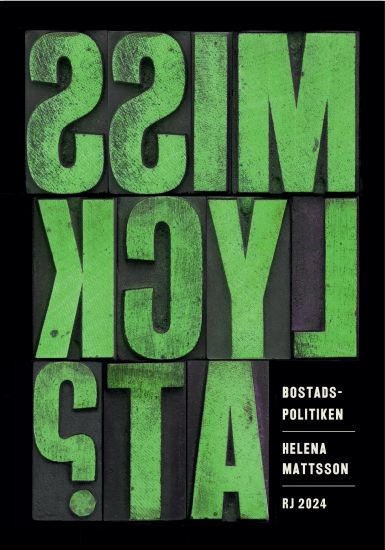
"Riv det!" Den koncisa uppmaningen var Dagens Nyheters reaktion på invigningen av Stockholmsförorten Skärholmen 1968 -- kritiken av miljonprogrammet är lika gammal som områdena själva. Misslyckandet blev en trop som ramade in förståelsen av dessa bostadsområden redan från början. I och med att miljonprogrammet sågs som en inkarnation av den socialdemokratiska välfärdsstaten hade föreställningen om misslyckandet tydliga partipolitiska implikationer. Men när planerna för Skärholmen skickades ut på remiss var det näringslivets organisationer som ville ha mer storskalighet, färre småbutiker, större parkeringsplatser och längre mellan tunnelbanestationerna. Var den statliga styrningen i själva verket för svag? Vad var det egentligen som var misslyckat med bostadspolitiken? Riksbankens Jubileumsfond publicerar under 2024 en samling essäer på temat Misslyckat? Arkitekturhistorikern Helena Mattsson skriver om misslyckandet som drivkraft inom bostadspolitiken. Helena Mattsson är professor i arkitekturens teori och historia på Kungliga Tekniska högskolan. Hennes forskning undersöker bland annat arkitekturens roll i förändringarna av den svenska välfärdsstaten under senare hälften av 1900-talet. Frågor kring samverkan mellan nyliberalisering, marknadisering, estetik och rumslig organisation är centrala i hennes arbete. Mattsson har bland annat publicerat Architecture and Retrenchment: Neoliberalization of the Swedish Model across Aesthetics and Space, 19681994 (2023). Stiftelsen Riksbankens Jubileumsfond (RJ) publicerar årligen en samling texter på ett aktuellt tema. Ambitionen är att ge en bild av kvaliteten och bredden i dagens forskning inom humaniora och samhällsvetenskap. År 2024 bidrar sex forskare med texter på temat Misslyckat? i form av häften som samlas i en box.
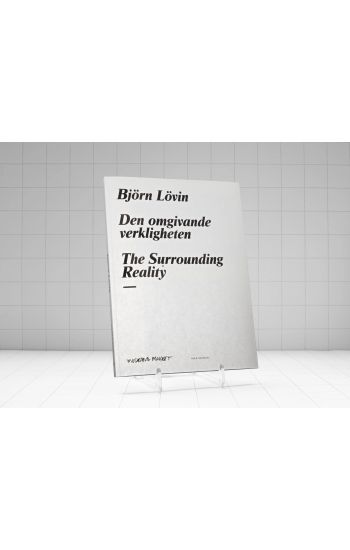
Moderna Museet exhibition catalogue no. 416: Björn Lövin -The Surrounding Reality Co-publishers: Moderna Museet & Verlag der Buchhandlung Walther und Franz König Texts: Gitte Ørskou, Matilda Olof-Ors, Rasmus Fleischer, Maria Lind & Helena Mattsson. Curator: Matilda Olof-Ors Concept and Editorial Work: Matilda Olof-Ors, Jonas Williamsson & Peo Olsson Design: Jonas Williamsson Photography: Albin Dahlström, Mats B, Ayao Yamazaki. Print: Narayana Press. About the exhibition: Björn Lövin -The Surrounding Reality Moderna Museet 2.4 – 18.9 2022 Stockholm With carefully chosen details, Björn Lövin (1937–2009) built up fictional worlds, like film sets, which the visitor could step into. In the exhibition “The Surrounding Reality”, three of Björn Lövin’s extensive environments have been reconstructed. Then, as now, visitors can enter the environments themselves and experience the art from up close. None of Björn Lövin’s original environments were preserved after being presented in their respective exhibitions in the 1970s and 1980s. The environments that you can see now in the exhibition are thus reconstructions interpreting and recreating a similar atmosphere as when the works were first shown. Extensive and winding research has been required to build up the environments. Based on photographs, films and archive documents, objects have been identified. These are the three environments that you will encounter in the exhibition: Consumer in Infinity and “Mr P’s hoard”, L’image and C – The struggle for reality. Curator: Matilda Olof-Ors About Björn Lövin Björn Lövin expanded traditional art genres and was one of the first Swedish artists in the late 1960s to make spatial installations, called environments at the time. He was born in Falun in 1937. In his youth Lövin studied in Barcelona, later attending Stockholm University and Uppsala University to study education, scientific theory and information technology. Despite his lack of formal artistic training, he had his first exhibition at Galleri Mejan in 1970, an early version of the more comprehensive exhibition Consumer in Infinity and “Mr P’s Hoard” – two environments by Björn Lövin that was presented at Moderna Museet the following year. His large scale works were critical to totalitarian systems, ranging from the People’s Home (Folkhemmet) to the consumption society, which includes some and excludes others and attract by offering an image of safety, but at the cost of individual freedom. His first solo show at Moderna Museet was curated by Pontus Hultén and later included solo shows at Centre Pompidou in Paris, Liljevalchs and Kulturhuset in Stockholm and at Malmö Konsthall amongst others.
Claes Caldenby; David Kendall; Helena Mattsson; Katarina Elvén; Astrid von Rosen; Hendrik Zeitler; Staffan Schmidt; Klas Grinell; Cecilia Gronberg; Ana Betancour; Alyssa Grossman; Patrik Elgstrom; Andrej Slavik; Victor Buchli
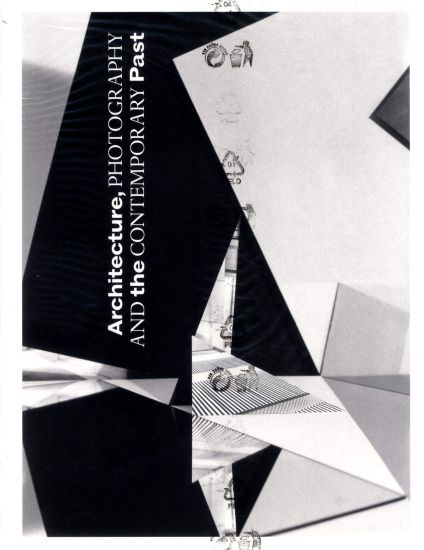
As traces left behind by the last two hundred years of profound historical change, architecture and photography contribute both to our contemporary skyline and to our image of the past. Their common history thus provides an indispensable background to every discussion of what has been called the contemporary past - that is, to modernity considered as an open problem rather than a closed historical period. Architecture can be seen as a kind of macromodernity, a social scope where the diverse discourses of modernity have assumed their most large-scale form. In analogy, photographic media constitute a micromodernity, where the underside of modern society has been registered, identified, classified, and archived. In both cases, we trace out the irregular borderline between the discursive and its opposite, the material. At this point of intersection, an interesting confrontation between traditional academic historiography and an artistic application of historical perspectives might be staged. What contribution can architecture and photography make to the exploration of our contemporary past? Victor Buchli, in his afterword, underlines the potential of such confrontations: Translation always betrays the original intention, but what might be described as the infelicities of the translation that are inherently treacherous are precisely what constitute its productive capacities.