Kirjojen hintavertailu. Mukana 12 390 323 kirjaa ja 12 kauppaa.

Kirjailija

Helena Varkkey

Kirjat ja teokset yhdessä paikassa: 4 kirjaa, julkaisuja vuosilta 2015-2023, suosituimpien joukossa The Haze Problem in Southeast Asia. Vertaile teosten hintoja ja tarkista saatavuus suomalaisista kirjakaupoista.

4 kirjaa

Kirjojen julkaisuhaarukka 2015-2023.

Global Methane Pledge: A Review of Data, Policy and Transparency in Reducing Methane Emissions in Malaysia

Global Methane Pledge: A Review of Data, Policy and Transparency in Reducing Methane Emissions in Malaysia

Matthew Ashfold; Helena Varkkey; Yong Jie Wong; Anjulie Razak; Shareen Yawanarajah; Mark Lunt; Emily Oi Yen Tse

ISEAS
2023
nidottu
Malaysia is a signatory of the Global Methane Pledge, but the implications for national action on methane emissions remain unclear. We reviewed publicly available literature and data, arriving at the following key findings:1. There is no clear national plan for methane action yet. Since signing the Pledge in 2021, there has been no demonstrable government initiative focusing on joined-up methane action at the national level. Malaysia does not have a methane strategy or policy, and sector-specific regulations focusing on methane emissions are either not present, vague, or publicly inaccessible.2. There are indications emissions are falling due to positive corporate action. Effective methane reduction initiatives exist in Malaysia's top two methane-emitting sectors, oil and gas and palm oil, and key players have committed to net zero pathways with methane reductions central to progress to 2030. Emissions should be expected to rapidly fall further if action can be scaled across all industry players.3. Quantifying reductions with confidence remains challenging. Different reporting approaches and incomplete information on assumptions and uncertainties in quantification approaches, make independent analyses of reported emissions challenging. Wider deployment of measurement-based emission quantification is a key option to improve confidence in progress.4. Improvements in corporate Monitoring, Reporting, and Verification (MRV) in the coming years are expected. While some corporate standards remain confidential, key companies have joined international frameworks featuring transparency and MRV measures like the Oil and Gas Methane Partnership 2.0 and, in a broader climate context, the evolving Science Based Targets initiative. Improved corporate MRV should enable improved national emissions reporting.5. Methane reduction is a "low-hanging fruit". Methane is a major initial lever to reduce greenhouse gas emissions up to 2030 in the climate plans of leading Malaysian industry players. Action to improve methane-related processes in the key oil and gas and palm oil sectors thus presents a valuable opportunity for Malaysia to contribute to global climate mitigation within its long-term national interests. Therefore, decisive methane action is needed even while plans for further crucial greenhouse gas emission reductions are developed and articulated in more detail.

The Forests for the Palms

The Forests for the Palms

Helena Varkkey

ISEAS
2021
nidottu
Transboundary haze has been a recurring problem in the Southeast Asian region since at least 1982. Why does this toxic form of air pollution still persist? Helena Varkkey, a Malaysian political scientist, has been studying this multifaceted problem for more than fifteen years. This book provides an ideal collection for those who want a clear but concise introduction to this complex issue. Its commentaries explore how often sensitive matters of ASEAN diplomacy, national interest or political patronage continue to stand in the way of clear skies in the region.
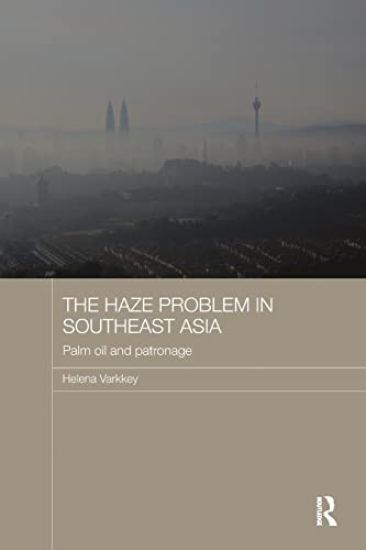
The Haze Problem in Southeast Asia

The Haze Problem in Southeast Asia

Helena Varkkey

CRC Press Inc
2018
nidottu
Despite the efforts of Southeast Asian governments and of ASEAN, transboundary haze continues to be a major environmental problem in Southeast Asia. This book demonstrates that the issue is complex, and explains why efforts to solve the problem in purely political terms are ineffective, and likely to continue to be ineffective. The book shows how state-led, state-incentivised agribusiness development lies at the heart of the problem, leading to a large rise in palm oil production, with extensive clearing of forests, leading to deliberate or accidental fires and the resulting haze. Moreover, although the forest clearing is occurring in Indonesia, many of the companies involved are Malaysian and Singaporean; and, further, many of these companies have close relationships with the politicians and officials responsible for addressing the problem and who thereby have a conflict of interest. The author concludes by discussing the huge difficulties involved in overturning this system of 'patronage politics'.
The Haze Problem in Southeast Asia

The Haze Problem in Southeast Asia

Helena Varkkey

Routledge
2015
sidottu
Despite the efforts of Southeast Asian governments and of ASEAN, transboundary haze continues to be a major environmental problem in Southeast Asia. This book demonstrates that the issue is complex, and explains why efforts to solve the problem in purely political terms are ineffective, and likely to continue to be ineffective. The book shows how state-led, state-incentivised agribusiness development lies at the heart of the problem, leading to a large rise in palm oil production, with extensive clearing of forests, leading to deliberate or accidental fires and the resulting haze. Moreover, although the forest clearing is occurring in Indonesia, many of the companies involved are Malaysian and Singaporean; and, further, many of these companies have close relationships with the politicians and officials responsible for addressing the problem and who thereby have a conflict of interest. The author concludes by discussing the huge difficulties involved in overturning this system of 'patronage politics'.