Kirjojen hintavertailu. Mukana 12 152 606 kirjaa ja 12 kauppaa.

Kirjailija

Hema Singh

Kirjat ja teokset yhdessä paikassa: 17 kirjaa, julkaisuja vuosilta 2015-2023, suosituimpien joukossa Radar Cross Section of Dipole Phased Arrays with Parallel Feed Network. Vertaile teosten hintoja ja tarkista saatavuus suomalaisista kirjakaupoista.

17 kirjaa

Kirjojen julkaisuhaarukka 2015-2023.

Low Radar Cross Section HIS-Based Phased Array

Low Radar Cross Section HIS-Based Phased Array

Hema Singh; Avinash Singh

TAYLOR FRANCIS LTD
2023
nidottu
The design and development of low radar cross section (RCS) phased array has been a challenging subject in stealth technology. The frequency selective surface elements act as absorbers in specific frequency band and facilitate gain enhancement and reduction of antenna RCS. This book presents a comprehensive EM design and analysis of such low-profile patch arrays with high impedance surface-based ground plane. It explains how to determine radiation mode RCS of low-profile antenna arrays with arbitrary configurations. Detailed descriptions of design, workflow of determining radiation and scattering behavior of antenna arrays have been supported with schematics, tables, and illustrations. Aimed at engineers and researchers for RCS, antenna engineers and graduate students in electrical engineering and electromagnetics, it• Discusses both radiation and scattering features of both planar and conformal HIS-based low profile antennas• Describes the theoretical background, design, simulations and analysis of low RCS phased array in detail• Presents the physics behind the resultant radiation and scattering characteristics of designed antenna array• Helps readers understand design and analysis of low RCS antenna array without any degradation in its radiation performance• Includes figures, schematics and illustrations to provide comprehensive descriptions of both radiation and scattering characteristics of phased arrays of different configurations
Optimization of Multilayered Radar Absorbing Structures (RAS) using Nature Inspired Algorithm

Optimization of Multilayered Radar Absorbing Structures (RAS) using Nature Inspired Algorithm

Vineetha Joy; Vishal G. Padwal; Hema Singh; Raveendranath U. Nair

TAYLOR FRANCIS LTD
2023
nidottu
Stealth technology is a crucial pre-requisite in the combat zone, where swiftness, surprise and initiative are the decisive elements for survivability. The supreme goal here is to reduce the visibility of military vehicles by shaping, application of radar absorbing materials, passive cancellation, active cancellation etc. With respect to multilayered radar absorbing structures (RAS), this book presents an efficient algorithm based on particle swarm optimization (PSO), for the material selection as well as optimization of thickness of multilayered RAS models considering both normal as well as oblique incidence cases. It includes a thorough overview of the theoretical background required for the analysis of multilayered RAS as well as the step-by-step procedure for the implementation of PSO-based algorithm. The accuracy and computational efficiency of the indigenously developed code is also clearly established using relevant validations and case studies.FEATURES Provides step-by-step procedure for the implementation of particle swarm optimization (PSO) based algorithm in the context of multilayered radar absorbing structures (RAS) design Helps to understand the EM design, analysis and optimization of multilayered RAS Describes the theoretical background required for the analysis of multilayered RAS Illustrates in detail the theoretical formulation supported by intuitive ray diagrams and comprehensive flowcharts to implement the algorithm with ease Includes elaborate validations and case studiesThis book will serve as a valuable resource for students, researchers, scientists, and engineers involved in the electromagnetic design and development of multi-layered radar absorbing structures.
Optimization of Multilayered Radar Absorbing Structures (RAS) using Nature Inspired Algorithm

Optimization of Multilayered Radar Absorbing Structures (RAS) using Nature Inspired Algorithm

Vineetha Joy; Vishal G. Padwal; Hema Singh; Raveendranath U. Nair

CRC Press
2021
sidottu
Stealth technology is a crucial pre-requisite in the combat zone, where swiftness, surprise and initiative are the decisive elements for survivability. The supreme goal here is to reduce the visibility of military vehicles by shaping, application of radar absorbing materials, passive cancellation, active cancellation etc. With respect to multilayered radar absorbing structures (RAS), this book presents an efficient algorithm based on particle swarm optimization (PSO), for the material selection as well as optimization of thickness of multilayered RAS models considering both normal as well as oblique incidence cases. It includes a thorough overview of the theoretical background required for the analysis of multilayered RAS as well as the step-by-step procedure for the implementation of PSO-based algorithm. The accuracy and computational efficiency of the indigenously developed code is also clearly established using relevant validations and case studies.FEATURES Provides step-by-step procedure for the implementation of particle swarm optimization (PSO) based algorithm in the context of multilayered radar absorbing structures (RAS) design Helps to understand the EM design, analysis and optimization of multilayered RAS Describes the theoretical background required for the analysis of multilayered RAS Illustrates in detail the theoretical formulation supported by intuitive ray diagrams and comprehensive flowcharts to implement the algorithm with ease Includes elaborate validations and case studiesThis book will serve as a valuable resource for students, researchers, scientists, and engineers involved in the electromagnetic design and development of multi-layered radar absorbing structures.
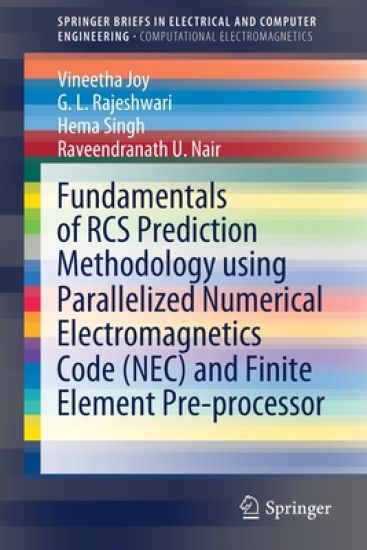
Fundamentals of RCS Prediction Methodology using Parallelized Numerical Electromagnetics Code (NEC) and Finite Element Pre-processor

Fundamentals of RCS Prediction Methodology using Parallelized Numerical Electromagnetics Code (NEC) and Finite Element Pre-processor

Vineetha Joy; G. L. Rajeshwari; Hema Singh; Raveendranath U. Nair

Springer Verlag, Singapore
2020
nidottu
This book presents a novel methodology for the computation of RCS of metallic structures using a parallelized version of NEC in conjunction with a finite element preprocessor which has been strategically incorporated for simplifying geometry modelling catering to NEC guidelines. It includes a thorough overview of the theoretical background of NEC including all relevant aspects of formulation and modelling. The revised methodology including all the required steps and details is discussed elaborately along with case studies and validations. This book will serve as a valuable resource for students, researchers, scientists, and engineers working in the field of RCS predictions and measurements.
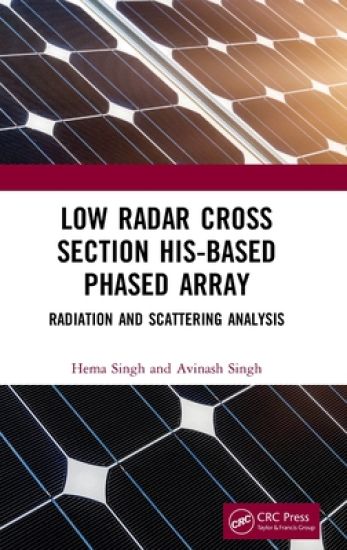
Low Radar Cross Section HIS-Based Phased Array

Low Radar Cross Section HIS-Based Phased Array

Hema Singh; Avinash Singh

CRC Press
2020
sidottu
The design and development of low radar cross section (RCS) phased array has been a challenging subject in stealth technology. The frequency selective surface elements act as absorbers in specific frequency band and facilitate gain enhancement and reduction of antenna RCS. This book presents a comprehensive EM design and analysis of such low-profile patch arrays with high impedance surface-based ground plane. It explains how to determine radiation mode RCS of low-profile antenna arrays with arbitrary configurations. Detailed descriptions of design, workflow of determining radiation and scattering behavior of antenna arrays have been supported with schematics, tables, and illustrations. Aimed at engineers and researchers for RCS, antenna engineers and graduate students in electrical engineering and electromagnetics, it• Discusses both radiation and scattering features of both planar and conformal HIS-based low profile antennas• Describes the theoretical background, design, simulations and analysis of low RCS phased array in detail• Presents the physics behind the resultant radiation and scattering characteristics of designed antenna array• Helps readers understand design and analysis of low RCS antenna array without any degradation in its radiation performance• Includes figures, schematics and illustrations to provide comprehensive descriptions of both radiation and scattering characteristics of phased arrays of different configurations
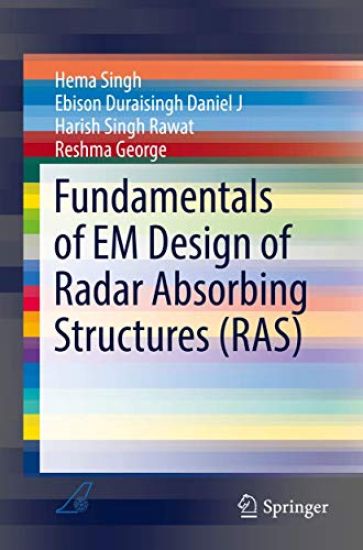
Fundamentals of EM Design of Radar Absorbing Structures (RAS)

Fundamentals of EM Design of Radar Absorbing Structures (RAS)

Hema Singh; Ebison Duraisingh Daniel J; Harish Singh Rawat; Reshma George

Springer Verlag, Singapore
2017
nidottu
This book presents a detailed analytical formulation, and step-by-step design procedure for the electromagnetic (EM) design of radar absorbing structures (RAS). It discusses both the equivalent circuit model and Smith chart approach with illustrations to provide a clear understanding of the steps involved in designing multilayered RAS according to the desired specifications. This book is a valuable resource for beginners, academicians, and R&D engineers working in the field of RAS design and development.
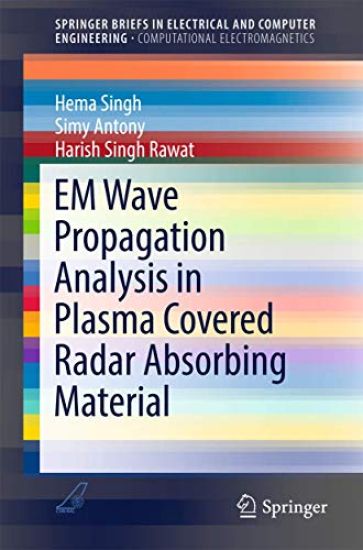
EM Wave Propagation Analysis in Plasma Covered Radar Absorbing Material

EM Wave Propagation Analysis in Plasma Covered Radar Absorbing Material

Hema Singh; Simy Antony; Harish Singh Rawat

Springer Verlag, Singapore
2016
nidottu
This book focuses on EM propagation characteristics within multilayered plasma-dielectric-metallic media. The method used for analysis is impedance transformation method. Plasma covered radar absorbing material is approximated as a multi-layered dielectric medium. The plasma is considered to be bounded homogeneous/inhomogeneous medium. The reflection coefficient and hence return loss is analytically derived. The role of plasma parameters, such as electron density, collision frequency, plasma thickness, and plasma density profile in the absorption behavior of multi-layered plasma-RAM structure is described. This book provides a clearer picture of EM propagation within plasma. The reader will get an insight of plasma parameters that play significant role in deciding the absorption characteristics of plasma covered surfaces.
Probe Suppression in Conformal Phased Array

Probe Suppression in Conformal Phased Array

Hema Singh; Mausumi Dutta; P. S. Neethu

Springer Verlag, Singapore
2016
nidottu
This book considers a cylindrical phased array with microstrip patch antenna elements and half-wavelength dipole antenna elements. The effect of platform and mutual coupling effect is included in the analysis. The non-planar geometry is tackled by using Euler's transformation towards the calculation of array manifold. Results are presented for both conducting and dielectric cylinder. The optimal weights obtained are used to generate adapted pattern according to a given signal scenario. It is shown that array along with adaptive algorithm is able to cater to an arbitrary signal environment even when the platform effect and mutual coupling is taken into account. This book provides a step-by-step approach for analyzing the probe suppression in non-planar geometry. Its detailed illustrations and analysis will be a useful text for graduate and research students, scientists and engineers working in the area of phased arrays, low-observables and stealth technology.
EM Design and Analysis of Dipole Arrays on Non-planar Dielectric Substrate

EM Design and Analysis of Dipole Arrays on Non-planar Dielectric Substrate

Hema Singh; R. Chandini; Rakesh Mohan Jha

Springer Verlag, Singapore
2015
nidottu
This book presents a simple and systematic description of EM design of antenna arrays. Printed dipole antennas are known to be simple yet more efficient than wire antennas. The dielectric substrate and the presence of ground plane affect the antenna performance and the resonant frequency is shifted. This book includes the EM design and performance analysis of printed dipole arrays on planar and cylindrical substrates. The antenna element is taken as half-wave centre-fed dipole. The substrate is taken as low-loss dielectric. The effect of substrate material, ground plane, and the curvature effect is discussed. Results are presented for both the linear and planar dipole arrays. The performance of dipole array is analyzed in terms of input impedance, return loss, and radiation pattern for different configurations. The effect of curved platform (substrate and ground plane) on the radiation behaviour of dipole array is analyzed. The book explains fundamentals of EM design and analysis of dipole antenna array through numerous illustrations. It is essentially a step-to-step guide for beginners in the field of antenna array design and engineering.
Scattering Cross Section of Unequal Length Dipole Arrays

Scattering Cross Section of Unequal Length Dipole Arrays

Hema Singh; H. L. Sneha; Rakesh Mohan Jha

Springer Verlag, Singapore
2015
nidottu
This book presents a detailed and systematic analytical treatment of scattering by an arbitrary dipole array configuration with unequal-length dipoles, different inter-element spacing and load impedance. It provides a physical interpretation of the scattering phenomena within the phased array system. The antenna radar cross section (RCS) depends on the field scattered by the antenna towards the receiver. It has two components, viz. structural RCS and antenna mode RCS. The latter component dominates the former, especially if the antenna is mounted on a low observable platform. The reduction in the scattering due to the presence of antennas on the surface is one of the concerns towards stealth technology. In order to achieve this objective, a detailed and accurate analysis of antenna mode scattering is required. In practical phased array, one cannot ignore the finite dimensions of antenna elements, coupling effect and the role of feed network while estimating the antenna RCS. This book presents the RCS estimation of an array with unequal-length dipoles. The signal reflections within the antenna system and the mutual coupling effect are considered to arrive at the total RCS for series and parallel feed. The computations are valid for any arbitrary array configurations, including side-by-side arrangement, parallel-in-echelon, etc.
Active Cancellation of Probing in Linear Dipole Phased Array

Active Cancellation of Probing in Linear Dipole Phased Array

Hema Singh; N. Bala Ankaiah; Rakesh Mohan Jha

Springer Verlag, Singapore
2015
nidottu
In this book, a modified improved LMS algorithm is employed for weight adaptation of dipole array for the generation of beam pattern in multiple signal environments. In phased arrays, the generation of adapted pattern according to the signal scenario requires an efficient adaptive algorithm. The antenna array is expected to maintain sufficient gain towards each of the desired source while at the same time suppress the probing sources. This cancels the signal transmission towards each of the hostile probing sources leading to active cancellation. In the book, the performance of dipole phased array is demonstrated in terms of fast convergence, output noise power and output signal-to-interference-and noise ratio. The mutual coupling effect and role of edge elements are taken into account. It is established that dipole array along with an efficient algorithm is able to maintain multilobe beamforming with accurate and deep nulls towards each probing source. This work has application to the active radar cross section (RCS) reduction. This book consists of formulation, algorithm description and result discussion on active cancellation of hostile probing sources in phased antenna array. It includes numerous illustrations demonstrating the theme of the book for different signal environments and array configurations. The concepts in this book are discussed in an easy-to-understand manner, making it suitable even for the beginners in the field of phased arrays and adaptive array processing.
Radar Cross Section of Dipole Phased Arrays with Parallel Feed Network

Radar Cross Section of Dipole Phased Arrays with Parallel Feed Network

Hema Singh; H. L. Sneha; Rakesh Mohan Jha

Springer Verlag, Singapore
2015
nidottu
This book presents the detailed analytical formulation for the RCS of parallel-fed linear dipole array in the presence of mutual coupling. The radar cross section (RCS) of an object represents its electromagnetic (EM) scattering properties for a given incident wave. The analysis of scattered field is critical in military and defence arenas, especially while designing low-observable platforms. It is well-known that the presence of an antenna/array on the target influences its echo area significantly. The primary cause for such scattering of the incident signals is reflection that occurs within the antenna aperture and its feed network. In this book, the RCS estimation is done based on the signal path within the antenna system. The scattered field is expressed in terms of array design parameters including the reflection and transmission coefficients. The computed results show the variation in the RCS pattern with and without mutual coupling. The effect of finite dipole-length, inter-element spacing, scan angle, array configuration, amplitude distribution and terminating load impedance on the RCS pattern is studied. It is shown that the array RCS can be controlled by choosing optimum design parameters, including terminating impedance and geometric configuration. This book explains each step of the RCS estimation and analysis of dipole array with detailed schematics, tables and illustrations. Moreover, it includes parametric analysis of RCS estimation and control. This book provides an insight into the phenomenon of scattering within the phased array system.
Plasma-based Radar Cross Section Reduction

Plasma-based Radar Cross Section Reduction

Hema Singh; Simy Antony; Rakesh Mohan Jha

Springer Verlag, Singapore
2015
nidottu
This book presents a comprehensive review of plasma-based stealth, covering the basics, methods, parametric analysis, and challenges towards the realization of the idea. The concealment of aircraft from radar sources, or stealth, is achieved through shaping, radar absorbing coatings, engineered materials, or plasma, etc. Plasma-based stealth is a radar cross section (RCS) reduction technique associated with the reflection and absorption of incident electromagnetic (EM) waves by the plasma layer surrounding the structure. A plasma cloud covering the aircraft may give rise to other signatures such as thermal, acoustic, infrared, or visual. Thus it is a matter of concern that the RCS reduction by plasma enhances its detectability due to other signatures. This needs a careful approach towards the plasma generation and its EM wave interaction. The book starts with the basics of EM wave interactions with plasma, briefly discuss the methods used to analyze the propagation characteristics of plasma, and its generation. It presents the parametric analysis of propagation behaviour of plasma, and the challenges in the implementation of plasma-based stealth technology. This review serves as a starting point for the graduate and research students, scientists and engineers working in the area of low-observables and stealth technology.
RCS Estimation of Linear and Planar Dipole Phased Arrays: Approximate Model

RCS Estimation of Linear and Planar Dipole Phased Arrays: Approximate Model

Hema Singh; R. Chandini; Rakesh Mohan Jha

Springer Verlag, Singapore
2015
nidottu
In this book, the RCS of a parallel-fed linear and planar dipole array is derived using an approximate method. The signal propagation within the phased array system determines the radar cross section (RCS) of phased array. The reflection and transmission coefficients for a signal at different levels of the phased-in scattering array system depend on the impedance mismatch and the design parameters. Moreover the mutual coupling effect in between the antenna elements is an important factor. A phased array system comprises of radiating elements followed by phase shifters, couplers, and terminating load impedance. These components lead to respective impedances towards the incoming signal that travels through them before reaching receive port of the array system. In this book, the RCS is approximated in terms of array factor, neglecting the phase terms. The mutual coupling effect is taken into account. The dependence of the RCS pattern on the design parameters is analyzed. The approximate model is established as an efficient method for RCS estimation of phased arrays. This book presents a detailed formulation of approximate method to determine RCS of phased arrays, which is explained using schematics and illustrations. This book should help the reader understand the impinging signal path and its reflections/transmissions within the phased array system.
Low Profile Conformal Antenna Arrays on High Impedance Substrate

Low Profile Conformal Antenna Arrays on High Impedance Substrate

Hema Singh; R. Chandini; Rakesh Mohan Jha

Springer Verlag, Singapore
2015
nidottu
This book presents electromagnetic (EM) design and analysis of dipole antenna array over high impedance substrate (HIS). HIS is a preferred substrate for low-profile antenna design, owing to its unique boundary conditions. Such substrates permit radiating elements to be printed on them without any disturbance in the radiation characteristics. Moreover HIS provides improved impedance matching, enhanced bandwidth, and increased broadside directivity owing to total reflection from the reactive surface and high input impedance. This book considers different configurations of HIS for array design on planar and non-planar high-impedance surfaces. Results are presented for cylindrical dipole, printed dipole, and folded dipole over single- and double-layered square-patch-based HIS and dogbone-based HIS. The performance of antenna arrays is analyzed in terms of performance parameters such as return loss and radiation pattern. The design presented shows acceptable return loss and mainlobe gain of radiation pattern. This book provides an insight to EM design and analysis of conformal arrays. This book serves as an introduction for beginners in the design and analysis of HIS-based antenna arrays. It includes pictorial description of both planar and non-planar array design and the detailed discussion of the performance analysis of HIS-based planar and non-planar antenna array. It will prove useful to researchers and professionals, alike.
Parallel-Fed Planar Dipole Antenna Arrays for Low-Observable Platforms

Parallel-Fed Planar Dipole Antenna Arrays for Low-Observable Platforms

Hema Singh; Chandini R.; Rakesh Mohan Jha

Springer Verlag, Singapore
2015
nidottu
This book focuses on determination of scattering of parallel-fed planar dipole arrays in terms of reflection and transmission coefficients at different levels of the array system. In aerospace vehicles, the phased arrays are often in planar configuration. The radar cross section (RCS) of the vehicle is mainly due to its structure and the antennas mounted over it. There can be situation when the signatures due to antennas dominate over the structural RCS of the platform. This necessitates the study towards the reduction and control of antenna/ array RCS. The planar dipole array is considered as a stacked linear dipole array. A systematic, step-by-step approach is used to determine the RCS pattern including the finite dimensions of dipole antenna elements. The mutual impedance between the dipole elements for planar configuration is determined. The scattering till second-level of couplers in parallel feed network is taken into account. The phase shifters are modelled as delay line. All the couplers in the feed network are assumed to be four port devices. It is shown that the array RCS can be reduced considerably for a low observable platform by an optimization of array design parameters even in the presence of mutual coupling. This book presents a systematic step-by-step analytical formulation for RCS of planar half-wavelength centre-fed dipole arrays through various schematics and illustrations. The analytical description and analysis provided in this book should be useful forstudents, researchers, and design engineers of phased arrays.
Active Radar Cross Section Reduction

Active Radar Cross Section Reduction

Hema Singh; Rakesh Mohan Jha

Cambridge University Press
2015
sidottu
This book discusses the active and passive radar cross section (RCS) estimation and techniques to examine the low observable aerospace platforms. It begins with the fundamentals of RCS, followed by the dielectric, magnetic and metamaterials parameters of the constituent materials and then explains various methods and the emerging trends followed in this area of study. The RCS estimation of phased array including the mutual coupling effect is also presented in detail in the book. The active RCS reduction is carefully touched upon through the performance of phased arrays, sidelobe cancellers and mitigation of multipath effect. Providing information on various adaptive algorithms like least mean square (LMS), recursive least square (RLS) and weighted least square algorithms, the authors also mention the recent developments in the area of embedded antennas, conformal load bearing antenna, metamaterials and frequency selective surface (FSS) based RCS reduction.