Kirjojen hintavertailu. Mukana 12 152 606 kirjaa ja 12 kauppaa.

Kirjailija

Henri Benisty

Kirjat ja teokset yhdessä paikassa: 4 kirjaa, julkaisuja vuosilta 2008-2025, suosituimpien joukossa Introduction to Nanophotonics. Vertaile teosten hintoja ja tarkista saatavuus suomalaisista kirjakaupoista.

4 kirjaa

Kirjojen julkaisuhaarukka 2008-2025.

Introduction to Nanophotonics

Introduction to Nanophotonics

Henri Benisty; Jean-Jacques Greffet; Philippe Lalanne

Oxford University Press
2025
nidottu
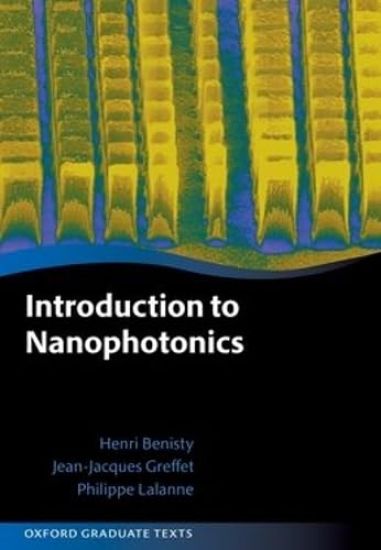
The aim of this textbook is to provide an overview of nanophotonics, a discipline which was developed around the turn of the millennium. This unique and rapidly evolving subject area is the result of a collaboration between various scientific communities working on different aspects of light-matter interaction at the nanoscale. These include near-field optics and super-resolution microscopy, photonic crystals, diffractive optics, plasmonics, optoelectronics, synthesis of metallic and semiconductor nanoparticles, two-dimensional materials, and metamaterials. The book is aimed at graduate students with a background in physics, electrical engineering, material science, or chemistry, as well as lecturers and researchers working within these fields.
Introduction to Nanophotonics

Introduction to Nanophotonics

Henri Benisty; Jean-Jacques Greffet; Philippe Lalanne

Oxford University Press
2022
sidottu
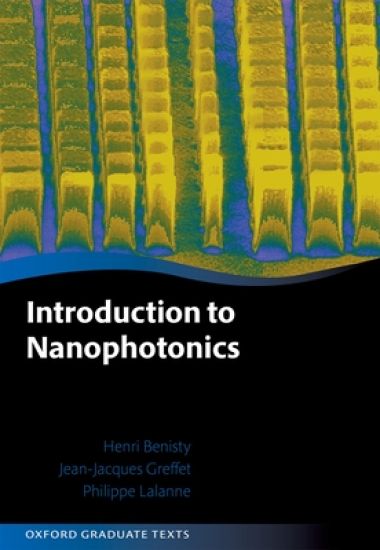
The aim of this textbook is to provide an overview of nanophotonics, a discipline which was developed around the turn of the millennium. This unique and rapidly evolving subject area is the result of a collaboration between various scientific communities working on different aspects of light-matter interaction at the nanoscale. These include near-field optics and super-resolution microscopy, photonic crystals, diffractive optics, plasmonics, optoelectronics, synthesis of metallic and semiconductor nanoparticles, two-dimensional materials, and metamaterials. The book is aimed at graduate students with a background in physics, electrical engineering, material science, or chemistry, as well as lecturers and researchers working within these fields.
Photonic Crystals

Photonic Crystals

Jean-Michel Lourtioz; Henri Benisty; Vincent Berger; Jean-Michel Gerard; Daniel Maystre; Alexei Tchelnokov

Springer-Verlag Berlin and Heidelberg GmbH Co. K
2010
nidottu
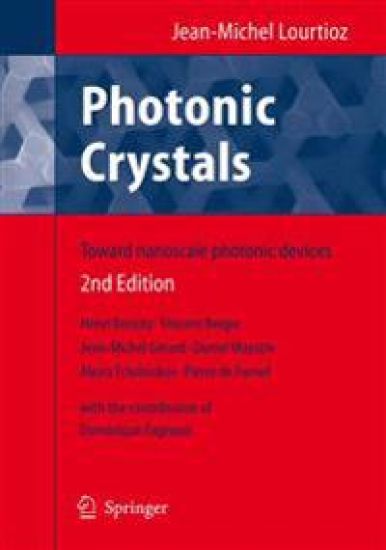
Just like the periodical crystalline potential in solid-state crystals determines their properties for the conduction of electrons, the periodical structuring of photonic crystals leads to envisioning the possibility of achieving a control of the photon flux in dielectric and metallic materials. The use of photonic crystals as a cage for storing, filtering or guiding light at the wavelength scale thus paves the way to the realisation of optical and optoelectronic devices with ultimate properties and dimensions. This should contribute toward meeting the demands for a greater miniaturisation that the processing of an ever increasing number of data requires. Photonic Crystals intends to provide students and researchers from different fields with the theoretical background needed for modelling photonic crystals and their optical properties, while at the same time presenting the large variety of devices, from optics to microwaves, where photonic crystals have found applications. As such, it aims at building bridges between optics, electromagnetism and solid-state physics. This book was written by six specialists of nanophotonics, and was coordinated by Jean-Michel Lourtioz, head of the Institut d'Électronique Fondamentale in Orsay and coordinator of the French Research Network in Nanophotonics.
Photonic Crystals

Photonic Crystals

Jean-Michel Lourtioz; Henri Benisty; Vincent Berger; Jean-Michel Gerard; Daniel Maystre; Alexei Tchelnokov

Springer-Verlag Berlin and Heidelberg GmbH Co. K
2008
sidottu
Just like the periodical crystalline potential in solid-state crystals determines their properties for the conduction of electrons, the periodical structuring of photonic crystals leads to envisioning the possibility of achieving a control of the photon flux in dielectric and metallic materials. The use of photonic crystals as a cage for storing, filtering or guiding light at the wavelength scale thus paves the way to the realisation of optical and optoelectronic devices with ultimate properties and dimensions. This should contribute toward meeting the demands for a greater miniaturisation that the processing of an ever increasing number of data requires. Photonic Crystals intends to provide students and researchers from different fields with the theoretical background needed for modelling photonic crystals and their optical properties, while at the same time presenting the large variety of devices, from optics to microwaves, where photonic crystals have found applications. As such, it aims at building bridges between optics, electromagnetism and solid-state physics. This book was written by six specialists of nanophotonics, and was coordinated by Jean-Michel Lourtioz, head of the Institut d'Électronique Fondamentale in Orsay and coordinator of the French Research Network in Nanophotonics.