

Kirjailija
Henri Cohen
Kirjat ja teokset yhdessä paikassa: 11 kirjaa, julkaisuja vuosilta 1993-2024, suosituimpien joukossa Les Secrets Du Regime 666. Vertaile teosten hintoja ja tarkista saatavuus suomalaisista kirjakaupoista.
11 kirjaa
Kirjojen julkaisuhaarukka 1993-2024.
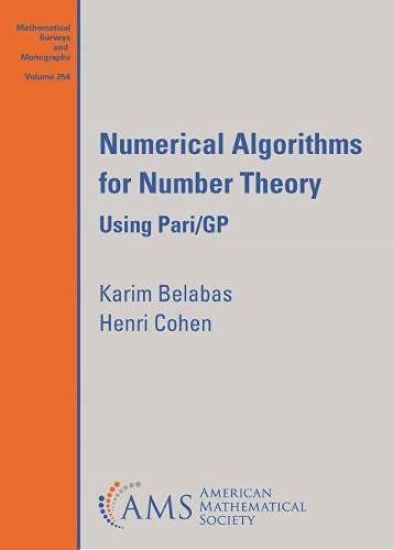
Numerical Algorithms for Number Theory
Karim Belabas; Henri Cohen
AMERICAN MATHEMATICAL SOCIETY
2021
pokkari
Presents multiprecision algorithms used in number theory and elsewhere, such as extrapolation, numerical integration, numerical summation (including multiple zeta values and the Riemann-Siegel formula), evaluation and speed of convergence of continued fractions, Euler products and Euler sums, inverse Mellin transforms, and complex $L$-functions.

Advanced Topics in Computational Number Theory
Henri Cohen
Springer-Verlag New York Inc.
2012
nidottu
The computation of invariants of algebraic number fields such as integral bases, discriminants, prime decompositions, ideal class groups, and unit groups is important both for its own sake and for its numerous applications, for example, to the solution of Diophantine equations. The practical com pletion of this task (sometimes known as the Dedekind program) has been one of the major achievements of computational number theory in the past ten years, thanks to the efforts of many people. Even though some practical problems still exist, one can consider the subject as solved in a satisfactory manner, and it is now routine to ask a specialized Computer Algebra Sys tem such as Kant/Kash, liDIA, Magma, or Pari/GP, to perform number field computations that would have been unfeasible only ten years ago. The (very numerous) algorithms used are essentially all described in A Course in Com putational Algebraic Number Theory, GTM 138, first published in 1993 (third corrected printing 1996), which is referred to here as [CohO]. That text also treats other subjects such as elliptic curves, factoring, and primality testing. Itis important and natural to generalize these algorithms. Several gener alizations can be considered, but the most important are certainly the gen eralizations to global function fields (finite extensions of the field of rational functions in one variable overa finite field) and to relative extensions ofnum ber fields. As in [CohO], in the present book we will consider number fields only and not deal at all with function fields.

A Course in Computational Algebraic Number Theory
Henri Cohen
Springer-Verlag Berlin and Heidelberg GmbH Co. K
2010
nidottu
With the advent of powerful computing tools and numerous advances in math ematics, computer science and cryptography, algorithmic number theory has become an important subject in its own right. Both external and internal pressures gave a powerful impetus to the development of more powerful al gorithms. These in turn led to a large number of spectacular breakthroughs. To mention but a few, the LLL algorithm which has a wide range of appli cations, including real world applications to integer programming, primality testing and factoring algorithms, sub-exponential class group and regulator algorithms, etc ... Several books exist which treat parts of this subject. (It is essentially impossible for an author to keep up with the rapid pace of progress in all areas of this subject.) Each book emphasizes a different area, corresponding to the author's tastes and interests. The most famous, but unfortunately the oldest, is Knuth's Art of Computer Programming, especially Chapter 4. The present book has two goals. First, to give a reasonably comprehensive introductory course in computational number theory. In particular, although we study some subjects in great detail, others are only mentioned, but with suitable pointers to the literature. Hence, we hope that this book can serve as a first course on the subject. A natural sequel would be to study more specialized subjects in the existing literature.
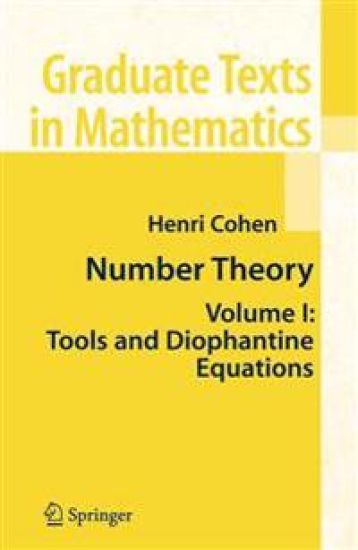
The central theme of this book is the solution of Diophantine equations, i.e., equations or systems of polynomial equations which must be solved in integers, rational numbers or more generally in algebraic numbers. This theme, in particular, is the central motivation for the modern theory of arithmetic algebraic geometry. In this text, this is considered through three of its most basic aspects. The book contains more than 350 exercises and the text is largely self-contained. Much more sophisticated techniques have been brought to bear on the subject of Diophantine equations, and for this reason, the author has included five appendices on these techniques.
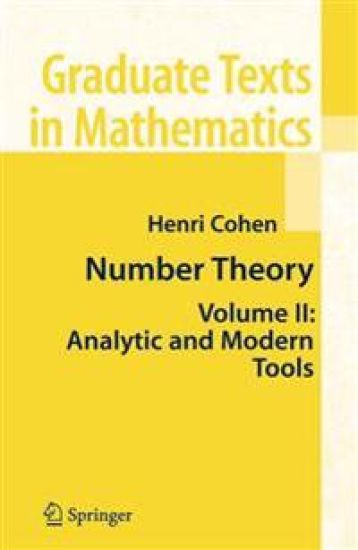
This book deals with several aspects of what is now called "explicit number theory." The central theme is the solution of Diophantine equations, i.e., equations or systems of polynomial equations which must be solved in integers, rational numbers or more generally in algebraic numbers. This theme, in particular, is the central motivation for the modern theory of arithmetic algebraic geometry. In this text, this is considered through three of its most basic aspects. The local aspect, global aspect, and the third aspect is the theory of zeta and L-functions. This last aspect can be considered as a unifying theme for the whole subject.
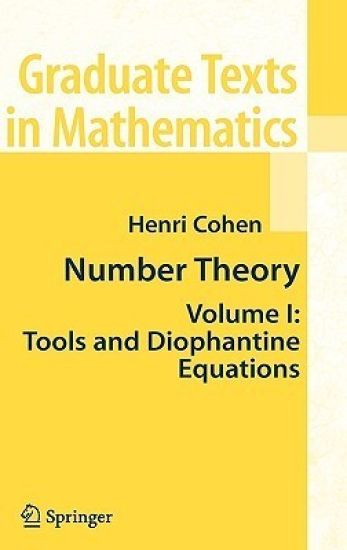
The central theme of this book is the solution of Diophantine equations, i.e., equations or systems of polynomial equations which must be solved in integers, rational numbers or more generally in algebraic numbers. This theme, in particular, is the central motivation for the modern theory of arithmetic algebraic geometry. In this text, this is considered through three of its most basic aspects. The book contains more than 350 exercises and the text is largely self-contained. Much more sophisticated techniques have been brought to bear on the subject of Diophantine equations, and for this reason, the author has included five appendices on these techniques.
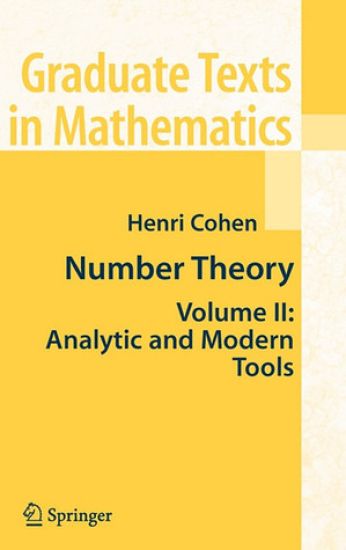
This book deals with several aspects of what is now called "explicit number theory." The central theme is the solution of Diophantine equations, i.e., equations or systems of polynomial equations which must be solved in integers, rational numbers or more generally in algebraic numbers. This theme, in particular, is the central motivation for the modern theory of arithmetic algebraic geometry. In this text, this is considered through three of its most basic aspects. The local aspect, global aspect, and the third aspect is the theory of zeta and L-functions. This last aspect can be considered as a unifying theme for the whole subject.
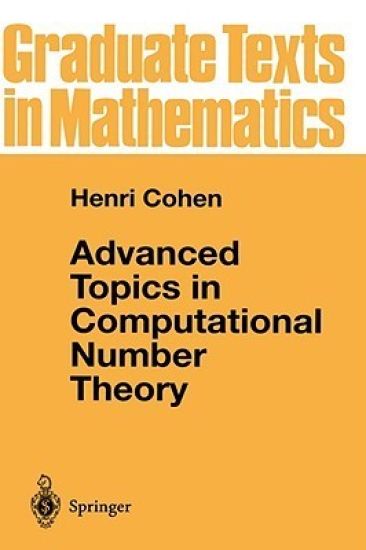
Advanced Topics in Computational Number Theory
Henri Cohen
Springer-Verlag New York Inc.
1999
sidottu
The computation of invariants of algebraic number fields such as integral bases, discriminants, prime decompositions, ideal class groups, and unit groups is important both for its own sake and for its numerous applications, for example, to the solution of Diophantine equations. The practical com pletion of this task (sometimes known as the Dedekind program) has been one of the major achievements of computational number theory in the past ten years, thanks to the efforts of many people. Even though some practical problems still exist, one can consider the subject as solved in a satisfactory manner, and it is now routine to ask a specialized Computer Algebra Sys tem such as Kant/Kash, liDIA, Magma, or Pari/GP, to perform number field computations that would have been unfeasible only ten years ago. The (very numerous) algorithms used are essentially all described in A Course in Com putational Algebraic Number Theory, GTM 138, first published in 1993 (third corrected printing 1996), which is referred to here as [CohO]. That text also treats other subjects such as elliptic curves, factoring, and primality testing. Itis important and natural to generalize these algorithms. Several gener alizations can be considered, but the most important are certainly the gen eralizations to global function fields (finite extensions of the field of rational functions in one variable overa finite field) and to relative extensions ofnum ber fields. As in [CohO], in the present book we will consider number fields only and not deal at all with function fields.
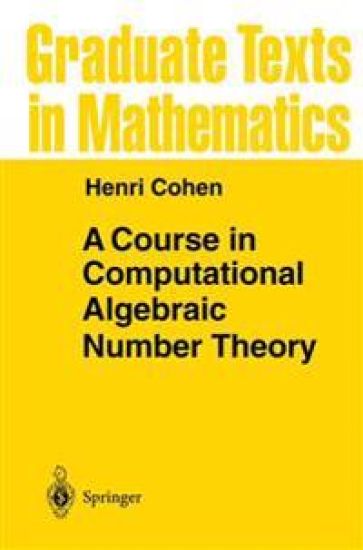
A Course in Computational Algebraic Number Theory
Henri Cohen
Springer-Verlag Berlin and Heidelberg GmbH Co. K
1993
sidottu
With the advent of powerful computing tools and numerous advances in math ematics, computer science and cryptography, algorithmic number theory has become an important subject in its own right. Both external and internal pressures gave a powerful impetus to the development of more powerful al gorithms. These in turn led to a large number of spectacular breakthroughs. To mention but a few, the LLL algorithm which has a wide range of appli cations, including real world applications to integer programming, primality testing and factoring algorithms, sub-exponential class group and regulator algorithms, etc ... Several books exist which treat parts of this subject. (It is essentially impossible for an author to keep up with the rapid pace of progress in all areas of this subject.) Each book emphasizes a different area, corresponding to the author's tastes and interests. The most famous, but unfortunately the oldest, is Knuth's Art of Computer Programming, especially Chapter 4. The present book has two goals. First, to give a reasonably comprehensive introductory course in computational number theory. In particular, although we study some subjects in great detail, others are only mentioned, but with suitable pointers to the literature. Hence, we hope that this book can serve as a first course on the subject. A natural sequel would be to study more specialized subjects in the existing literature.