Kirjojen hintavertailu. Mukana 12 174 446 kirjaa ja 12 kauppaa.

Kirjailija

Henri Lefebvre

Kirjat ja teokset yhdessä paikassa: 30 kirjaa, julkaisuja vuosilta 1968-2023, suosituimpien joukossa The Missing Pieces. Vertaile teosten hintoja ja tarkista saatavuus suomalaisista kirjakaupoista.

30 kirjaa

Kirjojen julkaisuhaarukka 1968-2023.

State, Space, World

State, Space, World

Henri Lefebvre

University of Minnesota Press
2009
nidottu
Leading intellectual Henri Lefebvre on political and state theoryOne of the most influential Marxist theorists of the twentieth century, Henri Lefebvre pioneered the study of the modern state in an age of accelerating global economic integration and fragmentation. Shortly after the 1974 publication of his landmark book The Production of Space, Lefebvre embarked on one of the most ambitious projects of his career: a consideration of the history and geographies of the modern state through a monumental study that linked several disciplines, including political science, sociology, geography, and history. State, Space, World collects a series of Lefebvre’s key writings on the state from this period. Making available in English for the first time the as-yet-unexplored political aspect of Lefebvre’s work, it contains essays on philosophy, political theory, state formation, spatial planning, and globalization, as well as provocative reflections on the possibilities and limits of grassroots democracy under advanced capitalism.State, Space, World is an essential complement to The Production of Space, The Urban Revolution, and The Critique of Everyday Life. Lefebvre’s original and prescient analyses that emerge in this volume are urgently relevant to contemporary debates on globalization and neoliberal capitalism.
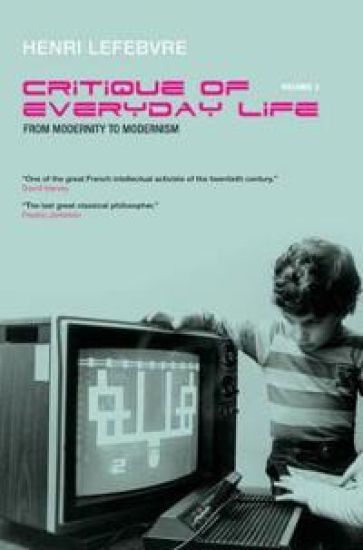
Critique of Everyday Life, Vol. 2

Critique of Everyday Life, Vol. 2

Henri Lefebvre

Verso Books
2008
nidottu
Volume 2 This book identifies categories within everyday life, such as the theories of the semantic field and of moments. "The Critique of Everyday Life" is perhaps the richest, most prescient work by one of the twentieth century's greatest philosophers. The trilogy which provided the philosophy behind the 1968 student revolution in France, it is considered to be the founding text of what we now know as cultural studies. Whether discussing sport, household gadgets, the countryside, surrealism, Charlie Chaplin or religion, Lefebvre always concentrates on the minutiae of lived experience in work and leisure, daydreams, and festivities. Denounced by both the right and left when it was first published in France in 1947, today this text is recognized as a path-breaking, radical, and hugely influential book.
Critique of Everyday Life, Vol. 3

Critique of Everyday Life, Vol. 3

Henri Lefebvre

Verso Books
2008
nidottu
Volume 3 Henri Lefebvre's magnum opus: a monumental exploration of contemporary society. Henri Lefebvre's three-volume Critique of Everyday Life is perhaps the richest, most prescient work by one of the twentieth century's greatest philosophers. Written at the birth of post-war consumerism, the Critique was a philosophical inspiration for the 1968 student revolution in France and is considered to be the founding text of all that we know as cultural studies, as well as a major influence on the fields of contemporary philosophy, geography, sociology, architecture, political theory and urbanism. A work of enormous range and subtlety, Lefebvre takes as his starting-point and guide the "trivial" details of quotidian experience: an experience colonized by the commodity, shadowed by inauthenticity, yet one which remains the only source of resistance and change.This is an enduringly radical text, untimely today only in its intransigence and optimism.
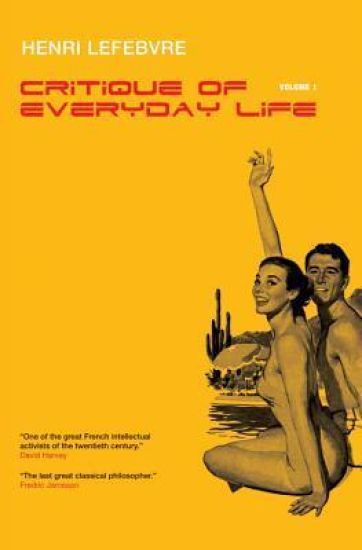
Critique of Everyday Life

Critique of Everyday Life

Henri Lefebvre; John (TRN) Moore; Michel (INT) Trebitsch

Verso Books
2008
pokkari
Volume 1 This book focuses on the various phenomena of daily life and considers them in new ways. "The Critique of Everyday Life" is perhaps the richest, most prescient work by one of the twentieth century's greatest philosophers. The trilogy which provided the philosophy behind the 1968 student revolution in France, it is considered to be the founding text of what we now know as cultural studies. Whether discussing sport, household gadgets, the countryside, surrealism, Charlie Chaplin or religion, Lefebvre always concentrates on the minutiae of lived experience in work and leisure, daydreams, and festivities. Denounced by both the right and left when it was first published in France in 1947, today this text is recognized as a path-breaking, radical, and hugely influential book.
Rhythmanalysis

Rhythmanalysis

Henri Lefebvre

Continuum International Publishing Group Ltd.
2004
nidottu
Rhythmanalysis displays all the characteristics which made Lefebvre one of the most important Marxist thinkers of the twentieth century. In the analysis of rhythms -- both biological and social -- Lefebvre shows the interrelation of space and time in the understanding of everyday life. With dazzling skills, Lefebvre moves between discussions of music, the commodity, measurement, the media and the city. In doing so he shows how a non-linear conception of time and history balanced his famous rethinking of the question of space. This volume also includes his earlier essays on "The Rhythmanalysis Project" and "Attempt at the Rhythmanalysis of Mediterranean Towns."
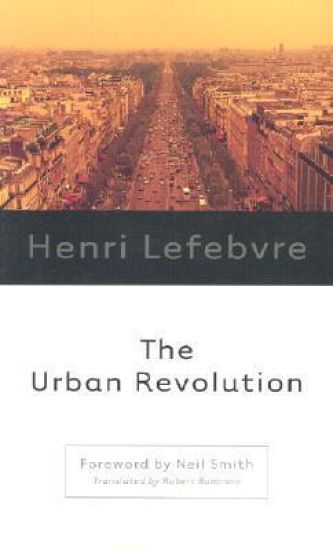
The Urban Revolution

The Urban Revolution

Henri Lefebvre

University of Minnesota Press
2003
nidottu
The first English translation of Lefebvre's groundbreaking work on the urban experience. Originally published in 1970, The Urban Revolution marked Henri Lefebvre's first sustained critique of urban society, a work in which he pioneered the use of semiotic, structuralist, and poststructuralist methodologies in analyzing the development of the urban environment. Although it is widely considered a foundational book in contemporary thinking about the city, The Urban Revolution has never been translated into English—until now. This first English edition, deftly translated by Robert Bononno, makes available to a broad audience Lefebvre's sophisticated insights into the urban dimensions of modern life. Lefebvre begins with the premise that the total urbanization of society is an inevitable process that demands of its critics new interpretive and perceptual approaches that recognize the urban as a complex field of inquiry. Dismissive of cold, modernist visions of the city, particularly those embodied by rationalist architects and urban planners like Le Corbusier, Lefebvre instead articulates the lived experiences of individual inhabitants of the city. In contrast to the ideology of urbanism and its reliance on commodification and bureaucratization—the capitalist logic of market and state—Lefebvre conceives of an urban utopia characterized by self-determination, individual creativity, and authentic social relationships. A brilliantly conceived and theoretically rigorous investigation into the realities and possibilities of urban space, The Urban Revolution remains an essential analysis of and guide to the nature of the city.
Writings on Cities

Writings on Cities

Henri Lefebvre

JOHN WILEY AND SONS LTD
1995
nidottu
The work of Henri Lefebvre - the only major French intellectual of the post-war period to give extensive consideration to the city and urban life - received considerable attention among both academics and practitioners of the built environment following the publication in English of The Production of Space. This new collection brings together, for the first time in English, Lefebvre's reflections on the city and urban life written over a span of some twenty years. The selection of writings is contextualized by an introduction - itself a significant contribution to the interpretation of Henri Lefebvre's work - which places the material within the context of Lefebvre's intellectual and political life and times and raises pertinent issues as to their relevance for contemporary debates over such questions as the nature of urban reality, the production of space and modernity. Writings on Cities is of particular relevance to architects, planners, geographers, and those interested in the philosophical and political understanding of contemporary life.
The Production of Space

The Production of Space

Henri Lefebvre

JOHN WILEY AND SONS LTD
1991
nidottu
Henri Lefebvre has considerable claims to be the greatest living philosopher. His work spans some sixty years and includes original work on a diverse range of subjects, from dialectical materialism to architecture, urbanism and the experience of everyday life. The Production of Space is his major philosophical work and its translation has been long awaited by scholars in many different fields. The book is a search for a reconciliation between mental space (the space of the philosophers) and real space (the physical and social spheres in which we all live). In the course of his exploration, Henri Lefebvre moves from metaphysical and ideological considerations of the meaning of space to its experience in the everyday life of home and city. He seeks, in other words, to bridge the gap between the realms of theory and practice, between the mental and the social, and between philosophy and reality. In doing so, he ranges through art, literature, architecture and economics, and further provides a powerful antidote to the sterile and obfuscatory methods and theories characteristic of much recent continental philosophy. This is a work of great vision and incisiveness. It is also characterized by its author's wit and by anecdote, as well as by a deftness of style which Donald Nicholson-Smith's sensitive translation precisely captures.