Kirjailija
Henry A. Giroux
Kirjat ja teokset yhdessä paikassa: 97 kirjaa, julkaisuja vuosilta 1987-2026, suosituimpien joukossa America at War with Itself. Vertaile teosten hintoja ja tarkista saatavuus suomalaisista kirjakaupoista.
97 kirjaa
Kirjojen julkaisuhaarukka 1987-2026.
Henry A. Giroux argues that education holds a crucial role in shaping politics at a time when ignorance, lies and fake news have empowered right-wing groups and created deep divisions in society. Education, with its increasingly corporate and conservative-based technologies, is partly responsible for creating these division. It contributes to the pitting of people against each other through the lens of class, race, and any other differences that don't embrace White nationalism. Giroux’s analysis ranges from the pandemic and the inequality it has revealed, to the rise of Trumpism and its afterlife, and to the work of Paulo Freire and how his book Pedagogy of Hope can guide us in these dark times and help us produce critical and informed citizens. He argues that underlying the current climate of inequity, isolation, and social atomization (all exacerbated by the pandemic) is a crisis of education. Out of this comes the need for a pedagogy of resistance that is accessible to everyone, built around a vision of hope for an alternative society rooted in the ideals of justice, equality, and freedom.
In this book Henry A. Giroux passionately argues that education and critical pedagogy are needed now more than ever to combat injustices in our society caused by fake news, toxic masculinity, racism, consumerism and white nationalism. At the heart of the book is the idea that pedagogy has the power to create narratives of desire, values, identity, and agency at time when these narratives are being manipulated to promote right wing populism and emerging global fascist politics. The book expands on the notion of the plague as not only a medical crisis but also a crisis of politics, ethics, education, and democracy itself. The chapters cover a range topics beginning with historical perspectives on fascism and moving on to issues of social atomization, depoliticization, neoliberal pedagogy, the scourge of staggering inequality, populism, and pandemic pedagogy. The book concludes with a call for educators to make education central to politics, develop a discourse of critique and possibility, reclaim the vision of a radical democracy, and embrace their role as powerful agents of change.
Alongside Paulo Freire, Henry A. Giroux is widely considered to be the founding father of critical pedagogy. This classic work represents his best writing on critical pedagogy spanning the past 40 years. The 2nd edition includes four new chapters covering the rise of fascist culture in America and across the globe and the dictatorship of ignorance in the age of Trump and post-truth.This impassioned work opens by discussing critical pedagogy in schools before extending the notion to the educational force of culture, politics, and society. Giroux analyses the increasingly empirical orientation of teaching, focusing on the culture of positivism and examines some of the major economic, social, and political forces undermining the promise of democratic schooling in both public and higher education. He argues against the tendency by both right wing and neo-liberal interests to reduce schooling to training, and students merely to customers. He points to the increasing attack on pubic and higher education by right-wing populists and the Trump administration in an age of growing authoritarianism. Giroux also considers the legacy of Freire and issues a fundamental challenge to educators, public intellectuals, and others who believe in the promise of radical democracy.
Giroux exposes the corporate forces at play and charts a clear-minded and inspired course of action out of the shadows of market-driven education policy. Championing the youth around the globe who have dared to resist the bartering of their future, he calls upon public intellectuals—as well as all people concerned about the future of democracy—to speak out and defend the university as a site of critical learning and democratic promise. In this updated edition, Giroux puts all of this into the context of the Trump era, arguing that education remains a key battleground for the fight against authoritarianism.
A far-ranging critique of the rise of authoritarianism and white nationalism in the US and the consequences for democracy.In this searing critique of the Trump presidency and the rise of authoritarianism in the U.S., Henry Giroux asks, How have we arrived here, and what can be done? In a discussion of events that ranges from the Administration's ongoing attempts to repeal Obamacare and its anti-immigration policies and travel bans, to the normalization of a culture of cruelty and the "weaponization of ignorance," Giroux details the urgency of our current crisis.Giroux explores the political dystopias-those of recent history and those depicted in some of the classics of Western literature-that result when authoritarian forces outmaneuver accountability. He argues that only through increased civic investment in multicultural democracy, education, and resistance can we hope to push back the ominous convergence of white nationalism and elite economic interests.Praise for American Nightmare:"In this current era of corporate media misdirection and misinformation . . . Henry Giroux is one of the few great political voices of today, with powerful insight into the truth. Dr. Giroux is defiantly explaining, against the grain, what's REALLY going on right now, and doing so quite undeniably. Simply put, the ideas he brings forth are a beacon that need to be seen and heard and understood in order for the world to progress."-Julian Casablancas, lead vocalist for The Strokes"In frightening times like these, what is desperately needed is an informed and wise voice that speaks clearly and with conviction about the situation we are in, and what can be done. Henry Giroux is one of the great public intellectuals of our times, and American Nightmare is exactly the book for people grappling with how to understand the Trump era and how to proceed. This is precisely the book that needs to be shared with friends and acquaintances. It will provoke hard thinking, bring clarity, and stimulate much needed conversation and action."-Robert W. McChesney, co-author of People Get Ready: The Fight Against a Jobless Economy and a Citizenless Democracy"We have no greater chronicler of these dystopian times. Giroux's critique cuts to the crux of today's authoritarian crisis, yet his voice remains of one hope that the people may collectively regain control. Even while living though systemic efforts to privatize hope, Giroux's critique enacts the sort of shared resistance that can effectively challenge authoritarianism. American Nightmare demonstrates how we can resist the normalization of hate, authoritarianism and alienation in Trump's America. He shows us that not only are we not alone, but we are among a majority who oppose the cruelties of American social policies."-David H. Price, author of Cold War Anthropology: The CIA and the Growth of Dual Use Anthropology"At a moment when the news cycle presents the dangers of Trumpian authoritarianism through disjointed and discrete hottakes, Giroux's wide-reaching analysis accounts for our current American nightmare with necessary historical context, and in so doing creates an aperture for resistance more meaningful than a hashtag."-Natasha Lennard, contributing writer for The Intercept, co-editor of Violence: Humans in Dark Times"In this passionately argued volume, Henry Giroux, long known for his critical commentaries on the de-democratization of the U.S.A., on its rising inequ(al)ity and neoliberal excesses, reflects very thoughtfully on the specter of Trump's America: on its violence, cruelty, and incivility, its burgeoning authoritarianism, its inexorable edging toward a Grave Neo World: in short, a rising specter that demands to be countered at all cost if the U.S. is to be rescued from itself."-John Comaroff, Professor of African and African American Studies and of Anthropology, Harvard University
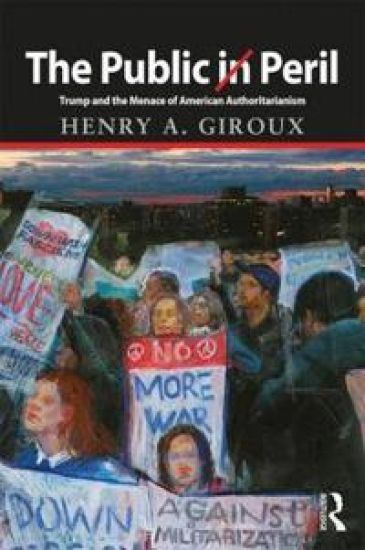
This is one of the first books to thoroughly critique the rise of Trumpism and its potential impact, nationally and globally. One of the world’s leading social critics, Giroux offers new critiques of Trump and his early Cabinet choices in the context of longer term trends, including the rise of right-wing populism, the threat of planetary peril, anti-intellectual fervor, the war on youth, a narrowing political discourse, deepening inequality and disposability, authoritarianism, the crisis of civic culture, the rise of the mass incarceration state, and more. Giroux dissects the diverse forces that led to Trump’s rise and points to pathways for resisting his authoritarian instincts. Offering a new language of hope and possibility, Giroux’s optimism is rooted especially in the resurgence of progressive politics among youth. Giroux reclaims the centrality of education to politics and boldly articulates a vision in which the radical imagination merges with civic courage as part of a broad-based struggle for a radical democracy. Deep inquiries into fast-changing and pressing issues of our time makes this book 'the essential Giroux' that citizens and students must read, debate, and act upon.
Public spending on education is under attack. In this challenging book Aronowitz and Giroux examine the thinking behind that attack, in the USA and in other industrialized countries.
In the United States today, the term "terrorism" conjures up images of dangerous, outside threats: religious extremists and suicide bombers in particular. Harder to see but all the more pervasive is the terrorism perpetuated by the United States itself, whether through military force overseas or woven into the very fabric of society at home. Henry Giroux, in this passionate and incisive book, turns the conventional wisdom on terrorism upside down, demonstrating how fear and lawlessness have become organizing principles of life in the United States, and violence an acceptable form of social mediation. He addresses the most pressing issues of the moment, from officially sanctioned torture to militarized police forces to austerity politics. Giroux also examines the ongoing degradation of the education system and how young people in particular suffer its more nefarious outcomes. Against this grim picture, Giroux posits a politics of hope and a commitment to accurate-and radical-historical memory.He draws on a long, distinguished career developing the tenets of critical pedagogy to propose a cure for our addiction to terrorism: a kind of "public pedagogy" that challenges the poisoned narratives of "America's dis-imagination machine."
Disposable Youth: Racialized Memories, and the Culture of Cruelty
Henry A. Giroux
Routledge
2016
sidottu
Facing a crisis unlike that of any other generation, young people are caught between the discourses of consumerism and a powerful crime-control-complex, and are viewed increasingly as commodities or are subjected to the dictates of an ever expanding criminal justice system. Drawing upon critical analyses, biography, and social theory, Disposable Youth explores the current conditions of young people now face within an emerging culture of privatization, insecurity, and commodification and raises some important questions regarding the role that educators, young people, and concerned citizens might play in challenging the plight of young people, while deepening and extending the promise of a better future and a viable democracy.
In the United States today, the term "terrorism" conjures up images of dangerous, outside threats: religious extremists and suicide bombers in particular. Harder to see but all the more pervasive is the terrorism perpetuated by the United States itself, whether through military force overseas or woven into the very fabric of society at home. Henry Giroux, in this passionate and incisive book, turns the conventional wisdom on terrorism upside down, demonstrating how fear and lawlessness have become organizing principles of life in the United States, and violence an acceptable form of social mediation. He addresses the most pressing issues of the moment, from officially sanctioned torture to militarized police forces to austerity politics. Giroux also examines the ongoing degradation of the education system and how young people in particular suffer its more nefarious outcomes. Against this grim picture, Giroux posits a politics of hope and a commitment to accurate-and radical-historical memory. He draws on a long, distinguished career developing the tenets of critical pedagogy to propose a cure for our addiction to terrorism: a kind of "public pedagogy" that challenges the poisoned narratives of "America's dis-imagination machine."
"This is a must-read book for anyone ready to transcend fear and imagine a new reality."--Tikkun Disposable Futures makes the case that we have not just become desensitized to violence, but rather, that we are being taught to desire it. From movies and other commercial entertainment to "extreme" weather and acts of terror, authors Brad Evans and Henry Giroux examine how a contemporary politics of spectacle--and disposability--curates what is seen and what is not, what is represented and what is ignored, and ultimately, whose lives matter and whose do not. Disposable Futures explores the connections between a range of contemporary phenomena: mass surveillance, the militarization of police, the impact of violence in film and video games, increasing disparities in wealth, and representations of ISIS and the ongoing terror wars. Throughout, Evans and Giroux champion the significance of public education, social movements and ideas that rebel against the status quo in order render violence intolerable. "Disposable Futures poses, and answers, the pressing question of our times: How is it that in this post-Fascist, post-Cold War era of peace and prosperity we are saddled with more war, violence, inequality and poverty than ever? The neoliberal era, Evans and Giroux brilliantly reveal, is defined by violence, by drone strikes, 'smart' bombs, militarized police, Black lives taken, prison expansion, corporatized education, surveillance, the raw violence of racism, patriarchy, starvation and want. The authors show how the neoliberal regime normalizes violence, renders its victims disposable, commodifies the spectacle of relentless violence and sells it to us as entertainment, and tries to contain cultures of resistance. If you're not afraid of the truth in these dark times, then read this book. It is a beacon of light."--Robin D. G. Kelley, author of Freedom Dreams: The Black Radical Imagination "Disposable Futures confronts a key conundrum of our times: How is it that, given the capacity and abundance of resources to address the critical needs of all, so many are having their futures radically discounted while the privileged few dramatically increase their wealth and power? Brad Evans and Henry Giroux have written a trenchant analysis of the logic of late capitalism that has rendered it normal to dispose of any who do not service the powerful. A searing indictment of the socio-technics of destruction and the decisions of their deployability. Anyone concerned with trying to comprehend these driving dynamics of our time would be well served by taking up this compelling book."--David Theo Goldberg, author of The Threat of Race: Reflections on Racial Neoliberalism "Disposable Futures is an utterly spellbinding analysis of violence in the later 20th and early 21st centuries. It strikes me as a new breed of street-smart intellectualism moving through broad ranging theoretical influences of Adorno, Arendt, Bauman, Deleuze, Foucault, Zizek, Marcuse, and Reich. I especially appreciated a number of things, including: the discussion of representation and how it functions within a broader logics of power; the descriptions and analyses of violence mediating the social field and fracturing it through paralyzing fear and anxiety; the colonization of bodies and pleasures; and the nuanced discussion of how state violence, surveillance, and disposability connect. Big ideas explained using a fresh straightforward voice."--Adrian Parr, author of The Wrath of Capital: Neoliberalism and Climate Change Politics Brad Evans and Henry A. Giroux are internationally renowned educators, authors, and intellectuals. Together, they curate a forum for Truthout.com that explores the theme of "Disposable Futures." Evans is director of histories of violence project at the University of Bristol, United Kingdom. Giroux holds McMaster University Chair for Scholarship in the Public Interest, and is the Paulo Freire Distinguished Scholar in Critical Pedagogy.
Updated with both a new introduction and a series of interviews, the second edition of Education and the Crisis of Public Values examines American society’s shift away from democratic public values, the ensuing move toward a market-driven mode of education, and the last decade’s growing social disinvestment in youth. The book discusses the number of ways that the ideal of public education as a democratic public sphere has been under siege, including full-fledged attacks by corporate interests on public school teachers, schools of education, and teacher unions. It also reveals how a business culture cloaked in the guise of generosity and reform has supported a charter school movement that aims to dismantle public schools in favor of a corporate-friendly privatized system. The book encourages educators to become public intellectuals, willing to engage in creating a formative culture of learning that can nurture the ability to defend public and higher education as a general good – one crucial to sustaining a critical citizenry and a democratic society.
Giroux probes the depth and range of forces pushing the United States into a new form of authoritarianism, one that connects the Orwellian surveillance state with the forms of ideological control made famous by Aldous Huxley. Addressing how neoliberalism, or the new market fundamentalism, is shaping a range of registers from language and memory to youth and higher education, Giroux explores how education in a variety of spheres is transformed into a type of miseducation perpetuated through what he calls a "disimagination machine"-one that reproduces the present by either distorting or erasing the past. But Giroux is not content to focus on how matters of politics, subjectivity, power, and desire are colonized through forms of miseducation; he is also concerned with the educative nature of politics as the practice of freedom and how the emphasis on critique must be matched by a politics and discourse of resistance, hope, and possibility. This becomes particularly evident in his chapters on Noam Chomsky and Howard Zinn. Thinking Dangerously makes clear that at the heart of the struggle for a radical democracy is the reviving of the radical imagination as the basis for new forms of political and collective struggle. Probing these issues through a series of interrelated essays and important interviews, Giroux provides an accessible, layered, and sustained example of how thinking dangerously is central to and connected with the struggle over the radical imagination and the fight to fulfill the promise of a radical democracy.
Paulo Freire and the Curriculum
Georgios Grollios; Henry A. Giroux; Panayota Gounari; Donaldo Macedo
Paradigm
2015
nidottu
How can Paulo Freire s progressive and vital contributions to curriculum planning can be made more relevant today for educators, policy makers and anybody involved in education? This book provides a necessary framework as it articulates significant questions. The first deals with Freire s positions on curriculum planning, the second is devoted to the historical development and the character of his perspective on curriculum planning, and the third refers to the ways his perspective compares to others, as well as to its contemporary value. Freire s perspective comes into direct conflict with traditional views on curriculum planning, the content of which represents what is perceived as the highest expression of Western civilization. Freire also breaks with the dominant perspective of social efficiency on curriculum planning whose main aim is to supply, via behavioral objectives, the knowledge and skills deemed necessary for the efficient function of the economy and the society, treats learners as passive receivers of knowledge, and assigns to curriculum a technical character disarticulated from social, political or ideological conflicts. In addition, he does not focus on studying the learner in an abstract or a-historical framework, nor does he adopt an individualistic interpretation which fetishizes spontaneity. In contrast to traditional perspectives on the curriculum, Freire provides a fertile ground for teachers and any others who seek to transform schools and improve student s learning and lives."
Giroux probes the depth and range of forces pushing the United States into a new form of authoritarianism, one that connects the Orwellian surveillance state with the forms of ideological control made famous by Aldous Huxley. Addressing how neoliberalism, or the new market fundamentalism, is shaping a range of registers from language and memory to youth and higher education, Giroux explores how education in a variety of spheres is transformed into a type of miseducation perpetuated through what he calls a "disimagination machine"-one that reproduces the present by either distorting or erasing the past. But Giroux is not content to focus on how matters of politics, subjectivity, power, and desire are colonized through forms of miseducation; he is also concerned with the educative nature of politics as the practice of freedom and how the emphasis on critique must be matched by a politics and discourse of resistance, hope, and possibility. This becomes particularly evident in his chapters on Noam Chomsky and Howard Zinn. Thinking Dangerously makes clear that at the heart of the struggle for a radical democracy is the reviving of the radical imagination as the basis for new forms of political and collective struggle. Probing these issues through a series of interrelated essays and important interviews, Giroux provides an accessible, layered, and sustained example of how thinking dangerously is central to and connected with the struggle over the radical imagination and the fight to fulfill the promise of a radical democracy.
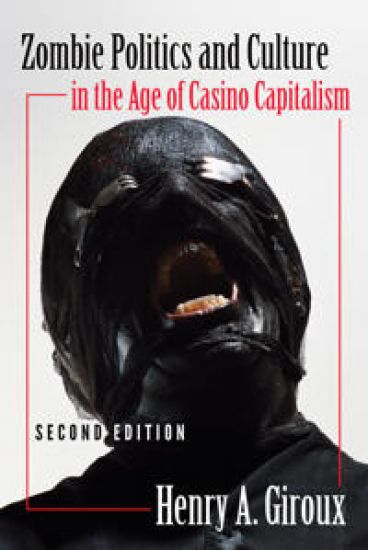
Zombie Politics and Culture in the Age of Casino Capitalism
Henry A. Giroux
Peter Lang Publishing Inc
2014
nidottu
In the second edition of Zombie Politics and Culture in the Age of Casino Capitalism, Henry A. Giroux uses the metaphor of the zombie to highlight how America has embraced a machinery of social and civil death that chills any vestige of a robust democracy. He charts the various ways in which the political, corporate, and intellectual zombies that rule America embrace death-dealing institutions such as a bloated military, the punishing state, a form of predatory capitalism, and an authoritarian, death-driven set of policies that sanction torture, targeted assassinations, and a permanent war psychology. The author argues that government and corporate paranoia runs deep in America. While maintaining a massive security state, the ruling forces promote the internalization of their ideology, modes of governance, and policies by either seducing citizens with the decadent pleasures of a celebrity-loving consumer culture or by beating them into submission. Giroux calls for a systemic alternative to zombie capitalism through a political and pedagogical imperative to address and inform a new cultural vision, mode of individual subjectivity, and understanding of critical agency. As part of a larger effort to build a broad-based social movement, he argues for a new political language capable of placing education at the center of politics. Connecting the language of critique to the discourse of educated hope he calls for the reclaiming of public spaces and institutions where formative cultures can flourish that nourish the radical imagination, and the ongoing search for justice, equality, and the promise of a democracy to come.