Kirjojen hintavertailu. Mukana 12 595 353 kirjaa ja 12 kauppaa.

Kirjailija

Henry Aaron

Kirjat ja teokset yhdessä paikassa: 10 kirjaa, julkaisuja vuosilta 1978-2008, suosituimpien joukossa On Social Welfare. Vertaile teosten hintoja ja tarkista saatavuus suomalaisista kirjakaupoista.

10 kirjaa

Kirjojen julkaisuhaarukka 1978-2008.

Reforming Medicare

Reforming Medicare

Henry Aaron; Jeanne M. Lambrew

Brookings Institution
2008
nidottu
"Everyone agrees on the need to reform Medicare but not on how to do it. Some argue the program is too comprehensive, others that it is not comprehensive enough. Some suggest it pays too much for health care, others, too little. Meanwhile, the financial stakes continue to mount. Medicare spending exceeded $400 billion in 2007, making it more expensive than the entire health systems of most other nations, as well as the largest national public program other than Social Security and national defense. In R eforming Medicare, Henry J. Aaron and Jeanne M. Lambrew deftly guide readers through this complex debate. They identify and analyze the three leading approaches to reform. Updated social insurance would retain the current system while rationalizing coverage and reducing bureaucracy. Premium support would replace the current system with a capped, per-person payment that beneficiaries could use to buy health insurance. Consumer-directed Medicare would have beneficiaries pay for care up to a high deductible from government- supported savings accounts and offer premium-support coverage above the deductible. In addition to rating each option on its ability to promote access to health care, improve the quality of care, and control costs, the authors evaluate each reform's political strengths and weaknesses. Given the heat generated by the Medicare debate, it is unlikely that any single approach will be implemented in full. Consequently, Aaron and Lambrew describe incremental strategies that blend elements of each plan. Their analysis provides essential insight into the types of hybrid policies that Congress will consider in coming years."
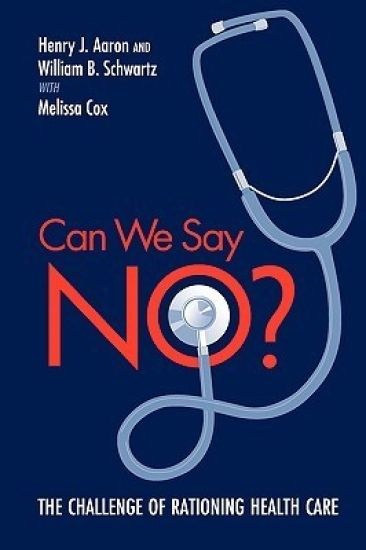
Can We Say No?

Can We Say No?

Henry Aaron; William B. Schwartz; Melissa Cox

Brookings Institution
2005
nidottu
"Over the past four decades, the share of income devoted to health care nearly tripled. If policy is unchanged, this trend is likely to continue. Should Americans decide to rein in the growth of health care spending, they will be forced to consider whether to ration care for the well-insured, a prospect that is odious and unthinkable to many. This book argues that sensible health care rationing can not only save money but improve general welfare and public health. It reviews the experience with health care rationing in Great Britain. The choices the British have made point up the nature of the options Americans will face if they wish to keep public health care budgets from driving taxes ever higher and private health care spending from crowding out increases in other forms of worker compensation and consumption. This book explains why serious consideration of health care rationing is inescapable. It also provides the information policymakers and concerned citizens need to think clearly about these difficult issues and engage in an informed debate."
The Problem that Won't Go Away

The Problem that Won't Go Away

Henry Aaron

Brookings Institution
1995
nidottu
Why did President Clinton's efforts to reform the financing of American health care fail? For years to come, politicians and scholars of public policy will revisit the debate over Clinton's health care plan. What did planners do right? And what did they do wrong? How can the mistakes of that experience be avoided in the future? What steps can now be taken to achieve some measure of reform in smaller pieces? In The Problem That Won't Go Away, economists, political scientists, sociologists, public opinion experts, and government staff offer answers to these and other crucial questions. They recount the history of the Clinton health care plan, present several alternative strategies the administration might have pursued, and conclude that none was likely to achieve the administration's goals of universal coverage and cost containment. Many support the view that the administration, Congress, and the nation lacked the political consensus and the information to credibly describe the effects of any single bill to reform the U.S. health care system. In that case, was the only option available to the administration to reach for goals far more modest than those it sought? Health care financing as a national political issue will not go away. Pressure to cut public spending to balance the budget means that medicare and medicaid will stay in the legislative spotlight; the retirement of the baby-boom generation in the beginning of the next century promises large increases in the cost of medicare; and a flood of new and costly medical technologies will continue to put financial pressure on everyone responsible for paying for health insurance. But, as this book illustrates, the nature of the debate in the years after the demise of the Clinton plan will be altogether different from that of the past several decades.
Serious and Unstable Condition

Serious and Unstable Condition

Henry Aaron

Brookings Institution
1991
nidottu
The United States spends more on health care than any other nation in the world, yet millions of Americans cannot afford basic care for acute illnesses, few are insured against the costs of long-term care, and many frequently used medical procedures have never been fully evaluated. The goals of controlling spiraling health care costs and extending insurance coverage or even maintaining current insurance coverage seem to be in conflict. But progress can be made on both goals if they are tacked together. Henry Aaron evaluates these critical issues and explores how adequate care can be provided without fueling inflation. Because the current arrangements for financing America's health care cannot endure, Aaron contends that a major national debate on the restructuring of the U.S. system of financing health care is inescapable, and major legislation is likely. Serious and Unstable Condition offers a guide that is crucial to understanding the reform debate. It explains the important economic issues of health care as a background for evaluating both the current system and proposals for change. Aaron compares the U.S. system of health care financing with certain foreign systems and reviews major options for reform. He cautions that unless the health insurance system is radically changed, the number of uninsured will continue to increase and costs will continue to escalate. He then offers his own comprehensive plan to address these problems.
Can America Afford to Grow Old?

Can America Afford to Grow Old?

Henry Aaron; Barry P. Bosworth; Gary Burtless

Brookings Institution
1988
nidottu
Examines the effects of rising social security costs and of measures adopted to deal with them, and discusses possible ways of coping with the shortfall of available money for the aging American population.
The Comparable Worth Controversy

The Comparable Worth Controversy

Henry Aaron; Cameran M. Lougy

Brookings Institution
1986
nidottu
The well-documented gap between men's and women's earnings has aroused intense debate over the concept of comparable worth, that is, equal pay for work judged to be of equal value. Government, business, labor unions, and the courts have been forced to consider whether workers in dissimilar jobs of comparable worth—measured by such criteria as working conditions, degree of difficulty, and knowledge and responsibility required—should receive equal wages, and how wage adjustments can be implemented.The issue has provoked inflated rhetoric, litigation, and considerable confusion.In this concise study, Henry J. Aaron and Cameran M. Lougy review the conditions that have sparked the debate and unravel the implications of comparable worth for employers in public and private sectors, for labor union agendas and employer-employee negotiations, and for the administrative and and judicial burdens of the nation's courts. The authors conclude with general guidelines for implementing wage adjustments in ways that would not seriously disrupt society or have a major impact on overall economic efficiency.
Assessing Tax Reform

Assessing Tax Reform

Henry Aaron; Harvey Galper

Brookings Institution
1985
nidottu
"Reform of the United States tax system has become a central political issue. Assessing Tax Reform is a concise, nontechnical book to help general readers and students understand the tax reform issues Congress is now debating. Henry Aaron and Harvey Galper lay out the major alternative proposals and analyze principles of taxation that can be used for judging them. They explore the issues surrounding a move to a comprehensive income tax, a cash-flow tax, and the value-added tax or other consumption-based taxes. They show the conflicts and opportunities resulting from large current government deficits and the move for tax reform.In addition to clarifying the problems that must be solved if large-scale, long-term reform is to be achieved, the authors describe alternative strategies for increasing revenues quickly. They also present their own program for a fair, efficient, and less complex tax structure. They conclude with an examination of the political pitfalls that continue to make any major improvements in the tax system hard to enact."
On Social Welfare

On Social Welfare

Henry Aaron

University Press of America
1984
sidottu
Originally published by Abt Books in 1980, this collection examines some of the major issues that have to be addressed whenever Congress takes action on welfare, Social Security, or health insurance. The author argues that with the decline of inequality and poverty as national priorities, it will be possible to bring about major reforms in these areas under the guise of technical improvements in costly elements of the federal budget.
Economic Effects of Social Security

Economic Effects of Social Security

Henry Aaron

Brookings Institution
1982
nidottu
The social security system affects people throughout most of their lives, at work and in retirement. The supposed effects of social security on saving, labor supply, and the distribution of income figure prominently in current debates about whether and how to change the system. Theorists have developed alternative analytical frameworks for studying social security, but all involve extreme assumptions introduced for the sake of analytical tractability. Each study seems to describe the behavior of some, but not all or even most people. The shortcomings of available data have created additional roadblocks. As a result, the effects of social security on saving and labor supply are difficult to measure, and how such a complex system influences behavior is not at all well understood.Yet decisions on social security cannot be avoided. If analysts cannot agree, policymakers are likely to increase the weight they attach to perceptions of equity, adequacy of benefits, fairness of taxes, and similar qualitative considerations. Hence it is desirable for lay observers to understand the framework that analysts use and the reasons why there is so much uncertainty.This book sheds light on social security issues by examining evidence from economic studies about how the system affects saving, labor supply, and income distribution. It shows that these studies provide little evidence to support or refute assertions that social security has reduced saving, but they do indicate that it has contributed to the trend toward early retirement. The author finds that the aged are now about as well off on the average as the general population and that social security has played a considerable role in bringing about this equality.This volume is the sixteenth in the second series of Brookings Studies of Government Finance.
Politics and the Professors

Politics and the Professors

Henry Aaron

Brookings Institution
1978
nidottu
"In the early 1960s America was in a confident mood and embarked on a series of efforts to solve the problems of poverty, racial discrimination, unemployment, and inequality of educational opportunity. The programs of the Great Society and the War on Poverty were undergirded by a broad consensus about what our problems as a nation were and how we should solve them. But by the early seventies both political and scholarly tides had shifted. Americans were divided and uncertain about what to do abroad, fearful of military inferiority, and pessimistic about the capacity of government to deal affirmatively with domestic problems. A new administration renounced the rhetoric of the Great Society and changed the emphasis of many programs. On the scholarly front, new research called into question the old faiths on which liberal legislation had been based.In this book, the sixteenth volume in the Brookings series in Social Economics, Henry Aaron describes both the initial consensus and its subsequent decline. He examines the evolution of attitude and pronouncements by scholars and popular writers on the role of the federal government and its capacity to bring about beneficial change in three broad areas: poverty and discrimination, education and training, and unemployment and inflation. He argues that the political eclipse of the Great Society depended more on events external to it—war in Vietnam, dissolution of the civil rights coalition, and, finally, the Watergate scandal and all its repercussions—than on its intrinsic failings. Aaron concludes that both the initial commitment to use national polices to solve social and economic problems and the subsequent disillusionment of scholars and laymen alike rest largely on preconceptions and faiths that have little to do with research themselves."