Kirjojen hintavertailu. Mukana 12 595 353 kirjaa ja 12 kauppaa.

Kirjailija

Henry C. Clark

Kirjat ja teokset yhdessä paikassa: 4 kirjaa, julkaisuja vuosilta 2006-2024, suosituimpien joukossa The Moral Economy We Have Lost. Vertaile teosten hintoja ja tarkista saatavuus suomalaisista kirjakaupoista.

Mukana myös kirjoitusasut: Henry C Clark

4 kirjaa

Kirjojen julkaisuhaarukka 2006-2024.

The Moral Economy We Have Lost

The Moral Economy We Have Lost

Henry C Clark

Edward Everett Root Publishers Co. Ltd.
2024
sidottu
THIS LANDMARK WORK of cultural synthesis clearly debates fundamental historical issues of morality, government, autonomy, power and self-responsibility, labor, exchange, household economy and consumption. It offers a wide-ranging social-historical assessment of the moralization of economic conduct among ordinary people in pre-modern Europe. Its detailed survey presents a microcosmic view of the human condition. It resets the baseline for critical assessments of modern "capitalism" by offering an alternative to one of the most successful theories of the past half-century: E.P. Thompson's famous paradigm of the "moral economy." This book casts modernity itself in a new light. It records and analyses many of the ordinary activities of ordinary people with a sympathy and a kindly wit which brings them to life after the lapse of centuries, uncoloured by the heroics of popular but unhistorical romanticism. Professor Clark's observations are shrewd, real, compassionate, historically-based, and unsentimental. The work highlights fundamental understandings of the most fascinating sources and vignettes. It shows the richness and variety of human character and the implications of the social and moral changes which took place.
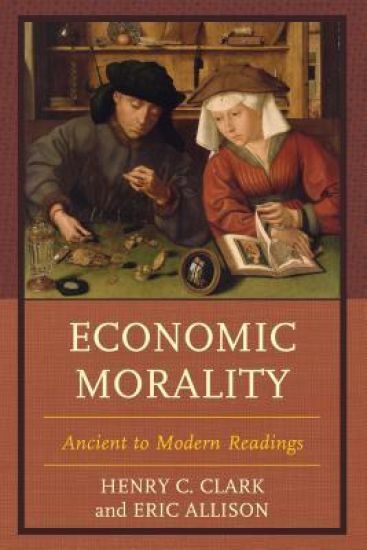
Economic Morality

Economic Morality

Henry C. Clark; Eric Allison

Lexington Books
2014
sidottu
This volume provides an integrated and wide-ranging set of primary-source readings on the relationship between moral values and economic activity, as articulated by some of the leading figures in Western civilization. From the ancient Greeks to the present, Economic Morality: Ancient to Modern Readings offers substantial coverage to each major period of history: classical Antiquity, the Middle Ages, the Renaissance and Reformation, the Enlightenment, the Industrial Revolution, and the modern era. Everything from Aristotle to Adam Smith, from Marx to Hayek, and from Proudhon to Nozick has been brought together in one comprehensive survey. The perspectives represented in our volume include those of Christians and Muslims; Protestants, Catholics, and Jews; believers and non-believers; capitalists and socialists; conservatives and libertarians. They emphasize both law and mores, as well as history, philosophy, religion, and economics. This is a genuinely interdisciplinary volume, and one that invites a catholic and humanistic conversation. In preparing this collection, the contributors aim to recover something of the range of moral opinion that first accompanied the rise of “economics” in the eighteenth-century Enlightenment. The loss of that range of opinion has left a troubling void in our academic and public discourse. Those who broadly embrace the modern economic project tend to view it pragmatically but not morally, while those who are more critical of it often end up in a moral monologue that is unsatisfying to all sides. By showing the optimistic pragmatists the rich tradition of moral criticism and the pessimistic critics the equally rich tradition of (qualified) moral approbation, this volume seeks to facilitate conversation and bring much-needed mutual comprehension to a perennial debate.
Compass of Society

Compass of Society

Henry C. Clark

Lexington Books
2006
nidottu
Compass of Society rethinks the French route to a conception of "commercial society" in the seventeenth and eighteenth centuries. Henry C. Clark finds that the development of market liberalism, far from being a narrow and abstract ideological episode, was part of a broad-gauged attempt to address a number of perceived problems generic to Europe and particular to France during this period. In the end, he offers a neo-Tocquevillian account of a topic which Tocqueville himself notoriously underemphasized, namely the emergence of elements of a modern economy in eighteenth century France and the place this development had in explaining the failure of the Old Regime and the onset of the Revolution. Compass of Society will aid in understanding the conflicted French engagement with liberalism even up to the twenty-first century.
Compass of Society

Compass of Society

Henry C. Clark

Lexington Books
2006
sidottu
Compass of Society rethinks the French route to a conception of 'commercial society' in the seventeenth and eighteenth centuries. Henry C. Clark finds that the development of market liberalism, far from being a narrow and abstract ideological episode, was part of a broad-gauged attempt to address a number of perceived problems generic to Europe and particular to France during this period. In the end, he offers a neo-Tocquevillian account of a topic which Tocqueville himself notoriously underemphasized, namely the emergence of elements of a modern economy in eighteenth century France and the place this development had in explaining the failure of the Old Regime and the onset of the Revolution. Compass of Society will aid in understanding the conflicted French engagement with liberalism even up to the twenty-first century.