Kirjojen hintavertailu. Mukana 12 390 323 kirjaa ja 12 kauppaa.

Kirjailija

Henry C. Lucas

Kirjat ja teokset yhdessä paikassa: 8 kirjaa, julkaisuja vuosilta 1981-2020, suosituimpien joukossa Beware the Winner's Curse. Vertaile teosten hintoja ja tarkista saatavuus suomalaisista kirjakaupoista.

8 kirjaa

Kirjojen julkaisuhaarukka 1981-2020.

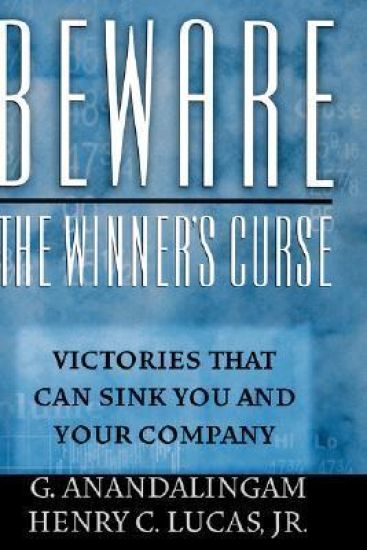
Beware the Winner's Curse

Beware the Winner's Curse

G. Anandalingam; Henry C. Lucas

Oxford University Press Inc
2004
sidottu
In the roaring 1990s, many companies seemed to claim great victories-acquiring another company, obtaining state-of-the art technology, or hiring a potential CEO savior-only to find that they had made a great mistake. The term "Winner's Curse" was coined by economists to explain an effect commonly observed in auctions. In such situations, since the winning bidder is usually the most optimistic about the value of the item being auctioned, there is a very good chance that the bid will be more (sometimes much more) than the item is worth. So a company that overvalues a good or service, or bids higher than its value has the potential of experiencing this Winner's Curse. In this book, G. Anandalingam and Henry C. Lucas, Jr. expand the model of the Winner's Curse to explain how companies like Tyco, MCI-WorldCom and Bank One overpaid for acquisitions, and how shareholders suffered as a result. They elucidate the disasters that happened during the rush to acquire new technologies and illuminate the reasons that companies that were seemingly pioneers in the dot-com era fell by the wayside. Beginning by exploring the psychological, personal and market factors that can encourage a decision maker to overvalue an asset and experience the Winner's Curse, the book goes on to examine several case studies, including the disastrous wireless spectrum auctions that have devastated the telecommunications industry, and the dot-com bust. It concludes by discussing ways to avoid the Winner's Curse, calling for major changes in the behavior of CEOs and members of boars of directors, as well as the use of powerful techniques for analyzing decisions, including a systems approach to decision making, scenario analysis and game theory.
Inside the Future

Inside the Future

Henry C. Lucas

Praeger Publishers Inc
2008
sidottu
From iPods to EZPass technology to YouTube to eGovernment initiatives, the impact of technology is changing our lives more and more each day. This book, a counterpart to a Maryland Public Television documentary, chronicles how and why and shows ways people can take advantage of the revolution in their personal and professional lives. As technology expert Henry C. Lucas, Jr., argues, the fundamentals of business and the economy—not to mention the details of daily life—are changing in every market, in every industry, and in every nation. This book explores the most significant of these technology-enabled transformations to help readers understand and appreciate the opportunities and threats presented by a new, technology-driven global economy.Among other things, Inside the Future demonstrates that: -A revolution in technology is transforming business and the way individuals live and work. -It's essential to adapt to change. Resisting technological advances is futile, and countries or people that fall behind in technology may never catch up. -The U.S. needs to prepare current and future workers for an economy that incorporates technology in every business process, an economy in which there are almost no constraints from time and place, and an economy in which most hierarchical organizations disappear. -The future competitiveness of the country depends on our ability to innovate and implement change enabled by technology. This revolution is leaving no person or organization untouched. From business to education and healthcare, the digitization and mobilization of every process affects us all. Yet this isn't a book about technology, but one that shows how people and organizations can adapt technology to transform their businesses as well as create a more productive, satisfying personal life. Readers will gain a new awareness of how leading organizations apply IT to create transformations, and how they can use technology to improve their lives, remain competitive in the workforce, and survive in this new age of constant change and re-invention.
Information Technology

Information Technology

Henry C. Lucas

John Wiley Sons Inc
2004
nidottu
Managers must be able to keep pace with the latest technological advances and make decisions on what needs to be implemented. This book gives them the tools to effectively manage technology in a 21st Century organization. The author clearly demonstrates how to best allocate resources to and within the technology function. He also includes a framework for determining IT strategy given the dynamic environment of electronic commerce and the Internet. Throughout the chapters, emphasis is placed on strategy and management issues to show the relevance of information technology.
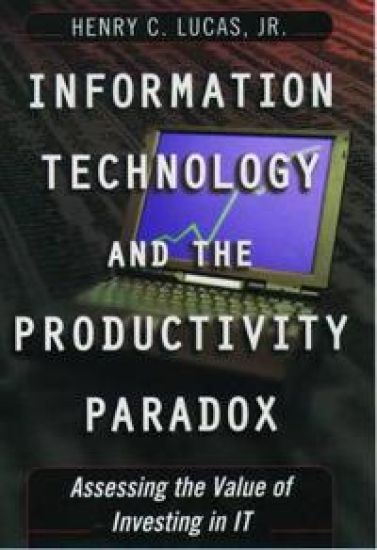
Information Technology and the Productivity Paradox

Information Technology and the Productivity Paradox

Henry C. Lucas

Oxford University Press Inc
1999
sidottu
From networks to databases, email to voicemail, the amount of capital being invested in information technology each year is staggering. By 1996, U.S. firms were spending more than $500 billion annually on software, networks and staff. The recently merged Bank of America and NationsBank have an initial IT budget of 4 billion dollars. As firms like this push rapidly into the business world of the 21st century, the question has remained: how do firms measure returns from these substantial investments in information technology? Henry C. Lucas effectively answers this question by providing a creative and reliable framework for measuring the competitive advantages and profits gained through investments in state-of-the-art information systems. There is value in information technology, and it is possible to show returns, Lucas argues--unfortunately this value just doesn't always show up clearly on the bottom line of a ledger. In five expertly presented sections, he spells out exactly what businesses can expect from their information technology investments--some investments create a measurable value, some do not, but all are important nonetheless. Through a precise mix of frameworks and models, such as an Investment Opportunities Matrix, and punctuated with real examples from successful firms, this is the first book to allow executives to see exactly how their information technology investment can be expected to return value, thereby maximizing their advantages in an age of global competitiveness. Indeed, firms who manage their information systems most efficiently are best suited to succeed in a rapidly evolving marketplace. With so much at stake, Information Technology is certain to be the essential guide for firms determined to compete and flourish in the highly competitive economy of the next century.