Kirjojen hintavertailu. Mukana 12 595 353 kirjaa ja 12 kauppaa.

Kirjailija

Henry C. Tuckwell

Kirjat ja teokset yhdessä paikassa: 7 kirjaa, julkaisuja vuosilta 1988-2019, suosituimpien joukossa Elementary Applications of Probability Theory. Vertaile teosten hintoja ja tarkista saatavuus suomalaisista kirjakaupoista.

7 kirjaa

Kirjojen julkaisuhaarukka 1988-2019.

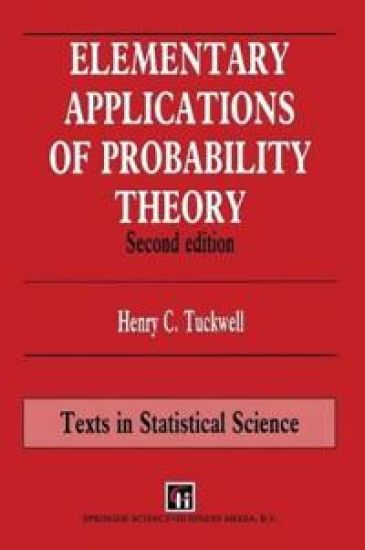
Elementary Applications of Probability Theory
This book provides a clear and straightforward introduction to applications of probability theory with examples given in the biological sciences and engineering. The first chapter contains a summary of basic probability theory. Chapters two to five deal with random variables and their applications. Topics covered include geometric probability, estimation of animal and plant populations, reliability theory and computer simulation. Chapter six contains a lucid account of the convergence of sequences of random variables, with emphasis on the central limit theorem and the weak law of numbers. The next four chapters introduce random processes, including random walks and Markov chains illustrated by examples in population genetics and population growth. This edition also includes two chapters which introduce, in a manifestly readable fashion, the topic of stochastic differential equations and their applications.
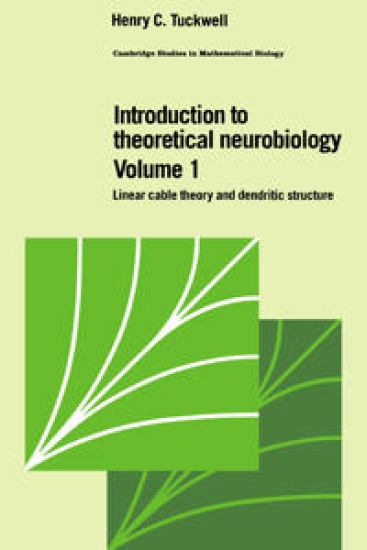
Introduction to Theoretical Neurobiology: Volume 1, Linear Cable Theory and Dendritic Structure
The human brain contains billions of nerve cells whose activity plays a critical role in the way we behave, feel, perceive, and think. This two-volume set explains the basic properties of a neuron - an electrically active nerve cell - and develops mathematical theories for the way neurons respond to the various stimuli they receive. Volume 1 contains descriptions and analyses of the principal mathematical models that have been developed for neurons in the past thirty years. It provides a brief review of the basic neuroanatomical and neurophysiological facts that will form the focus of the mathematical treatment. Tuckwell discusses the mathematical theories, beginning with the theory of membrane potentials. He then goes on to treat the Lapicque model, linear cable theory, and time-dependent solutions of the cable equations. He concludes with a description of Rall's model nerve cell. Because the level of mathematics increases steadily upward from Chapter Two, some familiarity with differential equations and linear algebra is desirable.
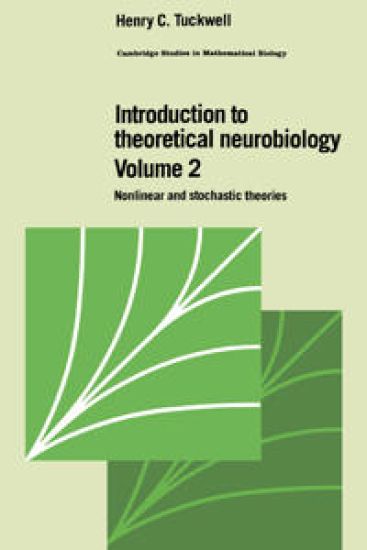
Introduction to Theoretical Neurobiology: Volume 2, Nonlinear and Stochastic Theories
The second part of this two-volume set contains advanced aspects of the quantitative theory of the dynamics of neurons. It begins with an introduction to the effects of reversal potentials on response to synaptic input. It then develops the theory of action potential generation based on the seminal Hodgkin-Huxley equations and gives methods for their solution in the space-clamped and non-space-clamped cases. The remainder of the book discusses stochastic models of neural activity and ends with a statistical analysis of neuronal data with emphasis on spike trains. The mathematics is more complex in this volume than in the first volume and involves numerical methods of solution of partial differential equations and the statistical analysis of point processes.
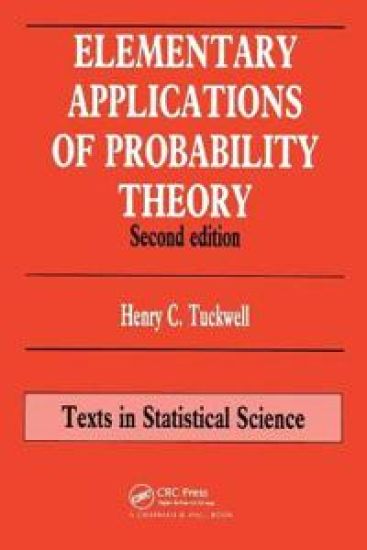
Elementary Applications of Probability Theory

Elementary Applications of Probability Theory

Henry C. Tuckwell

Chapman Hall/CRC
1995
sidottu
This book provides a clear and straightforward introduction to applications of probability theory with examples given in the biological sciences and engineering. The first chapter contains a summary of basic probability theory. Chapters two to five deal with random variables and their applications. Topics covered include geometric probability, estimation of animal and plant populations, reliability theory and computer simulation. Chapter six contains a lucid account of the convergence of sequences of random variables, with emphasis on the central limit theorem and the weak law of numbers. The next four chapters introduce random processes, including random walks and Markov chains illustrated by examples in population genetics and population growth. This edition also includes two chapters which introduce, in a manifestly readable fashion, the topic of stochastic differential equations and their applications.
Stochastic Processes in the Neurosciences

Stochastic Processes in the Neurosciences

Henry C. Tuckwell

Society for Industrial Applied Mathematics,U.S.
1989
pokkari
This monograph is centred on quantitative analysis of nerve cell behavior. The work is foundational, with many higher order problems still remaining, especially in connection with neural networks. Thoroughly addressed topics include stochastic problems in neurobiology, and the treatment of the theory of related Markov processes.
Introduction to Theoretical Neurobiology: Volume 2, Nonlinear and Stochastic Theories
The second part of this two-volume set contains advanced aspects of the quantitative theory of the dynamics of neurons. It begins with an introduction to the effects of reversal potentials on response to synaptic input. It then develops the theory of action potential generation based on the seminal Hodgkin-Huxley equations and gives methods for their solution in the space-clamped and nonspaceclamped cases. The remainder of the book discusses stochastic models of neural activity and ends with a statistical analysis of neuronal data with emphasis on spike trains. The mathematics is more complex in this volume than in the first volume and involves numerical methods of solution of partial differential equations and the statistical analysis of point processes.
Introduction to Theoretical Neurobiology: Volume 1, Linear Cable Theory and Dendritic Structure
The human brain contains billions of nerve cells whose activity plays a critical role in the way we behave, feel, perceive, and think. This two-volume set explains the basic properties of a neuron--an electrically active nerve cell--and develops mathematical theories for the way neurons respond to the various stimuli they receive. Volume 1 contains descriptions and analyses of the principle mathematical models that have been developed for neurons in the past thirty years. It provides a brief review of the basic neuroanatomical and neurophysiological facts that will form the focus of the mathematical treatment. Tuckwell discusses the mathematical theories, beginning with the theory of membrane potentials. He then goes on to treat the Lapicque model, linear cable theory, and time-dependent solutions of the cable equations. He concludes with a description of Rall's model nerve cell. Because the level of mathematics increases steadily upward from Chapter Two some familiarity with differential equations and linear algebra is desirable.