Kirjojen hintavertailu. Mukana 12 284 564 kirjaa ja 12 kauppaa.

Kirjailija

Henry H. Willis

Kirjat ja teokset yhdessä paikassa: 23 kirjaa, julkaisuja vuosilta 2004-2024, suosituimpien joukossa Improving the Security of Soft Targets and Crowded Places. Vertaile teosten hintoja ja tarkista saatavuus suomalaisista kirjakaupoista.

Mukana myös kirjoitusasut: Henry H Willis

23 kirjaa

Kirjojen julkaisuhaarukka 2004-2024.

Improving the Security of Soft Targets and Crowded Places

Improving the Security of Soft Targets and Crowded Places

John S Hollywood; Keith Gierlack; Pauline Moore; Thomas Goode; Henry H Willis; Devon Hill; Rahim Ali; Annie Brothers; Ryan Bauer; Jonathan Tran

RAND Corporation
2024
pokkari
Attacks on soft targets and crowded places are a significant challenge. The U.S. Department of Homeland Security requires research and development to assess methods for reducing the propensity and loss of life from these types of attacks. Researchers conducted a comprehensive landscape assessment of the threat and corresponding security measures in order to identify needs for improvement, and they recommended research and investment priorities.
Current and Future Exposure of Infrastructure in the United States to Natural Hazards

Current and Future Exposure of Infrastructure in the United States to Natural Hazards

Henry H. Willis; Anu Narayanan; Jordan R. Fischbach; Edmundo Molina-Perez; Chuck Stelzner; Kathleen Loa; Lauren Kendrick

RAND
2016
pokkari
Communities, companies, and governments at all levels in the United States are making decisions that will influence where, what and how infrastructure will be built. This report describes insights about exposures from natural hazards now and in the future, as well as gaps in data that, if filled, could improve the nation s ability to assess infrastructure risk and improve infrastructure resilience."
Green Warriors

Green Warriors

David E. Mosher; Beth E. Lachman; Michael D. Greenberg; Tiffany Nichols; Brian Rosen; Henry H. Willis

RAND
2008
pokkari
This study assesses whether Army policy, doctrine, and guidance adequately address environmental activities in post-conflict phases of contingencies. A review of policy, doctrine, operational experience, and documentation, as well as interviews with Army personnel, indicates that environmental concerns can have significant impacts.Recommendations are made for improving the Army's approach to environmental issues in contingency operations.It looks at the growing importance of environmental considerations for the Army in contingency operations, and recommendations for ways to better address environmental issues in Army planning, training, policy, guidance, and operations.
Estimating Terrorism Risk

Estimating Terrorism Risk

Henry H. Willis; Andrew R. Morral; Terrence K. Kelly; Jamison Jo Medby

RAND
2006
pokkari
This monograph provides a practical definition of terrorism risk, presents a method of estimating it, and demonstrates a framework for evaluating this method. Results support conclusions on how to improve risk-based resource allocation. The Department of Homeland Security is responsible for protecting the United States from terrorism. It does so partly through the Urban Areas Security Initiative, though its distribution has been criticized for not reflecting risk. This monograph offers a practical definition of terrorism risk and a method for estimating it that addresses inherent uncertainties. It also demonstrates a framework for evaluating alternative risk estimates. Finally, it makes five recommendations for improving resource allocation.
Homeland Security National Risk Characterization

Homeland Security National Risk Characterization

Henry H Willis; Mary Tighe; Andrew Lauland; Liisa Ecola; Shoshana R Shelton; Meagan L Smith; John G Rivers; Kristin J Leuschner; Terry Marsh; Daniel M Gerstein

RAND
2018
nidottu
To provide transparency into the decisionmaking process surrounding its planning processes, the U.S. Department of Homeland Security (DHS) asked RAND to develop a risk assessment methodology that can be used to identify the greatest risks to homeland security and support prioritization of DHS mission elements. The methodology is presented in this report.
Scenario Development for the 2015 Quadrennial Energy Review

Scenario Development for the 2015 Quadrennial Energy Review

Keith Crane; Debra Knopman; Nicholas Burger; Anu Narayanan; James D. Powers; Henry H. Willis

RAND
2016
pokkari
RAND researchers developed a framework and metrics for examining vulnerabilities, opportunities, and risks to U.S. transmission, storage, and distribution (TS&D) systems through 2030 under a range of uncertainties. They assessed major stresses on and opportunities in three TS&D systems: oil and refined-oil products, electric power, and natural gas. They also considered the resilience that these systems have to short-term shocks and disruptions.
Characterizing National Exposures to Infrastructure from Natural Disasters

Characterizing National Exposures to Infrastructure from Natural Disasters

Anu Narayanan; Henry H. Willis; Jordan R. Fischbach; Drake Warren; Edmundo Molina-Perez; Chuck Stelzner; Kathleen Loa; Lauren Kendrick; Paul Sorensen; Tom LaTourrette

RAND
2016
pokkari
This report serves as the technical documentation and reference document for the data, methods, and analytic approach used in the analysis of national exposures to infrastructure from natural disasters. The analysis includes 11 natural hazards and five infrastructure sectors. Analytic findings about current and future exposures of infrastructure in the United States drawn from this data analysis are documented in a separate report.
Enhancing U.S. Coast Guard Metrics

Enhancing U.S. Coast Guard Metrics

Scott Savitz; Henry H. Willis; Aaron C. Davenport; Martina Melliand; William Sasser; Elizabeth Tencza; Dulani Woods

RAND
2015
pokkari
The U.S. Coast Guard needs to measure its operational-level performance effectively. To assist this effort, the authors created logic models detailing elements of the Coast Guard s 11 missions. After identifying and assessing the validity, reliability, and feasibility of relevant existing metrics, the authors go on to propose potential metrics that could improve on or complement existing metrics, as well as a framework for applying the metrics."
The Hurricane Sandy Rebuilding Task Force's Infrastructure Resilience Guidelines

The Hurricane Sandy Rebuilding Task Force's Infrastructure Resilience Guidelines

Melissa L. Finucane; Noreen Clancy; Henry H. Willis; Debra Knopman

RAND
2015
pokkari
To ensure that federal agencies incorporate key principles of resilience into their formulation, evaluation, and prioritization of infrastructure investments related to Sandy rebuilding, the Presidential Hurricane Sandy Rebuilding Task Force developed its Infrastructure Resilience Guidelines. RAND researchers conducted an initial assessment of federal agencies implementation of the guidelines to identify the main opportunities and challenges."
Measuring Cooperative Biological Engagement Program (Cbep) Performance

Measuring Cooperative Biological Engagement Program (Cbep) Performance

Stephanie Young; Henry H. Willis; Melinda Moore; Jeffrey Engstrom

RAND
2014
pokkari
The Cooperative Biological Engagement Program partners with about 20 countries in different regions around the world and works with them to address diverse threats to international security. This report describes a project to develop a comprehensive evaluation framework and recommends metrics for assessing and communicating progress toward the program s goals."
Capabilities-Based Planning for Energy Security at Department of Defense Installations
Department of Defense (DoD) installations rely on the commercial electricity grid for 99 percent of their electricity needs, but the U.S. electricity grid is vulnerable to disruption from natural hazards and actor-induced outages, such as physical or cyber attacks. Using portfolio analysis methods for assessing capability options, this paper presents a framework to evaluate choices among energy security strategies for DoD installations.
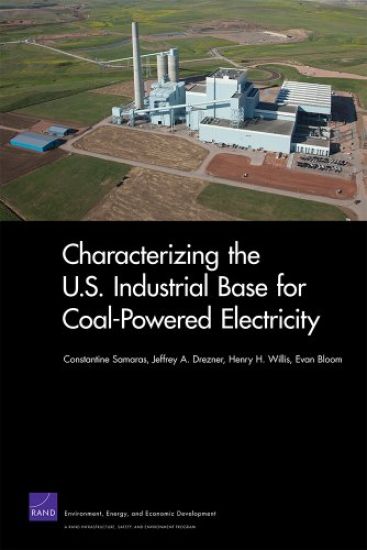
Characterizing the U.S. Industrial Base for Coal-Powered Electricity

Characterizing the U.S. Industrial Base for Coal-Powered Electricity

Constantine Samaras; Jeffrey A. Drezner; Henry H. Willis; Evan Bloom

RAND
2011
pokkari
To determine whether the industrial base for the U.S. domestic coal-based electricity generation industry can maintain the capability to design, construct, operate, and maintain coal-fired electricity generating units within reasonable cost, schedule, performance, environmental, and quality expectations, this book reviews interviews with stakeholders and data describing key elements of industry capability and validation or verification of concerns.
The State of U.S. Railroads

The State of U.S. Railroads

Brian Weatherford; Henry H. Willis; David S. Ortiz

RAND
2008
pokkari
U.S. railroads have improved their productivity, but increasing freight volume threatens performance - degrading capacity constraints. This report describes the current state of railroad capacity and performance for freight transportation. The public consequences of private investment decisions justify a public role in addressing concerns about railroads, but better data and analysis are needed to inform transportation policymaking.U.S. railroads have improved their productivity, but increasing freight volume threatens to cause performance - degrading capacity constraints. This report describes the current state of railroad capacity and performance for freight transportation.
Terrorism Risk Modeling for Intelligence Analysis and Infrastructure Protection
The Department of Homeland Security is moving increasingly to risk analysis and risk-based resource allocation, a process that is designed to manage the greatest risks instead of attempting to protect everything. The authors show how a probabilistic terrorism model can be used to assess terrorist risk across cities and within specific cities, and to assist intelligence analysis.