Kirjojen hintavertailu. Mukana 12 399 773 kirjaa ja 12 kauppaa.

Kirjailija

Henry Wai-Chung Yeung

Kirjat ja teokset yhdessä paikassa: 11 kirjaa, julkaisuja vuosilta 2002-2023, suosituimpien joukossa Entrepreneurship and the Internationalisation of Asian Firms. Vertaile teosten hintoja ja tarkista saatavuus suomalaisista kirjakaupoista.

11 kirjaa

Kirjojen julkaisuhaarukka 2002-2023.

Theory and Explanation in Geography

Theory and Explanation in Geography

Henry Wai-chung Yeung

JOHN WILEY SONS INC
2023
nidottu
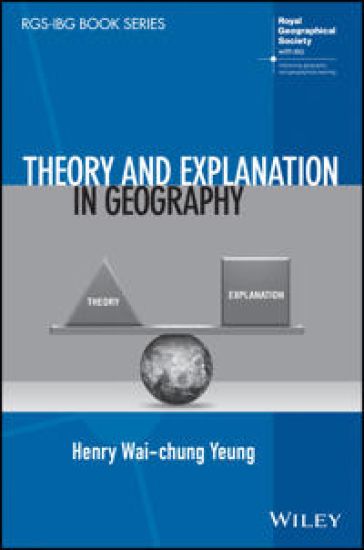
THEORY AND EXPLANATION IN GEOGRAPHY "With this book Henry Yeung puts Geography back into the driver's seat of new theory development. Foregrounding mid-range theories and mechanism-based explanations, he offers a pragmatic approach that has the capacity to shape the wider social sciences for years to come. The timing of this intervention is pitch-perfect, as scholars search for ways to understand and intervene in an increasingly distrustful and polarized world."—KATHARYNE MITCHELL, Distinguished Professor, University of California, Santa Cruz, USA "In Theory and Explanation in Geography Yeung presents us with a rare thing - an argument for geographical theory with forms of causal explanation at its heart. The book is both modest and ambitious. Modest in its insistence on mid-level theory without a call for some new “turn” or advocacy for any particular approach. Ambitious in its insistence that existing theoretical traditions are inadequate or incomplete insofar as they lack causal explanatory power. Geographers will be inspired and/or infuriated by Yeung’s arguments in this provocative and cogently argued call to theoretical arms for many years to come."—Tim Cresswell, Ogilvie Professor of Geography, University of Edinburgh, UK "Critical human geography possesses a distinctive theory culture—pluralist, creative, distributed, restless, contested—prone to “turning,” wary of orthodoxies and fixed positions. In this original and provocative contribution, the leading economic geographer Henry Yeung steps out beyond his home turf to engage styles and practices of theorizing across this diverse field, carving out a new remit and rubric for middle-range theorizing."—JAMIE PECK, Canadian Research Chair and Distinguished University Scholar, University of British Columbia, Canada Grounded in a generous reading of a multitude of critical approaches in human geography and their diverse conceptions of theory, Theory and Explanation in Geography draws upon cutting-edge debates on the mechanism-based approach to theory and explanation in analytical sociology, political science, and the philosophy of social sciences to inform current and future geographical thinking on theory. This consolidated conceptual work represents an extension and much further development of the author's well-cited works on relational geography, critical realism and causal explanation, process-based methodology, globalization and the theory of global production networks, and "theorizing back" and situated knowledges that were published in leading journals in Geography. The work has several chapters that identify new directions for Geography’s current and future engagement with the wider social sciences and relevant research agendas in geographical thought. Its main chapters provide the necessary conceptual toolkits for mobilizing such an expanding research program in the 2020s and beyond. Compared to typical texts on geographical thought, this book is less retrospective and historical and more prospective in nature. Detailing why and how mid-range explanatory theories can be better developed through causal mechanisms and relational thinking that have been revitalized in the social sciences, Theory and Explanation in Geography is an essential read for academics, geographers, and scholars seeking unique perspective on an important facet of the field.
Theory and Explanation in Geography

Theory and Explanation in Geography

Henry Wai-chung Yeung

JOHN WILEY SONS INC
2023
sidottu
THEORY AND EXPLANATION IN GEOGRAPHY "With this book Henry Yeung puts Geography back into the driver's seat of new theory development. Foregrounding mid-range theories and mechanism-based explanations, he offers a pragmatic approach that has the capacity to shape the wider social sciences for years to come. The timing of this intervention is pitch-perfect, as scholars search for ways to understand and intervene in an increasingly distrustful and polarized world."—KATHARYNE MITCHELL, Distinguished Professor, University of California, Santa Cruz, USA "In Theory and Explanation in Geography Yeung presents us with a rare thing - an argument for geographical theory with forms of causal explanation at its heart. The book is both modest and ambitious. Modest in its insistence on mid-level theory without a call for some new “turn” or advocacy for any particular approach. Ambitious in its insistence that existing theoretical traditions are inadequate or incomplete insofar as they lack causal explanatory power. Geographers will be inspired and/or infuriated by Yeung’s arguments in this provocative and cogently argued call to theoretical arms for many years to come."—Tim Cresswell, Ogilvie Professor of Geography, University of Edinburgh, UK "Critical human geography possesses a distinctive theory culture—pluralist, creative, distributed, restless, contested—prone to “turning,” wary of orthodoxies and fixed positions. In this original and provocative contribution, the leading economic geographer Henry Yeung steps out beyond his home turf to engage styles and practices of theorizing across this diverse field, carving out a new remit and rubric for middle-range theorizing."—JAMIE PECK, Canadian Research Chair and Distinguished University Scholar, University of British Columbia, Canada Grounded in a generous reading of a multitude of critical approaches in human geography and their diverse conceptions of theory, Theory and Explanation in Geography draws upon cutting-edge debates on the mechanism-based approach to theory and explanation in analytical sociology, political science, and the philosophy of social sciences to inform current and future geographical thinking on theory. This consolidated conceptual work represents an extension and much further development of the author's well-cited works on relational geography, critical realism and causal explanation, process-based methodology, globalization and the theory of global production networks, and "theorizing back" and situated knowledges that were published in leading journals in Geography. The work has several chapters that identify new directions for Geography’s current and future engagement with the wider social sciences and relevant research agendas in geographical thought. Its main chapters provide the necessary conceptual toolkits for mobilizing such an expanding research program in the 2020s and beyond. Compared to typical texts on geographical thought, this book is less retrospective and historical and more prospective in nature. Detailing why and how mid-range explanatory theories can be better developed through causal mechanisms and relational thinking that have been revitalized in the social sciences, Theory and Explanation in Geography is an essential read for academics, geographers, and scholars seeking unique perspective on an important facet of the field.
Interconnected Worlds

Interconnected Worlds

Henry Wai-Chung Yeung

STANFORD UNIVERSITY PRESS
2022
pokkari
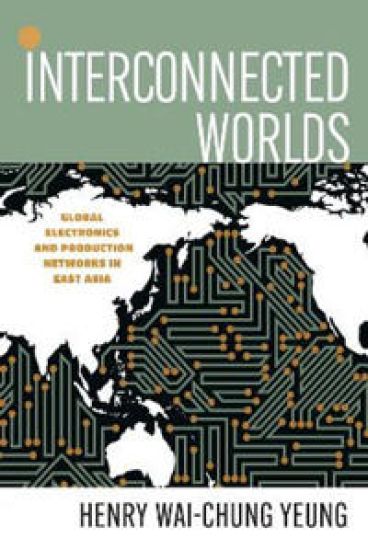
The global electronics industry is one of the most innovation-driven and technology-intensive sectors in the contemporary world economy. From semiconductors to end products, complex transnational production and value-generating activities have integrated diverse macro-regions and national economies worldwide into the "interconnected worlds" of global electronics. This book argues that the current era of interconnected worlds started in the early 1990s when electronics production moved from systems dominated by lead firms in the United States, Western Europe, and Japan towards increasingly globalized and cross-macro-regional electronics manufacturing centered in East Asia. By the 2010s, this co-evolution of production network complexity transformed global electronics, through which lead firms from South Korea, Taiwan, and China integrated East Asia into the interconnected worlds of electronics production across the globe. Drawing on literature on the electronics industry, new empirical material comprising custom datasets, and extensive personal interviews, this book examines through a "network" approach the co-evolution of globalized electronics production centered in East Asia across different national economies and sub-national regions. With comprehensive analysis up to 2021, Yeung analyzes the geographical configurations ("where"), organizational strategies ("how"), and causal drivers ("why") of global production networks, setting a definitive benchmark into the dynamic transformations in global electronics and other globalized industries. The book will serve as a crucial resource for academic and policy research, offering a conceptual, empirically driven grounding in the theory of these networks that has become highly influential across the social sciences.
Interconnected Worlds

Interconnected Worlds

Henry Wai-Chung Yeung

STANFORD UNIVERSITY PRESS
2022
sidottu
The global electronics industry is one of the most innovation-driven and technology-intensive sectors in the contemporary world economy. From semiconductors to end products, complex transnational production and value-generating activities have integrated diverse macro-regions and national economies worldwide into the "interconnected worlds" of global electronics. This book argues that the current era of interconnected worlds started in the early 1990s when electronics production moved from systems dominated by lead firms in the United States, Western Europe, and Japan towards increasingly globalized and cross-macro-regional electronics manufacturing centered in East Asia. By the 2010s, this co-evolution of production network complexity transformed global electronics, through which lead firms from South Korea, Taiwan, and China integrated East Asia into the interconnected worlds of electronics production across the globe. Drawing on literature on the electronics industry, new empirical material comprising custom datasets, and extensive personal interviews, this book examines through a "network" approach the co-evolution of globalized electronics production centered in East Asia across different national economies and sub-national regions. With comprehensive analysis up to 2021, Yeung analyzes the geographical configurations ("where"), organizational strategies ("how"), and causal drivers ("why") of global production networks, setting a definitive benchmark into the dynamic transformations in global electronics and other globalized industries. The book will serve as a crucial resource for academic and policy research, offering a conceptual, empirically driven grounding in the theory of these networks that has become highly influential across the social sciences.
Strategic Coupling

Strategic Coupling

Henry Wai-chung Yeung

Cornell University Press
2016
pokkari
In Strategic Coupling, Henry Wai-chung Yeung examines economic development and state-firm relations in East Asia, focusing in particular on South Korea, Taiwan, and Singapore. As a result of the massive changes of the last twenty-five years, new explanations must be found for the economic success and industrial transformation in the region. State-assisted startups and incubator firms in East Asia have become major players in the manufacture of products with a global reach: Taiwan's Hon Hai Precision has assembled more than 500 million iPhones, for instance, and South Korea's Samsung provides the iPhone's semiconductor chips and retina displays. Drawing on extensive interviews with top executives and senior government officials, Yeung argues that since the late 1980s, many East Asian firms have outgrown their home states, and are no longer dependent on state support; as a result the developmental state has lost much of its capacity to steer and direct industrialization. We cannot read the performance of national firms as a direct outcome of state action. Yeung calls for a thorough renovation of the still-dominant view that states are the primary engine of industrial transformation. He stresses action by national firms and traces various global production networks to incorporate both firm-specific activities and the international political economy. He identifies two sets of dynamics in these national-global articulations known as strategic coupling: coevolution in the confluence of state, firm, and global production networks, and the various strategies pursued by East Asian firms to attain competitive positions in the global marketplace.
Strategic Coupling

Strategic Coupling

Henry Wai-chung Yeung

Cornell University Press
2016
sidottu
In Strategic Coupling, Henry Wai-chung Yeung examines economic development and state-firm relations in East Asia, focusing in particular on South Korea, Taiwan, and Singapore. As a result of the massive changes of the last twenty-five years, new explanations must be found for the economic success and industrial transformation in the region. State-assisted startups and incubator firms in East Asia have become major players in the manufacture of products with a global reach: Taiwan's Hon Hai Precision has assembled more than 500 million iPhones, for instance, and South Korea's Samsung provides the iPhone's semiconductor chips and retina displays. Drawing on extensive interviews with top executives and senior government officials, Yeung argues that since the late 1980s, many East Asian firms have outgrown their home states, and are no longer dependent on state support; as a result the developmental state has lost much of its capacity to steer and direct industrialization. We cannot read the performance of national firms as a direct outcome of state action. Yeung calls for a thorough renovation of the still-dominant view that states are the primary engine of industrial transformation. He stresses action by national firms and traces various global production networks to incorporate both firm-specific activities and the international political economy. He identifies two sets of dynamics in these national-global articulations known as strategic coupling: coevolution in the confluence of state, firm, and global production networks, and the various strategies pursued by East Asian firms to attain competitive positions in the global marketplace.
Global Production Networks

Global Production Networks

Neil M. Coe; Henry Wai-chung Yeung

Oxford University Press
2015
nidottu
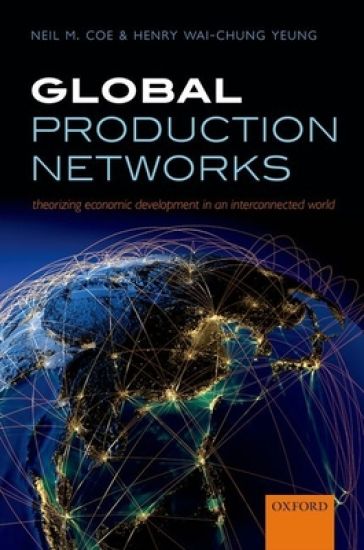
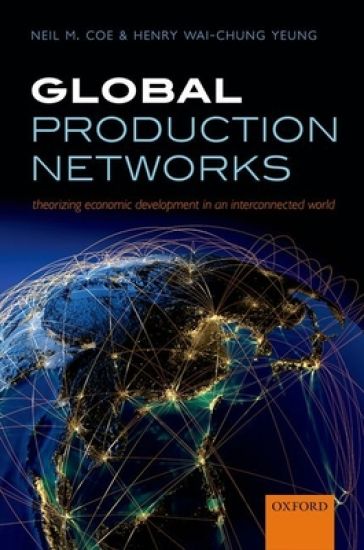
Accelerating processes of economic globalization have fundamentally reshaped the organization of the global economy towards much greater integration and functional interdependence through cross-border economic activity. In this interconnected world system, a new form of economic organization has emerged: Global Production Networks (GPNs). This brings together a wide array of economic actors, most notably capitalist firms, state institutions, labour unions, consumers and non-government organizations, in the transnational production of economic value. National and sub-national economic development in this highly interdependent global economy can no longer be conceived of, and understood within, the distinct territorial boundaries of individual countries and regions. Instead, global production networks are organizational platforms through which actors in these different national or regional economies compete and cooperate for a larger share of the creation, transformation, and capture of value through transnational economic activity. They are also vehicles for transferring the value captured between different places. This book ultimately aims to develop a theory of global production networks that explains economic development in the interconnected global economy. While primarily theoretical in nature, it is well grounded in cutting-edge empirical work in the parallel and highly impactful strands of social science literature on the changing organization of the global economy relating to global commodity chains (GCC), global value chains (GVC), and global production networks (GPN).
Global Production Networks

Global Production Networks

Neil M. Coe; Henry Wai-chung Yeung

Oxford University Press
2015
sidottu
Accelerating processes of economic globalization have fundamentally reshaped the organization of the global economy towards much greater integration and functional interdependence through cross-border economic activity. In this interconnected world system, a new form of economic organization has emerged: Global Production Networks (GPNs). This brings together a wide array of economic actors, most notably capitalist firms, state institutions, labour unions, consumers and non-government organizations, in the transnational production of economic value. National and sub-national economic development in this highly interdependent global economy can no longer be conceived of, and understood within, the distinct territorial boundaries of individual countries and regions. Instead, global production networks are organizational platforms through which actors in these different national or regional economies compete and cooperate for a larger share of the creation, transformation, and capture of value through transnational economic activity. They are also vehicles for transferring the value captured between different places. This book ultimately aims to develop a theory of global production networks that explains economic development in the interconnected global economy. While primarily theoretical in nature, it is well grounded in cutting-edge empirical work in the parallel and highly impactful strands of social science literature on the changing organization of the global economy relating to global commodity chains (GCC), global value chains (GVC), and global production networks (GPN).
Chinese Capitalism in a Global Era

Chinese Capitalism in a Global Era

Henry Wai-Chung Yeung

Routledge
2006
nidottu
Chinese Capitalism in a Global Era examines the dynamic ways in which millions of ethinic Chinese in East and Southeast Asian economies organize their economic activities. It analyses how Chinese capitalism has changed under conditions of contemporary globalization and anticipates what the future holds for it. The book challenges the conventional notion of Chinese cpitalism as 'crony capitalism', based around kinship networks and untouched by globalization.
Chinese Capitalism in a Global Era

Chinese Capitalism in a Global Era

Henry Wai-Chung Yeung

Routledge
2003
sidottu
Chinese Capitalism in a Global Era examines the dynamic ways in which millions of ethinic Chinese in East and Southeast Asian economies organize their economic activities. It analyses how Chinese capitalism has changed under conditions of contemporary globalization and anticipates what the future holds for it. The book challenges the conventional notion of Chinese cpitalism as 'crony capitalism', based around kinship networks and untouched by globalization.
Entrepreneurship and the Internationalisation of Asian Firms

Entrepreneurship and the Internationalisation of Asian Firms

Henry Wai-Chung Yeung

Edward Elgar Publishing Ltd
2002
sidottu
Entrepreneurs engaging in international business face business environments that are fundamentally different from their home countries. Despite decades of entrepreneurship research, we know little about these entrepreneurs and their strategic behaviour in establishing and managing transnational operations.This book applies an institutional perspective on transnational entrepreneurship to empirical investigations of transnational corporations (TNCs) from Hong Kong and Singapore. Henry Wai-chung Yeung argues that significant variations in institutional structures of home countries explain variations in the entrepreneurial endowments of prospective transnational business networks. This is illustrated by empirical data from two in-depth studies of over 300 TNCs from Hong Kong and Singapore and over 120 of their foreign affiliates in Asia.Entrepreneurship and the Internationalisation of Asian Firms is a timely contribution to theoretical and empirical studies in international business and will be widely read by those interested in international business, industrial economics, organisation studies, political economy, regional studies and economic geography.