Kirjojen hintavertailu. Mukana 12 510 285 kirjaa ja 12 kauppaa.

Kirjailija

Herbert A. Simon

Kirjat ja teokset yhdessä paikassa: 20 kirjaa, julkaisuja vuosilta 1963-2023, suosituimpien joukossa Economics, Bounded Rationality and the Cognitive Revolution. Vertaile teosten hintoja ja tarkista saatavuus suomalaisista kirjakaupoista.

Mukana myös kirjoitusasut: Herbert A Simon

20 kirjaa

Kirjojen julkaisuhaarukka 1963-2023.

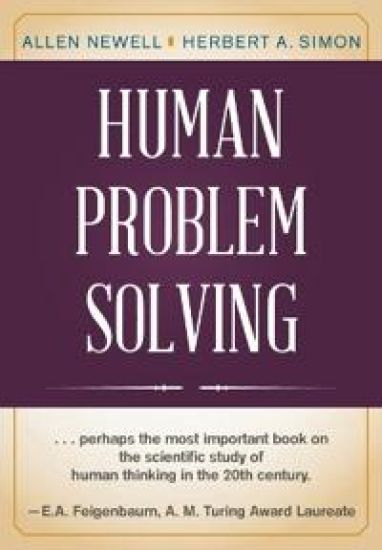
Human Problem Solving

Human Problem Solving

Allen Newell; Herbert A Simon

Echo Point Books Media, LLC
2023
pokkari
The Classic Study of Cognition by Two Pioneers of Artificial Intelligence First published in 1972, this monumental work develops and defends the authors' information processing theory of human reasoning. Human reasoners, they argue, can be modeled as symbolic "information processing systems" (IPSs), abstracted entirely from physiological bases. Modeling subjects with IPSs yields predictive theories of their problem-solving behavior and performance, and psychological insight into their heuristics and methods.Newell and Simon's previous epoch-making collaborations included the General Problem Solver, the Logic Theorist, and the Information Processing Language. This book is a careful application of those ideas from artificial intelligence - the ideas of AI's first golden age - to cognitive psychology. The authors first develop the formal theory of information processing systems. They then report studies of three symbolic reasoning tasks, and analyze that data using the information processing paradigm. In the final section, they state their comprehensive theory of human problem-solving. The success of the models of cognition given in Human Problem Solving was a major piece of evidence for the physical symbol system hypothesis, which Newell and Simon would first state a few years later. Newell went on to co-develop the Soar cognitive architecture, and Simon to receive the Nobel Prize in Economics. The two jointly received the Turing Award in 1975 for the research program of which Human Problem Solving was the culmination.This book is also available from Echo Point Books as a hardcover (ISBN 1635617928).

The Sciences of the Artificial

The Sciences of the Artificial

Herbert A. Simon

MIT Press
2019
pokkari
Herbert Simon's classic work on artificial intelligence in the expanded and updated third edition from 1996, with a new introduction by John E. Laird.Herbert Simon's classic and influential The Sciences of the Artificial declares definitively that there can be a science not only of natural phenomena but also of what is artificial. Exploring the commonalities of artificial systems, including economic systems, the business firm, artificial intelligence, complex engineering projects, and social plans, Simon argues that designed systems are a valid field of study, and he proposes a science of design. For this third edition, originally published in 1996, Simon added new material that takes into account advances in cognitive psychology and the science of design while confirming and extending the book's basic thesis: that a physical symbol system has the necessary and sufficient means for intelligent action.Simon won the Nobel Prize for Economics in 1978 for his research into the decision-making process within economic organizations and the Turing Award (considered by some the computer science equivalent to the Nobel) with Allen Newell in 1975 for contributions to artificial intelligence, the psychology of human cognition, and list processing. The Sciences of the Artificial distills the essence of Simon's thought accessibly and coherently. This reissue of the third edition makes a pioneering work available to a new audience.
Human Problem Solving

Human Problem Solving

Allen Newell; Herbert A Simon

Echo Point Books Media
2019
sidottu
First published in 1972, this monumental work develops and defends the authors' information processing theory of human reasoning. Human reasoners, they argue, can be modeled as symbolic "information processing systems" (IPSs), abstracted entirely from physiological bases. Modeling subjects with IPSs yields predictive theories of their problem-solving behavior and performance, and psychological insight into their heuristics and methods. Newell and Simon's previous epoch-making collaborations included the General Problem Solver, the Logic Theorist, and the Information Processing Language. This book is a careful application of those ideas from artificial intelligence - the ideas of AI's first golden age - to cognitive psychology. The authors first develop the formal theory of information processing systems. They then report studies of three symbolic reasoning tasks, and analyze that data using the information processing paradigm. In the final section, they state their comprehensive theory of human problem-solving. The success of the models of cognition given in this work was a major piece of evidence for the physical symbol system hypothesis, which Newell and Simon would first state a few years later. Newell went on to co-develop the Soar cognitive architecture, and Simon to receive the Nobel Prize in Economics. The two jointly received the Turing Award in 1975 for the research program of which Human Problem Solving was the culmination.
Public Administration

Public Administration

Herbert A. Simon

Routledge
2017
sidottu
At the time of its initial publication, Public Administration helped to define this field of study and practice by introducing two major new emphases: an orientation toward human behavior and human relations in organizations, and an emphasis on the interaction between administration, politics, and policy. Without neglecting more traditional concerns with organization structure, Simon, Thompson, and Smithburg viewed administration in its behavioral and political contexts. The viewpoints they express still are at the center of public administration's concerns.
Research Frontiers in Politics and Government: Brookings Lectures, 1955

Research Frontiers in Politics and Government: Brookings Lectures, 1955

Stephen Kemp Bailey; Herbert A. Simon; Robert A. Dahl

Literary Licensing, LLC
2012
sidottu
Research Frontiers in Politics and Government: Brookings Lectures, 1955 is a book written by Stephen Kemp Bailey. The book is a collection of lectures that were delivered at the Brookings Institution in 1955. The lectures cover a wide range of topics related to politics and government, including the role of the judiciary in American politics, the relationship between the executive and legislative branches of government, and the impact of public opinion on policy-making. The book provides a comprehensive overview of the key issues and debates in American politics and government during the mid-20th century. It is a valuable resource for students, scholars, and anyone interested in understanding the complexities of American politics and government.Additional Authors Richard C. Snyder, Alfred De Grazia, Malcolm Moos, Paul T. David, David B. Truman. Foreword By Robert D. Calkins.This scarce antiquarian book is a facsimile reprint of the old original and may contain some imperfections such as library marks and notations. Because we believe this work is culturally important, we have made it available as part of our commitment for protecting, preserving, and promoting the world's literature in affordable, high quality, modern editions, that are true to their original work.
Modularity

Modularity

Herbert A. Simon

MIT Press
2009
pokkari
Experts from diverse fields, including artificial life, cognitive science, economics, developmental and evolutionary biology, and the arts, discuss modularity.Modularity-the attempt to understand systems as integrations of partially independent and interacting units-is today a dominant theme in the life sciences, cognitive science, and computer science. The concept goes back at least implicitly to the Scientific (or Copernican) Revolution, and can be found behind later theories of phrenology, physiology, and genetics; moreover, art, engineering, and mathematics rely on modular design principles. This collection broadens the scientific discussion of modularity by bringing together experts from a variety of disciplines, including artificial life, cognitive science, economics, evolutionary computation, developmental and evolutionary biology, linguistics, mathematics, morphology, paleontology, physics, theoretical chemistry, philosophy, and the arts.The contributors debate and compare the uses of modularity, discussing the different disciplinary contexts of "modular thinking" in general (including hierarchical organization, near-decomposability, quasi-independence, and recursion) or of more specialized concepts (including character complex, gene family, encapsulation, and mosaic evolution); what modules are, why and how they develop and evolve, and the implication for the research agenda in the disciplines involved; and how to bring about useful cross-disciplinary knowledge transfer on the topic. The book includes a foreword by the late Herbert A. Simon addressing the role of near-decomposability in understanding complex systems.
Economics, Bounded Rationality and the Cognitive Revolution

Economics, Bounded Rationality and the Cognitive Revolution

Herbert A. Simon; Massimo Egidi; Ricardo Viale; Robin Marris

Edward Elgar Publishing Ltd
2008
nidottu
The purpose of this book is to publish the ideas of the late Herbert Simon and sympathetic economists, on the subject of bounded rationality, economics, cognitive science and related disciplines, and to reprint some of Professor Simon’s classic papers which have appeared in journals not widely read by economists. Not only on account of his Nobel Prize in Economics, but also because of the widespread applications of his ideas and theories, it is especially valuable to readers to have a book of this kind at the present time. Currently in this whole field, there is increasing emphasis on computer-related theory building. Herbert Simon, beginning from the time when microcomputers did not exist, was a pioneer of this approach. The book begins with an edited transcript of a colloquium, held between Herbert Simon and a group of Italian economists in Italy in 1988. It continues with the reprinted Simon papers and papers by three scholars, Raymond Boudon, Massimo Egidi and Riccardo Viale coming from different disciplines but holding a common interest in bounded rationality and ends with a response by a sympathetic economist, Robin Marris.
The New Professor's Handbook

The New Professor's Handbook

Cliff I. Davidson; Susan A. Ambrose; Herbert A. Simon

Anker Publishing Co
2007
nidottu
This book is an ideal resource for those making the transition from graduate student to new faculty member in engineering and science. Developed through years of use with new faculty, it tackles the two themes that will be constant in a young faculty member’s career: teaching and research. The book first distills the abundant literature that has already been published on teaching, covering student learning and course planning, conducting discussions and lecturing, creating exams and assignments, and working with teaching assistants. Bringing together guidance gained from numerous seminars, discussions, and interviews, and the little existing in current literature on starting and conducting scientific research, the next section includes assembling research teams, supervising graduate research, getting research funding, writing research papers, reviewing research proposals, presenting results, and conducting graduate seminar programs. The book features practical chapter exercises that apply concepts, and it concludes with an extensive bibliography. It will be of help to any faculty member embarking on a teaching and research career in higher education in the sciences.
Administrative Behavior, 4th Edition

Administrative Behavior, 4th Edition

Herbert A. Simon

The Free Press
1997
pokkari
In this fourth edition of his ground-breaking work, Herbert A. Simon applies his pioneering theory of human choice and administrative decision-making to concrete organizational problems. To commemorate the fiftieth anniversary of the book's original publication, Professor Simon enhances his timeless observations on the human decision-making process with commentaries examining new facets of organizational behavior. Investigating the impact of changing social values and modem technology on the operation of organizations, the new ideas featured in this revised edition update a book that has become a worldwide classic. Named by Public Administration Review as "Book of the Half Century," Administrative Behavior is considered one of the most influential books on social science thinking, and was referred to by the Nobel Committee as "epoch-making." Written for managers and other professionals who wish to understand the decision-making processes at the heart of organization and management, it is also essential reading for students in business and management, economics, sociology, psychology computer science, government, and law.
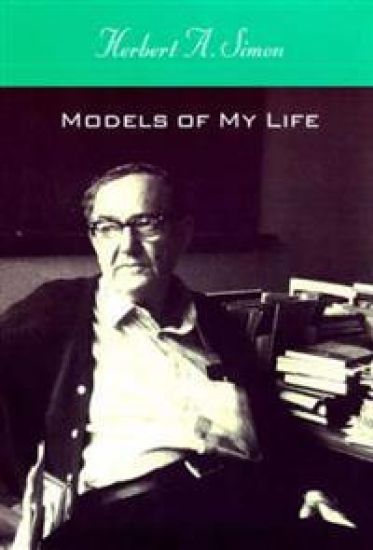
Models of My Life

Models of My Life

Herbert A. Simon

MIT Press
1996
pokkari
In this candid and witty autobiography, Nobel laureate Herbert A. Simon looks at his distinguished and varied career, continually asking himself whether (and how) what he learned as a scientist helps to explain other aspects of his life.A brilliant polymath in an age of increasing specialization, Simon is one of those rare scholars whose work defines fields of inquiry. Crossing disciplinary lines in half a dozen fields, Simon's story encompasses an explosion in the information sciences, the transformation of psychology by the information-processing paradigm, and the use of computer simulation for modeling the behavior of highly complex systems.Simon's theory of bounded rationality led to a Nobel Prize in economics, and his work on building machines that think-based on the notion that human intelligence is the rule-governed manipulation of symbols-laid conceptual foundations for the new cognitive science. Subsequently, contrasting metaphors of the maze (Simon's view) and of the mind (neural nets) have dominated the artificial intelligence debate.There is also a warm account of his successful marriage and of an unconsummated love affair, letters to his children, columns, a short story, and political and personal intrigue in academe.
Organizations

Organizations

James G. March; Herbert A. Simon

Blackwell Publishers
1993
nidottu
Everything you ever wanted to know about growing grapes March and Simon's Organizations has become a classic in the field of organizational management for its broad scope and depth of information. Written by two of the most prominent experts in the field, this book offers invaluable insight on all aspects of organizational culture through deep discussion of organization theory. The definitive reference for topics including bounded rationality, satisficing, inducement/contribution balances, attention focus, uncertainty absorption and more, this seminal text offers authoritative insight with a practical grounding in the field.
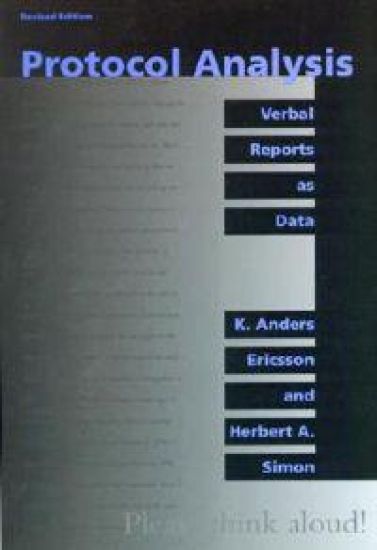
Protocol Analysis

Protocol Analysis

K. Anders Ericsson; Herbert A. Simon

Bradford Books
1993
pokkari
Since the publication of Ericsson and Simon's ground-breaking work in the early 1980s, verbal data has been used increasingly to study cognitive processes in many areas of psychology, and concurrent and retrospective verbal reports are now generally accepted as important sources of data on subjects' cognitive processes in specific tasks. In this revised edition of the book that first put protocol analysis on firm theoretical ground, the authors review major advances in verbal reports over the past decade, including new evidence on how giving verbal reports affects subjects' cognitive processes, and on the validity and completeness of such reports.In a substantial new preface Ericsson and Simon summarize the central issues covered in the book and provide an updated version of their information-processing model, which explains verbalization and verbal reports. They describe new studies on the effects of verbalization, interpreting the results of these studies and showing how their theory can be extended to account for them. Next, they address the issue of completeness of verbally reported information, reviewing the new evidence in three particularly active task domains. They conclude by citing recent contributions to the techniques for encoding protocols, raising general issues, and proposing directions for future research.All references and indexes have been updated.
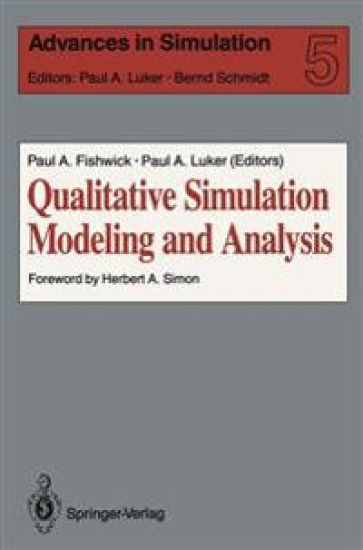
Qualitative Simulation Modeling and Analysis

Qualitative Simulation Modeling and Analysis

Herbert A. Simon

Springer-Verlag New York Inc.
1991
nidottu
Recently there has been considerable interest in qualitative methods in simulation and mathematical model- ing. Qualitative Simulation Modeling and Analysis is the first book to thoroughly review fundamental concepts in the field of qualitative simulation. The book will appeal to readers in a variety of disciplines including researchers in simulation methodology, artificial intelligence and engineering. This book boldly attempts to bring together, for the first time, the qualitative techniques previously found only in hard-to-find journals dedicated to single disciplines. The book is written for scientists and engineers interested in improving their knowledge of simulation modeling. The "qualitative" nature of the book stresses concepts of invariance, uncertainty and graph-theoretic bases for modeling and analysis.
Public Administration

Public Administration

Herbert A. Simon

Transaction Publishers
1991
nidottu
At the time of its initial publication, Public Administration helped to define this field of study and practice by introducing two major new emphases: an orientation toward human behavior and human relations in organizations, and an emphasis on the interaction between administration, politics, and policy. Without neglecting more traditional concerns with organization structure, Simon, Thompson, and Smithburg viewed administration in its behavioral and political contexts. The viewpoints they express still are at the center of public administration's concerns.
Reason in Human Affairs

Reason in Human Affairs

Herbert A. Simon

Stanford University Press
1990
pokkari
What can reason (or more broadly, thinking) do for us and what can't it do? This is the question examined by Herbert A. Simon, who received the 1978 Nobel Prize in Economic Sciences "for his pioneering work on decision-making processes in economic organizations." The ability to apply reason to the choice of actions is supposed to be one of the defining characteristics of our species. In the first two chapters, the author explores the nature and limits of human reason, comparing and evaluating the major theoretical frameworks that have been erected to explain reasoning processes. He also discusses the interaction of thinking and emotion in the choice of our actions. In the third and final chapter, the author applies the theory of bounded rationality to social institutions and human behavior, and points out the problems created by limited attention span human inability to deal with more than one difficult problem at a time. He concludes that we must recognize the limitations on our capabilities for rational choice and pursue goals that, in their tentativeness and flexibility, are compatible with those limits.
Models of Bounded Rationality

Models of Bounded Rationality

Herbert A. Simon

MIT Press
1984
pokkari
The Nobel Prize in Economics was awarded to Herbert Simon in 1978. At Carnegie-Mellon University he holds the title of Professor of Computer Science and Psychology. These two facts together delineate the range and uniqueness of his contributions in creating meaningful interactions among fields that developed in isolation but that are all concerned with human decision-making and problem-solving processes. In particular, Simon has brought the insights of decision theory, organization theory (especially as it applies to the business firm), behavior modeling, cognitive psychology, and the study of artificial intelligence to bear on economic questions. This has led not only to new conceptual dimensions for theoretical constructions, but also to a new humanizing realism in economics, a way of taking into account and dealing with human behavior and interactions that lie at the root of all economic activity.The sixty papers and essays contained in these two volumes are grouped under eight sections, each with a brief introductory essay. These are: Some Questions of Public Policy, Dynamic Programming Under Uncertainty; Technological Change; The Structure of Economic Systems; The Business Firm as an Organization; The Economics of Information Processing; Economics and Psychology; and Substantive and Procedural Reality. Most of Simon's papers on classical and neoclassical economic theory are contained in volume one. The second volume collects his papers on behavioral theory, with some overlap between the two volumes. The second edition of Simon's widely read and referenced The Sciences of the Artificial was published by The MIT Press 1981 and is available in both hardcover and paperback.
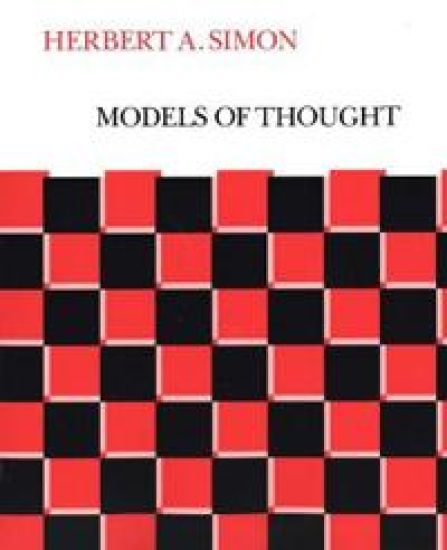
Models of Thought

Models of Thought

Herbert A. Simon

Yale University Press
1980
pokkari
Nobel Laureate Herbert A. Simon has in the past quarter century been in the front line of the information-processing revolution; in fact, to a remarkable extent his and his colleagues’ contributions have written the history of that revolution in cognitive psychology. Research in this burgeoning new branch of knowledge seeks to describe with precision the workings of the human mind in terms of a small number of basic mechanisms organized into strategies. Newly developed computer languages express theories of mental processes, so that computers can then simulate the predicted human behavior.This book brings together papers dating from the start of Simon’s career to the present. Its focus is on modeling the chief components of human cognition and on testing these models experimentally. After considering basic structural elements of the human information-processing system (especially search, selective attention, and storage in memory), Simon builds from these components a system capable of solving problems, inducing rules and concepts, perceiving, and understanding.These essays describe a relatively austere, simple, and unified processing system capable of highly complex and various tasks. They provide strong evidence for an explanation of human thinking in terms of basic information processes.
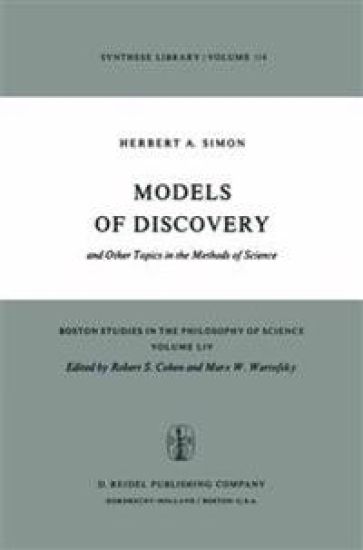
Models of Discovery

Models of Discovery

Herbert A. Simon

Kluwer Academic Publishers
1979
nidottu
We respect Herbert A. Simon as an established leader of empirical and logical analysis in the human sciences while we happily think of him as also the loner; of course he works with many colleagues but none can match him. He has been writing fruitfully and steadily for four decades in many fields, among them psychology, logic, decision theory, economics, computer science, management, production engineering, information and control theory, operations research, confirmation theory, and we must have omitted several. With all of them, he is at once the technical scientist and the philosophical critic and analyst. When writing of decisions and actions, he is at the interface of philosophy of science, decision theory, philosophy of the specific social sciences, and inventory theory (itself, for him, at the interface of economic theory, production engineering and information theory). When writing on causality, he is at the interface of methodology, metaphysics, logic and philosophy of physics, systems theory, and so on. Not that the interdisciplinary is his orthodoxy; we are delighted that he has chosen to include in this book both his early and little-appreciated treatment of straightforward philosophy of physics - the axioms of Newtonian mechanics, and also his fine papers on pure confirmation theory.
Essays on the Structure of Social Science Models

Essays on the Structure of Social Science Models

Albert Ando; Franklin M. Fisher; Herbert A. Simon

MIT Press
1963
pokkari
A set of related papers dealing with the meaning of causality in simulataneous dynamic equation systems. Investigation of the systems which only approximately satisfy the conditions enabling the definition of causality, leads to a set of limiting theorems concerning the dynamic behavior of such systems over time, and estimation procedures for the parameters of such systems. Implications of these theorems for some well-known propositions in economics and other social sciences are considered.