Kirjojen hintavertailu. Mukana 12 595 353 kirjaa ja 12 kauppaa.

Kirjailija

Herbert Marcuse

Kirjat ja teokset yhdessä paikassa: 43 kirjaa, julkaisuja vuosilta 1971-2025, suosituimpien joukossa Kapitalismus und Opposition. Vertaile teosten hintoja ja tarkista saatavuus suomalaisista kirjakaupoista.

43 kirjaa

Kirjojen julkaisuhaarukka 1971-2025.

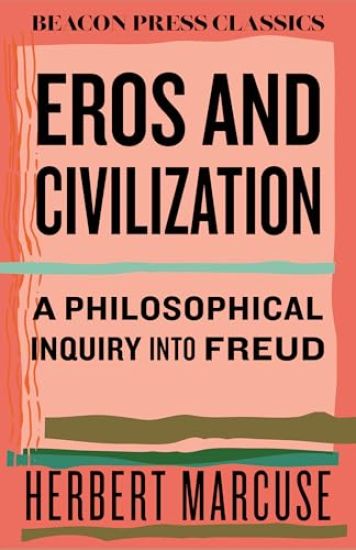
Eros and Civilization

Eros and Civilization

Herbert Marcuse

BEACON PRESS
2025
sidottu
A dazzling collectible edition of one of the most groundbreaking thinkers of the 20th century's incisive philosophical analysis of western civilization "Herbert Marcuse taught me that it was possible to be an academic and an activist, a scholar and a revolutionary." - Angela Davis Originally published in 1955, Herbert Marcuse's Eros and Civilization has been deemed by the New York Times "the most significant general treatment of psychoanalytic theory since Freud himself ceased publication." In this classic work, the internationally celebrated social theorist, philosopher, and political activist interrogates Freud's statement that civilization is based on the permanent subjugation of the human instincts to interpret the basic trends of western civilization. What emerges is an in-depth examination of the philosophical and sociological implications of Freud's reconstruction of the prehistory of mankind. Challenging the widespread repression of his time, Marcuse imagines a utopian civilization emphasizing liberation and play. Known as the "father of the New Left," Marcuse's incisive critique of capitalist society and analysis of consumerism and social repression remain more relevant than ever.
Reason and Revolution

Reason and Revolution

Herbert Marcuse

TAYLOR FRANCIS LTD
2023
sidottu
Few philosophers have had a more lasting impact on the philosophy of history than Friedrich Hegel. Reason and Revolution is Herbert Marcuse's brilliant interpretation of Hegel's philosophy and the influence it has had on political thought, from the French revolution to the twentieth century.In a masterpiece of dialectical thought, Marcuse superbly illuminates the implications of Hegel's philosophy, rescuing it from the taint of reactionary thought that distorted or dismissed it for the early part of the twentieth century. After a masterful survey of the main elements of Hegel's philosophical system, Marcuse argues that it is Hegel the rationalist and progressive who stands in contrast to the irrationalism of Nazism, providing the crucial platform on which Marxist thought would later build and take Hegel's thought in a radical and explosive new direction. A vital book in the development of critical theory and for understanding the great battle between liberal and reactionary thought, Reason and Revolution remains essential reading today.This Routledge Classics edition includes a new Foreword by J.M. Bernstein.
Reason and Revolution

Reason and Revolution

Herbert Marcuse

TAYLOR FRANCIS LTD
2023
nidottu
Few philosophers have had a more lasting impact on the philosophy of history than Friedrich Hegel. Reason and Revolution is Herbert Marcuse's brilliant interpretation of Hegel's philosophy and the influence it has had on political thought, from the French revolution to the twentieth century.In a masterpiece of dialectical thought, Marcuse superbly illuminates the implications of Hegel's philosophy, rescuing it from the taint of reactionary thought that distorted or dismissed it for the early part of the twentieth century. After a masterful survey of the main elements of Hegel's philosophical system, Marcuse argues that it is Hegel the rationalist and progressive who stands in contrast to the irrationalism of Nazism, providing the crucial platform on which Marxist thought would later build and take Hegel's thought in a radical and explosive new direction. A vital book in the development of critical theory and for understanding the great battle between liberal and reactionary thought, Reason and Revolution remains essential reading today.This Routledge Classics edition includes a new Foreword by J.M. Bernstein.
Eros and Civilization

Eros and Civilization

Herbert Marcuse

TAYLOR FRANCIS LTD
2023
sidottu
Hailed as the 'Guru of the New Left' and a leading figure of 1960s counterculture and liberation movements, the philosopher Herbert Marcuse is amongst the most renowned and controversial thinkers of the twentieth century. Eros and Civilization is one of his best-known books and brought him international fame.Taking his cue from Freud's view that repression of the instincts is a defining characteristic of the human mind, Marcuse fuses Freud's insight with Marx's theories of alienation and oppression. He argues that rather than our instincts turned in on themselves, it is modern capitalism itself that is preventing us from reaching the freedom we can find in a non-repressive society.A sweeping indictment of modern capitalism and consumerism that remains fresh and insightful, Eros and Civilization is a classic of activist and radical thinking that continues to fire debate and controversy today.This Routledge Classics edition includes a new Foreword by Douglas Kellner.
Eros and Civilization

Eros and Civilization

Herbert Marcuse

TAYLOR FRANCIS LTD
2023
nidottu
Hailed as the 'Guru of the New Left' and a leading figure of 1960s counterculture and liberation movements, the philosopher Herbert Marcuse is amongst the most renowned and controversial thinkers of the twentieth century. Eros and Civilization is one of his best-known books and brought him international fame.Taking his cue from Freud's view that repression of the instincts is a defining characteristic of the human mind, Marcuse fuses Freud's insight with Marx's theories of alienation and oppression. He argues that rather than our instincts turned in on themselves, it is modern capitalism itself that is preventing us from reaching the freedom we can find in a non-repressive society.A sweeping indictment of modern capitalism and consumerism that remains fresh and insightful, Eros and Civilization is a classic of activist and radical thinking that continues to fire debate and controversy today.This Routledge Classics edition includes a new Foreword by Douglas Kellner.
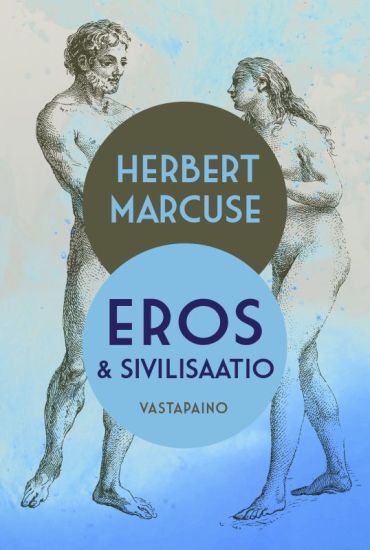
Eros ja sivilisaatio

Eros ja sivilisaatio

Herbert Marcuse; Sauli Havu

VASTAPAINO
2022
sidottu
Herbert Marcusen (1898-1979) Eros ja sivilisaatio on mannermaisen yhteiskuntafilosofian klassikko. Teos edustaa Frankfurtin koulukunnan kriittistä teoriaa, jossa yhdistyy kiinnostus Sigmund Freudin psykoanalyysiin ja Marxin kapitalismikritiikkiin.Teoksessa tarkastellaan kapitalismia tiedostumattoman näkökulmasta. Kuinka kapitalistinen talous tunkeutuu jokapäiväiseen elämään, ihmissuhteisiin, tunteisiin ja haluihin? Millaisia vastavoimia mielihyvä, halut ja ruumiillisuus voisivat muodostaa?Marcuselle psyykkinen torjunta ei ole pelkästään ihmisen biologisen olemuksen edellyttämää vaan osittain alistavien yhteiskunnallisten olosuhteiden tuotosta. Ihmiseksi kasvaminen on myös alistumista yhteiskunnallisille hierarkioille ja välineellisen järjen paaluttamille normeille. Mielihyvä ja Eros ovat Marcuselle vallankumouksellisia voimia. Niihin sisältyvä dynamiikka ilmenee erityisesti taiteessa, estetiikassa ja ruumiillisuudessa. Eros ja sivilisaatio vaikutti 1900-luvun puolivälissä vastakulttuurin muotoutumiseen ja innosti seksuaalivähemmistöjen kamppailuja. Herbert Marcuse oli 1960-luvulla opiskelijaradikalismin keskeinen innoittaja. Kiinnostus Marcusen filosofiaan on nyt uudessa nousussa.
Psychoanalysis, Politics, and Utopia

Psychoanalysis, Politics, and Utopia

Herbert Marcuse

Watkins Media Limited
2022
nidottu
Back in print after fifty years and with a new introduction by Ray Brassier, this often overlooked but prescient collection of Marcuse's lectures makes an impassioned plea for the overthrowing of capitalism. Analysing the work of Freud and Marx, and taking in topics like automation, work, postcapitalism, utopia, and technology, Psychoanalysis, Politics, and Utopia excavates the psychic roots of the current crisis of capitalist civilisation, and gives us a blueprint for the emancipation of humanity from the toils of capitalism. In a world reeling from the ongoing collapse of the neoliberal consensus, coupled with the accelerating pace of catastrophic climate change wrought by capitalism, Marcuse’s radical insights in Psychoanalysis, Politics, and Utopia are as urgently relevant today as they were in 1970.
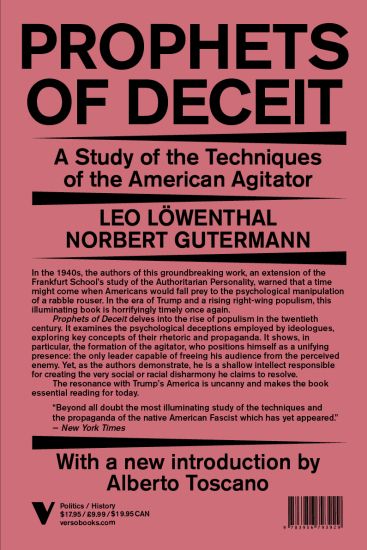
Prophets of Deceit

Prophets of Deceit

Leo Lowenthal; Norbert Guterman; Max Horkheimer; Herbert Marcuse

Verso Books
2021
nidottu
A classic book that analyzes and defines media appeals specific to American pro-fascist and anti-Semite agitators of the 1940s, such as the application of psychosocial manipulation for political ends. The book details psychological deceits that idealogues or authoritarians commonly used. The techniques are grouped under the headings "Discontent", "The Opponent", "The Movement" and "The Leader". The authors demonstrate repetitive patterns commonly utilized, such as turning unfocused social discontent towards a targeted enemy. The agitator positions himself as a unifying presence: he is the ideal, the only leader capable of freeing his audience from the perceived enemy. Yet, as the authors demonstrate, he is a shallow person who creates social or racial disharmony, thereby reinforcing that his leadership is needed. The authors believed fascist tendencies in America were at an early stage in the 1940s, but warned a time might come when Americans could and would be "susceptible to ... [the] psychological manipulation" of a rabble rouser. A book once again relevant in the Trump era, as made clear by Corey Robin's new introduction.
Revolution or Reform?

Revolution or Reform?

Thomas Molnar; Herbert Marcuse

Routledge
2020
nidottu
This series provides a forum for the critical review of enduring issues concerning ethics and society. The text of the debate between Herbert Marcuse and Sir Karl Popper which follows in this volume raises many important issues. The crucial issues between the two participants are (1) their anthropological-axiological positions with respect to the “nature” of man, society, and the practical functions of democracy as a mode of self-government; (2) the conceptions of science and of philosophy which lie behind each thinker’s claims with respect to these; and (3) their respective conceptions of the means required and feasible for attaining their respective social goals. The remarks which follow will attempt to focus upon, and deal critically with, the problems implicit in these three areas.
Reason and Revolution

Reason and Revolution

Herbert Marcuse

Actuel Editions
2020
pokkari
"Brilliant and penetrating ... the most important work which has opened up an understanding of Marx's humanism." - Erich FrommReason and Revolution: Hegel and the Rise of Social Theory is the philosopher Herbert Marcuse's first major work in English - a masterful interpretation of Hegel's philosophy and the influence it has had on European political thought from the French Revolution to the present day.Reason & Revolution, written in 1941, was the first Hegelian Marxist text to appear in English, the first systematic study of Hegel by a Marxist, and the first work in English to discuss the young Marx seriously. It introduced introduced Hegelian and Marxist concepts such as alienation, subjectivity, negativity, and the Frankfurt School's critique of positivism to a wide international audience. Acclaimed for its profound and undistorted reading of Hegel's social and political theory, the appreciation of Reason and Revolution has remained high, more relevant now than ever before. There is no better guide than Marcuse to where we have been and to what we might expect. The most influential radical philosopher of the 1960s, Marcuse's writings are as relevant to today's society as they were at the time they were written."We fell in love with Marcuse's mind, his method, his scholarship. We read everything he wrote... His book on Hegel and Marx, Reason and Revolution, was high on our list because we wanted to understand the intellectual origins of revolutionary Marxism." - Dan La Botz, author of A Troublemakers' Handbook: How to Fight Back Where You Work and Win "A Marxian philosopher who became a hero to the student radicals of the 1960s because of his view that modern society has enslaved mankind" - The Washington Post"A guiding figure to many social activists" - The New York TimesAbout the authorHerbert Marcuse (1898-1979) was a philosopher, sociologist, and political theorist. He studied at the University of Berlin and the University of Freiburg, and became a crucial figure at the Frankfurt Institute for Social Research, and of the Frankfurt School of social theory. He was forced to leave Germany in 1933, eventually settling in the United States, where he would spend much of his life and taught at many of the country's greatest schools and universities. A Hegelian-Freudian-Marxist, Marcuse highlighted the cultural forms of repression and the role of technology and the expansion of the production of consumer goods in the maintenance of the stability of capitalism. His classic studies of capitalist society were important influences on the New Left of the 1960s and 1970s and his libertarian socialism remains an important intellectual resource. Philosophical speculation seldom attracts headlines, let alone threats of death. Yet such was the fate that overtook Herbert Marcuse in the late 1960s, when he was catapulted into international controversy as a prophet of the revolutionary student movement. Among his major writings are Reason and Revolution, One-Dimensional Man, and Eros and Civilization.
Philosophy, Psychoanalysis and Emancipation

Philosophy, Psychoanalysis and Emancipation

Herbert Marcuse

CRC Press Inc
2017
nidottu
Edited by Douglas Kellner and Clayton Pierce, Philosophy, Psychoanalysis and Emancipation is the fifth volume of Herbert Marcuse's collected papers. Containing some of Marcuse’s most important work, this book presents for the first time his unique syntheses of philosophy, psychoanalysis, and critical social theory, directed toward human emancipation and social transformation.Within philosophy, Marcuse engaged with disparate and often conflicting philosophical perspectives - ranging from Heidegger and phenomenology, to Hegel, Marx, and Freud - to create unique philosophical insights, often overlooked in favor of his theoretical and political interventions with the New Left, the subject of previous volumes. This collection assembles significant, and in some cases unknown texts from the Herbert Marcuse archives in Frankfurt, including: critiques of positivism and idealism, Dewey’s pragmatism, and the tradition of German philosophy philosophical essays from the 1930s and 1940s that attempt to reconstruct philosophy on a materialist base Marcuse’s unique attempts to bring together Freud and philosophy philosophical reflections on death, human aggression, war, and peace Marcuse’s later critical philosophical perspectives on science, technology, society, religion, and ecology.A comprehensive introduction by Douglas Kellner, Tyson Lewis and Clayton Pierce places Marcuse’s work in the context of his engagement with the main currents of twentieth century politics and philosophy. An Afterword by Andrew Feenberg provides a personal memory of Marcuse as scholar, teacher and activist, and summarizes the lasting relevance of his radical thought.
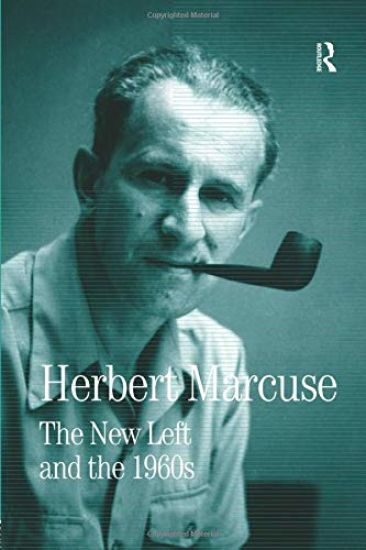
The New Left and the 1960s

The New Left and the 1960s

Herbert Marcuse

CRC Press Inc
2017
nidottu
The New Left and the 1960s is the third volume of Herbert Marcuse's collected papers. In 1964, Marcuse published a major study of advanced industrial society, One Dimensional Man, which was an important influence on the young radicals who formed the New Left. Marcuse embodied many of the defining political impulses of the New Left in his thought and politics - hence a younger generation of political activists looked up to him for theoretical and political guidance. The material collected in this volume provides a rich and deep grasp of the era and the role of Marcuse in the theoretical and political dramas of the day.This volume contains articles, letters, talks, and interviews including: "On the New Left," a transcription of the 1968 talk at the Guardian newspaper's twentieth anniversary; "Reflections on the French Revolution," which contains comments on the 1968 French student and worker uprising; "Liberation from the Affluent Society," which presents Marcuse's contribution to the 1967 Dialectics of Liberations conference; and "United States: Questions of Organization and the Revolutionary Subject," a conversation between Marcuse and the German writer Hans Magnus Enzenberger, published here in English for the first time.Edited by Douglas Kellner, this volume will be of interest to all those previously unfamiliar with Herbert Marcuse, generally acknowledged as a major figure in the intellectual and social mileux of the 1960s and 1970s, as well as to specialists, who will here have access to papers and articles collected in one volume for the first time.
Towards a Critical Theory of Society

Towards a Critical Theory of Society

Herbert Marcuse

CRC Press Inc
2017
nidottu
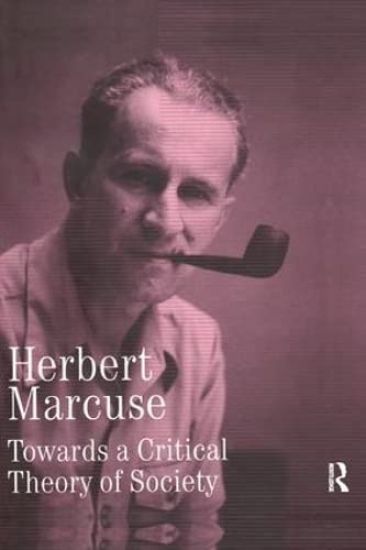
This second volume of Marcuse's collected papers includes unpublished manuscripts from the late 1960s and early 1970s, such as Beyond One-Dimensional Man, Cultural Revolution and The Historical Fate of Bourgeois Democracy, as well as a rich collection of letters. It shows Marcuse at his most radical, focusing on his critical theory of contemporary society, his analyses of technology, capitalism, the fate of the individual, and prospects for social change in contemporary society.
Art and Liberation

Art and Liberation

Herbert Marcuse

CRC Press Inc
2017
nidottu
The role of art in Marcuse’s work has often been neglected, misinterpreted or underplayed. His critics accused him of a religion of art and aesthetics that leads to an escape from politics and society. Yet, as this volume demonstrates, Marcuse analyzes culture and art in the context of how it produces forces of domination and resistance in society, and his writings on culture and art generate the possibility of liberation and radical social transformation.The material in this volume is a rich collection of many of Marcuse’s published and unpublished writings, interviews and talks, including ‘Lyric Poetry after Auschwitz’, reflections on Proust, and Letters on Surrealism; a poem by Samuel Beckett for Marcuse’s eightieth birthday with exchange of letters; and many articles that explore the role of art in society and how it provides possibilities for liberation.This volume will be of interest to those new to Marcuse, generally acknowledged as a major figure in the intellectual and social milieus of the 1960s and 1970s, as well as to the specialist, giving access to a wealth of material from the Marcuse Archive in Frankfurt and his private collection in San Diego, some of it published here in English for the first time.A comprehensive introduction by Douglas Kellner reflects on the genesis, development, and tensions within Marcuse’s aesthetic, while an afterword by Gerhard Schweppenhäuser summarizes their relevance for the contemporary era.
Technology, War and Fascism

Technology, War and Fascism

Herbert Marcuse

CRC Press Inc
2017
nidottu
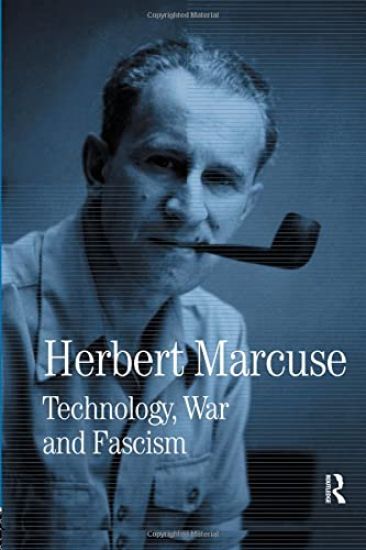
Herbert Marcuse is one of the most influential thinkers of our time. Born in Berlin, Marcuse studied philosophy with Husserl and Heidegger at the Universities of Freiburg and Berlin. Marcuse's critical social theory ingeniously fuses phenomenology, Freudian thought and Marxist theory; and provides a solid ground for his reputation as the most crucial figure inspiring the social activism and New Left politics of the 1960s and 1970s. The largely unpublished work collected in this volume makes clear the continuing relevance of Marcuse's thought to contemporary issues. The texts published here, dealing with concerns during the period 1942-1951, exhibit penetrating critiques of technology and analyses of the ways that modern technology produces novel forms of society and culture with new modes of social control. The material collected in Technology, War and Facism provides exemplary attempts to link theory with practice, to develop ideas that can be used to grasp and transform existing social reality.Technology, War and Fascism is the first of six volumes of Herbert Marcuse's Collected Papers to be edited by Douglas Kellner. Each volume is a collection of previously un-published or uncollected essays, unfinished manuscripts and letters by one of the greatest thinkers of our time.
Marxism, Revolution and Utopia

Marxism, Revolution and Utopia

Herbert Marcuse

CRC Press Inc
2017
nidottu
This collection assembles some of Herbert Marcuse’s most important work and presents for the first time his responses to and development of classic Marxist approaches to revolution and utopia, as well as his own theoretical and political perspectives.This sixth and final volume of Marcuse's collected papers shows Marcuse’s rejection of the prevailing twentieth-century Marxist theory and socialist practice - which he saw as inadequate for a thorough critique of Western and Soviet bureaucracy - and the development of his revolutionary thought towards a critique of the consumer society. Marcuse's later philosophical perspectives on technology, ecology, and human emancipation sat at odds with many of the classic tenets of Marx’s materialist dialectic which placed the working class as the central agent of change in capitalist societies. As the material from this volume shows, Marcuse was not only a theorist of Marxist thought and practice in the twentieth century, but also proves to be an essential thinker for understanding the neoliberal phase of capitalism and resistance in the twenty-first century.A comprehensive introduction by Douglas Kellner and Clayton Pierce places Marcuse’s philosophy in the context of his engagement with the main currents of twentieth century philosophy while also providing important analyses of his anticipatory theorization of capitalist development through a neoliberal restructuring of society. The volume concludes with an afterword by Peter Marcuse.