
Kirjailija
Herbert Silberer
Kirjat ja teokset yhdessä paikassa: 32 kirjaa, julkaisuja vuosilta 1903-2025, suosituimpien joukossa Der Traum. Vertaile teosten hintoja ja tarkista saatavuus suomalaisista kirjakaupoista.
32 kirjaa
Kirjojen julkaisuhaarukka 1903-2025.

Unver nderter Nachdruck der Originalausgabe von 1919. Der Verlag Antigonos spezialisiert sich auf die Herausgabe von Nachdrucken historischer B cher. Wir achten darauf, dass diese Werke der ffentlichkeit in einem guten Zustand zug nglich gemacht werden, um ihr kulturelles Erbe zu bewahren.


Reproduction of the original: Hidden Symbolism of Alchemy and the Occult Arts by Herbert Silberer

Charles Corliss presents, for the first time, the complete English translation of Herbert Silberer’s work on dreams, Der Traum: Einführung in die Traumpsychologie. Based on lectures delivered at the majestic Urania Star Observatory in Vienna in 1918, Der Traum was a wide-ranging, accessible introduction to the meaning of dreams, with examples from Silberer’s practice providing a rich source of illustration. One hundred years after the work was first published in Silberer’s native German, Corliss rescues his voice from obscurity and adds key supplementary information to place the work in context.The book begins with an introduction which surveys the range of Silberer’s contributions to psychoanalysis and sets out what is known of his life, before presenting the full original text. Presented in eight parts, each with preliminary remarks by Corliss, the book covers several topics including differing viewpoints on dreams, Silberer’s concept of the hypnagogic phenomenon, experimental dreams, and aspects of his own theory. Der Traum ends with a philosophical exploration of how dream content relates to the core moral fiber of our being, with the work as a whole reflecting Silberer’s optimistic, depth-oriented, and at times, almost mystical stance. Corliss concludes the book with a reflection on the rich, teleologically optimistic, and refreshingly panoramic value of Der Traum.This unique book will be of interest to analytical psychologists and Jungian psychotherapists in practice and training, as well as to academics and students of Jungian studies and the history of psychoanalysis, psychoanalytic studies, theology, philosophy, and the history of psychology.

Charles Corliss presents, for the first time, the complete English translation of Herbert Silberer’s work on dreams, Der Traum: Einführung in die Traumpsychologie. Based on lectures delivered at the majestic Urania Star Observatory in Vienna in 1918, Der Traum was a wide-ranging, accessible introduction to the meaning of dreams, with examples from Silberer’s practice providing a rich source of illustration. One hundred years after the work was first published in Silberer’s native German, Corliss rescues his voice from obscurity and adds key supplementary information to place the work in context.The book begins with an introduction which surveys the range of Silberer’s contributions to psychoanalysis and sets out what is known of his life, before presenting the full original text. Presented in eight parts, each with preliminary remarks by Corliss, the book covers several topics including differing viewpoints on dreams, Silberer’s concept of the hypnagogic phenomenon, experimental dreams, and aspects of his own theory. Der Traum ends with a philosophical exploration of how dream content relates to the core moral fiber of our being, with the work as a whole reflecting Silberer’s optimistic, depth-oriented, and at times, almost mystical stance. Corliss concludes the book with a reflection on the rich, teleologically optimistic, and refreshingly panoramic value of Der Traum.This unique book will be of interest to analytical psychologists and Jungian psychotherapists in practice and training, as well as to academics and students of Jungian studies and the history of psychoanalysis, psychoanalytic studies, theology, philosophy, and the history of psychology.


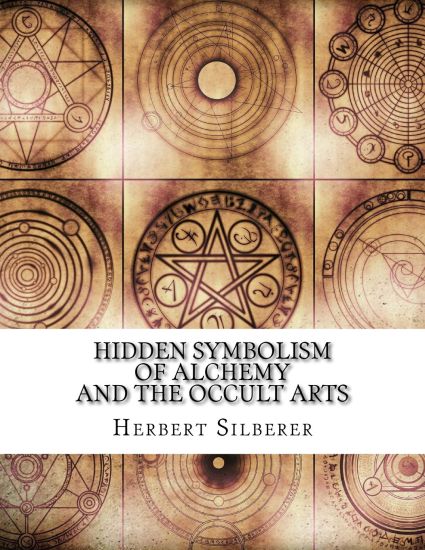
Herbert Silberer's examinations of alchemy and the occult, and his attempts to correlate the two crafts to the pursuit of psychoanalysis, is published here complete with the original illustrations. First published in 1917, this text represents the extensive investigations Herbert Silberer undertook in order to map occurrences in the occult with the ascendant psychoanalytic disciplines present in the Vienna School of which he was part. This text is marked by its depth of research, with sources such as Hermes Trismegistus, Flamel, Lacinius, Michael Meier, Paracelsus, and Boehme quoted and drawn upon in service of Silberer's thesis. The support of alchemy as a spiritual movement, on the same level as the yoga traditions of the Indian subcontinent, is also notable. Together with the three original illustrations, this edition also contains the extensive bibliography and notes of Silberer.

Herbert Silberer's examinations of alchemy and the occult, and his attempts to correlate the two crafts to the pursuit of psychoanalysis, is published here complete with the original illustrations. First published in 1917, this text represents the extensive investigations Herbert Silberer undertook in order to map occurrences in the occult with the ascendant psychoanalytic disciplines present in the Vienna School of which he was part. This text is marked by its depth of research, with sources such as Hermes Trismegistus, Flamel, Lacinius, Michael Meier, Paracelsus, and Boehme quoted and drawn upon in service of Silberer's thesis. The support of alchemy as a spiritual movement, on the same level as the yoga traditions of the Indian subcontinent, is also notable. Together with the three original illustrations, this edition also contains the extensive bibliography and notes of Silberer.
Hidden Symbolism of Alchemy and the Occult Arts
Herbert Silberer
Createspace Independent Publishing Platform
2018
nidottu
Prominent among the stones of a fireplace in my country den, one large rounded giant stands out. It was bourne by the glacial streams from a more northern resting place and is marked by a fossil of a mollusk that inhabited northern seas many million years ago. Yet in spite of the eons of time that have passed it can be compared with specimens of mollusks that live today. Down through the countless centuries the living stream has carved its structural habitations in much the same form. The science of Paleontology has collected this history and has attempted a reconstruction of life from its beginnings. The same principle here illustrated is true for the thought-life of mankind. The forms in which it has been preserved however are not so evident. The structuralizations are not so definite. If they were, evolution would not have been possible for the living stream of energy which is utilized by mind-stuff cannot be confined if it would advance to more complex integrations. Hence the products of mind in evolution are more plastic-more subtle and more changing. They are to be found in the myths and the folklore of ancient peoples, the poetry, dramatic art, and the language of later races. From age to age however the strivings continue the same. The living vessels must continue and the products express the most fundamental strivings, in varying though related forms.

Hidden Symbolism of Alchemy and the Occult Arts
Herbert Silberer
Createspace Independent Publishing Platform
2016
nidottu

Symbolism of Alchemy and the Occult Arts: Problems of Mysticism and Its Symbolism
Herbert Silberer
Createspace Independent Publishing Platform
2014
nidottu

Problems of Mysticism and Its Symbolism
Herbert Silberer; Smith Ely Jelliffe
Literary Licensing, LLC
2014
nidottu

Problems Of Mysticism And Its Symbolism
Herbert Silberer; Smith Ely Jelliffe
Literary Licensing, LLC
2014
sidottu
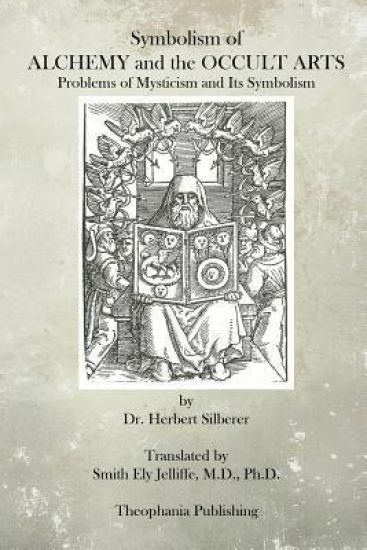
""Problems of Mysticism and Its Symbolism"" is a book written by Herbert Silberer, a prominent Austrian psychoanalyst and philosopher. The book is a comprehensive study of the symbolism used in mysticism, particularly in the context of religious and spiritual practices. Silberer explores the concept of mysticism and its various forms, including Christian mysticism, Hindu mysticism, and Sufism. He discusses the symbolism used in these practices, such as the use of light and darkness, the symbol of the cross, and the use of numbers and colors. The book also delves into the psychological aspects of mysticism and the role that symbolism plays in the human psyche. Silberer argues that the use of symbolism in mysticism is a way of expressing the unconscious mind and that it can be used as a tool for self-discovery and personal growth. Overall, ""Problems of Mysticism and Its Symbolism"" is a thought-provoking and insightful exploration of the role of symbolism in mysticism and its impact on the human psyche. It is a must-read for anyone interested in the study of mysticism, psychology, and philosophy.This Is A New Release Of The Original 1917 Edition.This scarce antiquarian book is a facsimile reprint of the old original and may contain some imperfections such as library marks and notations. Because we believe this work is culturally important, we have made it available as part of our commitment for protecting, preserving, and promoting the world's literature in affordable, high quality, modern editions, that are true to their original work.