Kirjojen hintavertailu. Mukana 12 595 353 kirjaa ja 12 kauppaa.

Kirjailija

Herwig Schopper

Kirjat ja teokset yhdessä paikassa: 4 kirjaa, julkaisuja vuosilta 2009-2024, suosituimpien joukossa Herwig Schopper. Vertaile teosten hintoja ja tarkista saatavuus suomalaisista kirjakaupoista.

4 kirjaa

Kirjojen julkaisuhaarukka 2009-2024.

Herwig Schopper

Herwig Schopper

Herwig Schopper; James Gillies

Springer International Publishing AG
2024
sidottu
This open access book is both a memoir and a biography. Born in Czechoslovakia in 1924, Herwig Schopper is one of the few people able to bear witness to 100 years of European history. His career has taken him from research to management to diplomacy, with a major part devoted to, and inspired by, CERN. Herwig enjoyed a rich childhood, spending his summers at his grandparent’s hotel on the Adriatic coast. It is there that he developed an interest in physics though eavesdropping on holidaying professors from Budapest and Belgrade who conversed in German. His youthful idyll was shattered by the annexation of the Sudetenland, which lead to him serving in the Luftwaffe signals corps. Working as a translator for the British administration in Hamburg after the war, he also enrolled at the University and was soon granted leave to travel outside Germany for his research. So began a long string of professional relationships with leading scientists of the day: LiseMeitner, Otto Frisch, Bob Wilson, Chien Shiung Wu, Masatoshi Koshiba and Sam Ting to name but a few. Herwig came to consider them all as friends. Through his long career, Herwig has played a leading role in institutions from Erlangen to Karlsruhe, and from DESY, where he was director from 1973 to 1980, to CERN, where he served as Director-General from 1981 to 1988. Since its foundation CERN has had two major missions: to conduct first-class scientific research and to foster peaceful relations between nations. Following this example Herwig has played a key role in pioneering the deployment of science for peace, notably through the SESAME laboratory in the Middle East. This book gives a full account of Herwig’s rich and varied life and concludes with his reflections on the challenges that society faces today.
Herwig Schopper

Herwig Schopper

Herwig Schopper; James Gillies

Springer International Publishing AG
2024
nidottu
This open access book is both a memoir and a biography. Born in Czechoslovakia in 1924, Herwig Schopper is one of the few people able to bear witness to 100 years of European history. His career has taken him from research to management to diplomacy, with a major part devoted to, and inspired by, CERN. Herwig enjoyed a rich childhood, spending his summers at his grandparent’s hotel on the Adriatic coast. It is there that he developed an interest in physics though eavesdropping on holidaying professors from Budapest and Belgrade who conversed in German. His youthful idyll was shattered by the annexation of the Sudetenland, which lead to him serving in the Luftwaffe signals corps. Working as a translator for the British administration in Hamburg after the war, he also enrolled at the University and was soon granted leave to travel outside Germany for his research. So began a long string of professional relationships with leading scientists of the day: LiseMeitner, Otto Frisch, Bob Wilson, Chien Shiung Wu, Masatoshi Koshiba and Sam Ting to name but a few. Herwig came to consider them all as friends. Through his long career, Herwig has played a leading role in institutions from Erlangen to Karlsruhe, and from DESY, where he was director from 1973 to 1980, to CERN, where he served as Director-General from 1981 to 1988. Since its foundation CERN has had two major missions: to conduct first-class scientific research and to foster peaceful relations between nations. Following this example Herwig has played a key role in pioneering the deployment of science for peace, notably through the SESAME laboratory in the Middle East. This book gives a full account of Herwig’s rich and varied life and concludes with his reflections on the challenges that society faces today.
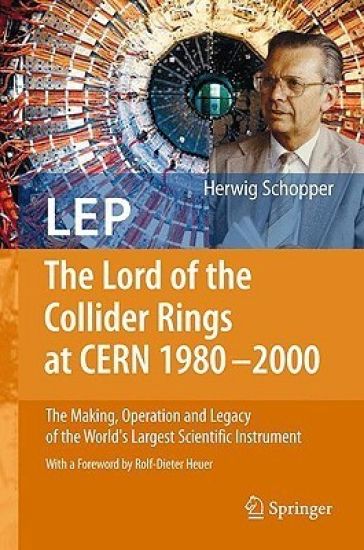
LEP - The Lord of the Collider Rings at CERN 1980-2000

LEP - The Lord of the Collider Rings at CERN 1980-2000

Herwig Schopper; Rolf-Dieter Heuer

Springer-Verlag Berlin and Heidelberg GmbH Co. K
2016
nidottu
Housed by a 4 m diameter tunnel of 27 km circumference, with huge underground labs and numerous surface facilities, and set up with a precision of 0.1 mm per kilometer, the Large Electron-Positron Collider (LEP) was not only the largest but also one of the most sophisticated scientific research instruments ever created by Man. Located at CERN, near Geneva, LEP was built during the years 1983 - 1989, was operational until 2000, and corroborated the standard model of particle physics through continuous high precision measurements. The Author, director-general of CERN during the crucial period of the construction of LEP, recounts vividly the convoluted decision-making and technical implementation processes - the tunnel alone being a highly challenging geo- and civil engineering project - and the subsequent extremely fruitful period of scientific research. Finally he describes the difficult decision to close down LEP, at a time when the discovery of the Higgs boson seemed within reach. LEP was eventually dismantled in 2000, enabling the tunnel to be reused for building the next generation machine, the much more powerful Large Hadron Collider (LHC), an upgrade then called LEP3 and foreseen from the beginning. It became operational just as this account was being completed. Written by the main protagonist responsible for making LEP a reality, this is the definitive inside story of a remarkable machine and the many thousands of scientists and engineers from around the world, whose efforts contributed to the new knowledge it produced.
LEP - The Lord of the Collider Rings at CERN 1980-2000

LEP - The Lord of the Collider Rings at CERN 1980-2000

Herwig Schopper; Rolf-Dieter Heuer

Springer-Verlag Berlin and Heidelberg GmbH Co. K
2009
sidottu
Housed by a 4 m diameter tunnel of 27 km circumference, with huge underground labs and numerous surface facilities, and set up with a precision of 0.1 mm per kilometer, the Large Electron-Positron Collider (LEP) was not only the largest but also one of the most sophisticated scientific research instruments ever created by Man. Located at CERN, near Geneva, LEP was built during the years 1983 - 1989, was operational until 2000, and corroborated the standard model of particle physics through continuous high precision measurements. The Author, director-general of CERN during the crucial period of the construction of LEP, recounts vividly the convoluted decision-making and technical implementation processes - the tunnel alone being a highly challenging geo- and civil engineering project - and the subsequent extremely fruitful period of scientific research. Finally he describes the difficult decision to close down LEP, at a time when the discovery of the Higgs boson seemed within reach. LEP was eventually dismantled in 2000, enabling the tunnel to be reused for building the next generation machine, the much more powerful Large Hadron Collider (LHC), an upgrade then called LEP3 and foreseen from the beginning. It became operational just as this account was being completed. Written by the main protagonist responsible for making LEP a reality, this is the definitive inside story of a remarkable machine and the many thousands of scientists and engineers from around the world, whose efforts contributed to the new knowledge it produced.