Kirjojen hintavertailu. Mukana 12 595 353 kirjaa ja 12 kauppaa.

Kirjailija

Hester Lees-Jeffries

Kirjat ja teokset yhdessä paikassa: 4 kirjaa, julkaisuja vuosilta 2007-2025, suosituimpien joukossa Shakespeare and Memory. Vertaile teosten hintoja ja tarkista saatavuus suomalaisista kirjakaupoista.

4 kirjaa

Kirjojen julkaisuhaarukka 2007-2025.

Textile Shakespeare

Textile Shakespeare

Hester Lees-Jeffries

Oxford University Press
2025
sidottu
Textile Shakespeare argues for the vital presence of the 'textile imagination' in the works of Shakespeare and his contemporaries, as it explores the economic, cultural, and social centrality of textiles to life in early modern England. Cloth, broadly interpreted, could function as a form of knowledge, skill, and expertise, of power, status, and control; it was a means of both storing and displaying wealth. Cloth, especially in the layered forms of early modern dress, furnished ways of imagining the body and the body politic, the community, the city, the nation, and the self; it was also central to thinking about language, rhetoric, literature, and the act of writing. In chapters based around different materials (linen, leather, wool, silk) and processes (sewing, cutting, folding), Textile Shakespeare recovers this textile liveliness, giving a comprehensive and immersive account of the place of textiles in early modern life and thought, and exploring and animating Shakespeare's plays in ways that have become largely invisible. Grounded in careful and illuminating close reading, it explores the entire range of Shakespeare's works, on the page and in performance in both the early modern theatre and on the contemporary stage. Richly illustrated, it includes detailed descriptions of surviving early modern garments and textiles, based on first-hand experience, and amasses and comprehensively reassesses the evidence for costuming and other staging in Shakespeare's time. It pays attention to textile labour, especially by women, and through its careful and original readings of Shakespeare's plays, it recovers the emotional and physical impact of clothing and other textiles on the lives and experiences of early modern people.
Shakespeare and Memory

Shakespeare and Memory

Hester Lees-Jeffries

Oxford University Press
2013
nidottu
Hamlet's father's Ghost asks his son to 'Remember me!', but how did people remember around 1600? And how do we remember now? Shakespeare and Memory brings together classical and early modern sources, theatre history, performance, material culture, and cognitive psychology and neuroscience in order to explore ideas about memory in Shakespeare's plays and poems. It argues that, when Shakespeare was writing, ideas about memory were undergoing a kind of crisis, as both the technologies of memory (print, the theatre itself) and the belief structures underpinning ideas about memory underwent rapid change. And it suggests that this crisis might be mirrored in our own time, when, despite all the increasing gadgetry at our disposal, memory can still be recovered, falsified, corrupted, or wiped: only we ourselves can remember, but the workings of memory remain mysterious. Shakespeare and Memory draws on works from all stages of Shakespeare's career, with a particular focus on Hamlet, the Sonnets, Twelfth Night, and The Winter's Tale. It considers some little things: what's Hamlet writing on? And why does Orsino think he smells violets? And it asks some big questions: how should the dead be remembered? What's the relationship between memory and identity? And is it art, above all, that enables love and beauty, memory and identity, to endure in the face of loss, time, and death?
Shakespeare and Memory

Shakespeare and Memory

Hester Lees-Jeffries

Oxford University Press
2013
sidottu
Hamlet's father's Ghost asks his son to 'Remember me!', but how did people remember around 1600? And how do we remember now? Shakespeare and Memory brings together classical and early modern sources, theatre history, performance, material culture, and cognitive psychology and neuroscience in order to explore ideas about memory in Shakespeare's plays and poems. It argues that, when Shakespeare was writing, ideas about memory were undergoing a kind of crisis, as both the technologies of memory (print, the theatre itself) and the belief structures underpinning ideas about memory underwent rapid change. And it suggests that this crisis might be mirrored in our own time, when, despite all the increasing gadgetry at our disposal, memory can still be recovered, falsified, corrupted, or wiped: only we ourselves can remember, but the workings of memory remain mysterious. Shakespeare and Memory draws on works from all stages of Shakespeare's career, with a particular focus on Hamlet, the Sonnets, Twelfth Night, and The Winter's Tale. It considers some little things: what's Hamlet writing on? And why does Orsino think he smells violets? And it asks some big questions: how should the dead be remembered? What's the relationship between memory and identity? And is it art, above all, that enables love and beauty, memory and identity, to endure in the face of loss, time, and death?
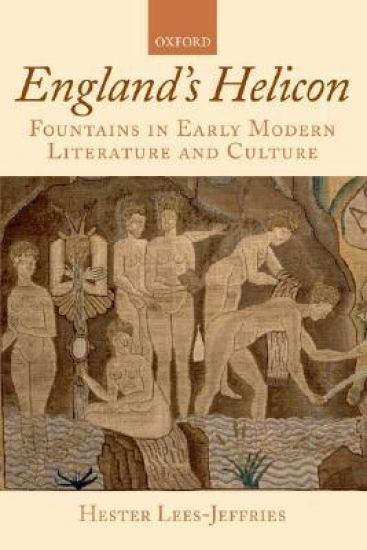
England's Helicon

England's Helicon

Hester Lees-Jeffries

Oxford University Press
2007
sidottu
England's Helicon is about one of the most important features of early modern gardens: the fountain. It is also a detailed study of works by Philip Sidney, Edmund Spenser, and Ben Jonson, and of an influential Italian romance, the Hypnerotomachia Poliphili. Fountains were 'strong points' in the iconography and structure of gardens, symbolically loaded and interpretatively dense, soliciting the most active engagement possible from those who encountered them. These qualities are registered and explored in their literary counterparts. England's Helicon is not a simple motif study of fountains in English Renaissance literature: it is, rather, an investigation of how each might work; of how literary fountains both inform and are informed by real fountains in early modern literature and culture. While its main focus remains the literature of the late sixteenth century, England's Helicon recognises that intertextuality and influence can be material as well as literary. It demonstrates that the 'missing piece' needed to make sense of a passage in a play, a poem, or a prose romance could be a fountain, a conduit, a well, or a reflecting pool, in general or even in a specific, known garden; it also considers portraits, textiles, jewellery, and other artefacts depicting fountains. Early modern English gardens and fountains are almost all lost, but to approach them through literary texts and objects is often to recover them in new ways. This is the double project that England's Helicon undertakes; in so doing, it offers a new model for the exploration of the interconnectedness of texts, images, objects and landscapes in early modern literature and culture.