Kirjojen hintavertailu. Mukana 12 595 353 kirjaa ja 12 kauppaa.

Kirjailija

Holoman D. Kern

Kirjat ja teokset yhdessä paikassa: 3 kirjaa, julkaisuja vuosilta 2012-2015, suosituimpien joukossa Charles Munch. Vertaile teosten hintoja ja tarkista saatavuus suomalaisista kirjakaupoista.

3 kirjaa

Kirjojen julkaisuhaarukka 2012-2015.

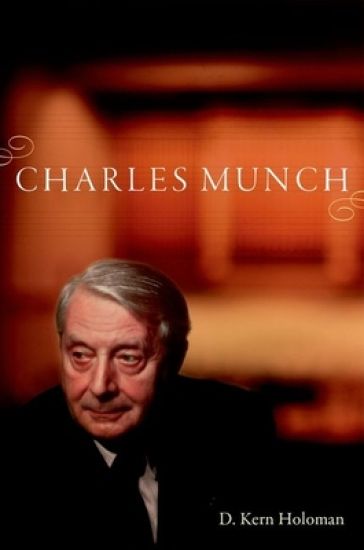
Charles Munch

Charles Munch

Holoman D. Kern

Oxford University Press Inc
2015
nidottu
A mesmerizing figure in concert, Charles Munch was celebrated for his electrifying public performances. He was a pioneer in many arenas of classical music—establishing Berlioz in the canon, perfecting the orchestral work of Debussy and Ravel, and leading the world to Roussel, Honegger, and Dutilleux. A pivotal figure, his accomplishments put him on a par with Arturo Toscanini and Leonard Bernstein. In Charles Munch, D. Kern Holoman provides the first full biography of this giant of twentieth-century music, tracing his dramatic survival in occupied Paris, his triumphant arrival at the Boston Symphony Orchestra, and his later years, when he was a leading cultural figure in the United States, a man known and admired by Presidents Truman, Eisenhower, and Kennedy. He turned to conducting only in middle age, after two decades as a violinist and concertmaster, a background which gave him special insight into the relationship between conductor and orchestra. At the podium, his bond with his musicians unleashed something in them and in himself. "A certain magic took wing that amounts to the very essence of music in concert," the author writes, as if "public performance loosed the facets of character and artistry and poetry otherwise muffled by his timidity and simple disinclination to say much." In concert, Munch was arresting, even seductive, sweeping his baton in an enormous arch from above his head down to his knee. Yet as Holoman shows, he remained a lonely, even sad figure, a widower with no children, a man who fled admirers and avoided reporters. With groundbreaking research and sensitive, lyrical writing, Charles Munch penetrates the enigma to capture this elusive musical titan.
The Orchestra: A Very Short Introduction

The Orchestra: A Very Short Introduction

Holoman D. Kern

Oxford University Press Inc
2012
nidottu
In this Very Short Introduction, D. Kern Holoman considers the structure, roots, and day-to-day functioning of the modern philharmonic society. He explores topics ranging from the life of a musician in a modern orchestra, the recent wave of new hall construction from Berlin to Birmingham, threats of bankruptcies and strikes, and the eyebrow-raising salaries of conductors and general managers. At the heart of the book lies a troubling pair of questions: Can such a seemingly anachronistic organization long survive? Does the symphony matter in contemporary culture? Holoman responds to both with a resounding yes. He shows that the orchestra remains a potent political and social force, a cultural diplomat par excellence. It has adapted well to the digital revolution, and it continues to be seen as an essential element of civic pride. In a time of upheaval in how classical music is created, heard, distributed, and evaluated, the orchestra has managed to retain its historic role as a meeting place of intellectual currents, an ongoing forum for public enlightenment. ABOUT THE SERIES: The Very Short Introductions series from Oxford University Press contains hundreds of titles in almost every subject area. These pocket-sized books are the perfect way to get ahead in a new subject quickly. Our expert authors combine facts, analysis, perspective, new ideas, and enthusiasm to make interesting and challenging topics highly readable.
Charles Munch

Charles Munch

Holoman D. Kern

Oxford University Press Inc
2012
sidottu
A mesmerizing figure in concert, Charles Munch was celebrated for his electrifying public performances. He was a pioneer in many arenas of classical music—establishing Berlioz in the canon, perfecting the orchestral work of Debussy and Ravel, and leading the world to Roussel, Honegger, and Dutilleux. A pivotal figure, his accomplishments put him on a par with Arturo Toscanini and Leonard Bernstein. In Charles Munch, D. Kern Holoman provides the first full biography of this giant of twentieth-century music, tracing his dramatic survival in occupied Paris, his triumphant arrival at the Boston Symphony Orchestra, and his later years, when he was a leading cultural figure in the United States, a man known and admired by Presidents Truman, Eisenhower, and Kennedy. He turned to conducting only in middle age, after two decades as a violinist and concertmaster, a background which gave him special insight into the relationship between conductor and orchestra. At the podium, his bond with his musicians unleashed something in them and in himself. "A certain magic took wing that amounts to the very essence of music in concert," the author writes, as if "public performance loosed the facets of character and artistry and poetry otherwise muffled by his timidity and simple disinclination to say much." In concert, Munch was arresting, even seductive, sweeping his baton in an enormous arch from above his head down to his knee. Yet as Holoman shows, he remained a lonely, even sad figure, a widower with no children, a man who fled admirers and avoided reporters. With groundbreaking research and sensitive, lyrical writing, Holoman penetrates the enigma to capture this elusive musical titan.