Kirjojen hintavertailu. Mukana 12 390 323 kirjaa ja 12 kauppaa.

Kirjailija

Horst Bunke

Kirjat ja teokset yhdessä paikassa: 11 kirjaa, julkaisuja vuosilta 1985-2011, suosituimpien joukossa Handbook Of Character Recognition And Document Image Analysis. Vertaile teosten hintoja ja tarkista saatavuus suomalaisista kirjakaupoista.

11 kirjaa

Kirjojen julkaisuhaarukka 1985-2011.

Dreidimensionales Computersehen

Dreidimensionales Computersehen

Xiaoyi Jiang; Horst Bunke

Springer-Verlag Berlin and Heidelberg GmbH Co. K
2011
nidottu
Dieses Buch bietet eine systematische Einführung in dieses neue Arbeitsfeld der automatischen Bildanalyse. Es behandelt sämtliche wichtigen Teilaspekte, beginnend mit der Gewinnung von Tiefenbildern durch passive und aktive Verfahren über die Extraktion charakteristischer Flächenmerkmale und die Segmentierung bis hin zur modellbasierten Objekterkennung. Daneben werden konkrete Anwendungen der Tiefenbildanalyse vorgestellt. Die Didaktik des Buches erlaubt es Forschern und Praktikern, sich selbständig in dieses Gebiet einzuarbeiten. Das teilweise schwer zugängliche Material wurde in einheitlicher Notation und verständlicher Form aufbereitet. Die beschriebenen Verfahren können damit leicht auf dem Computer implementiert werden. Die Literaturhinweise geben einen vollständigen Überblick über die aktuelle Forschung.
Graph Classification And Clustering Based On Vector Space Embedding

Graph Classification And Clustering Based On Vector Space Embedding

Kaspar Riesen; Horst Bunke

World Scientific Publishing Co Pte Ltd
2010
sidottu
This book is concerned with a fundamentally novel approach to graph-based pattern recognition based on vector space embedding of graphs. It aims at condensing the high representational power of graphs into a computationally efficient and mathematically convenient feature vector.This volume utilizes the dissimilarity space representation originally proposed by Duin and Pekalska to embed graphs in real vector spaces. Such an embedding gives one access to all algorithms developed in the past for feature vectors, which has been the predominant representation formalism in pattern recognition and related areas for a long time.
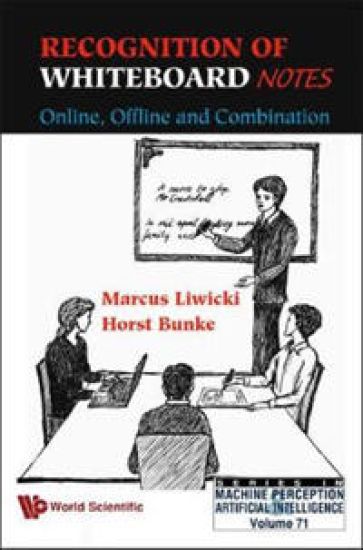
Recognition Of Whiteboard Notes: Online, Offline And Combination

Recognition Of Whiteboard Notes: Online, Offline And Combination

Horst Bunke; Marcus Liwicki

World Scientific Publishing Co Pte Ltd
2008
sidottu
This book addresses the task of processing online handwritten notes acquired from an electronic whiteboard, which is a new modality in handwriting recognition research. The main motivation of this book is smart meeting rooms, aim to automate standard tasks usually performed by humans in a meeting.The book can be summarized as follows. A new online handwritten database is compiled, and four handwriting recognition systems are developed. Moreover, novel preprocessing and normalization strategies are designed especially for whiteboard notes and a new neural network based recognizer is applied. Commercial recognition systems are included in a multiple classifier system. The experimental results on the test set show a highly significant improvement of the recognition performance to more than 86%.
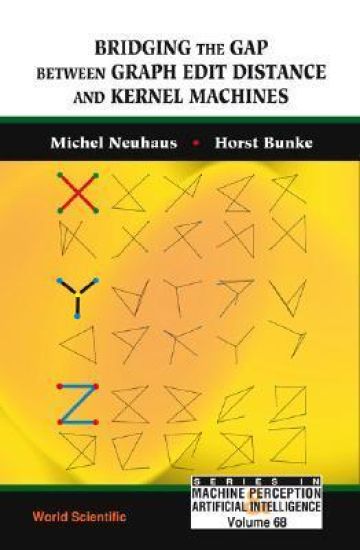
Bridging The Gap Between Graph Edit Distance And Kernel Machines

Bridging The Gap Between Graph Edit Distance And Kernel Machines

Michel Neuhaus; Horst Bunke

World Scientific Publishing Co Pte Ltd
2007
sidottu
In graph-based structural pattern recognition, the idea is to transform patterns into graphs and perform the analysis and recognition of patterns in the graph domain — commonly referred to as graph matching. A large number of methods for graph matching have been proposed. Graph edit distance, for instance, defines the dissimilarity of two graphs by the amount of distortion that is needed to transform one graph into the other and is considered one of the most flexible methods for error-tolerant graph matching.This book focuses on graph kernel functions that are highly tolerant towards structural errors. The basic idea is to incorporate concepts from graph edit distance into kernel functions, thus combining the flexibility of edit distance-based graph matching with the power of kernel machines for pattern recognition. The authors introduce a collection of novel graph kernels related to edit distance, including diffusion kernels, convolution kernels, and random walk kernels. From an experimental evaluation of a semi-artificial line drawing data set and four real-world data sets consisting of pictures, microscopic images, fingerprints, and molecules, the authors demonstrate that some of the kernel functions in conjunction with support vector machines significantly outperform traditional edit distance-based nearest-neighbor classifiers, both in terms of classification accuracy and running time.
A Graph-Theoretic Approach to Enterprise Network Dynamics

A Graph-Theoretic Approach to Enterprise Network Dynamics

Horst Bunke; Peter J. Dickinson; Miro Kraetzl; Walter D. Wallis

Birkhauser Boston Inc
2006
sidottu
Networks have become nearly ubiquitous and increasingly complex, and their support of modern enterprise environments has become fundamental. Accordingly, robust network management techniques are essential to ensure optimal performance of these networks. This monograph treats the application of numerous graph-theoretic algorithms to a comprehensive analysis of dynamic enterprise networks. Network dynamics analysis yields valuable information about network performance, efficiency, fault prediction, cost optimization, indicators and warnings. Based on many years of applied research of generic network dynamics, this work covers a number of elegant applications (including many new and experimental results) of traditional graph theory algorithms and techniques to computationally tractable network dynamics analysis to motivate network analysts, practitioners and researchers alike. The material is also suitable for graduate courses addressing state-of-the-art applications of graph theory in analysis of dynamic communication networks, dynamic databasing, and knowledge management.
Graph-theoretic Techniques For Web Content Mining

Graph-theoretic Techniques For Web Content Mining

Adam Schenker; Horst Bunke; Mark Last; Abraham Kandel

World Scientific Publishing Co Pte Ltd
2005
sidottu
This book describes exciting new opportunities for utilizing robust graph representations of data with common machine learning algorithms. Graphs can model additional information which is often not present in commonly used data representations, such as vectors. Through the use of graph distance — a relatively new approach for determining graph similarity — the authors show how well-known algorithms, such as k-means clustering and k-nearest neighbors classification, can be easily extended to work with graphs instead of vectors. This allows for the utilization of additional information found in graph representations, while at the same time employing well-known, proven algorithms.To demonstrate and investigate these novel techniques, the authors have selected the domain of web content mining, which involves the clustering and classification of web documents based on their textual substance. Several methods of representing web document content by graphs are introduced; an interesting feature of these representations is that they allow for a polynomial time distance computation, something which is typically an NP-complete problem when using graphs. Experimental results are reported for both clustering and classification in three web document collections using a variety of graph representations, distance measures, and algorithm parameters.In addition, this book describes several other related topics, many of which provide excellent starting points for researchers and students interested in exploring this new area of machine learning further. These topics include creating graph-based multiple classifier ensembles through random node selection and visualization of graph-based data using multidimensional scaling.
Dreidimensionales Computersehen

Dreidimensionales Computersehen

Xiaoyi Jiang; Horst Bunke

Springer-Verlag Berlin and Heidelberg GmbH Co. K
1996
sidottu
Dieses Buch bietet eine systematische Einführung in dieses neue Arbeitsfeld der automatischen Bildanalyse. Es behandelt sämtliche wichtigen Teilaspekte, beginnend mit der Gewinnung von Tiefenbildern durch passive und aktive Verfahren über die Extraktion charakteristischer Flächenmerkmale und die Segmentierung bis hin zur modellbasierten Objekterkennung. Daneben werden konkrete Anwendungen der Tiefenbildanalyse vorgestellt. Die Didaktik des Buches erlaubt es Forschern und Praktikern, sich selbständig in dieses Gebiet einzuarbeiten. Das teilweise schwer zugängliche Material wurde in einheitlicher Notation und verständlicher Form aufbereitet. Die beschriebenen Verfahren können damit leicht auf dem Computer implementiert werden. Die Literaturhinweise geben einen vollständigen Überblick über die aktuelle Forschung.