Kirjojen hintavertailu. Mukana 12 306 255 kirjaa ja 12 kauppaa.

Kirjailija

Hossam Hawash

Kirjat ja teokset yhdessä paikassa: 8 kirjaa, julkaisuja vuosilta 2021-2026, suosituimpien joukossa Artificial Intelligence and Internet of Things in Smart Farming. Vertaile teosten hintoja ja tarkista saatavuus suomalaisista kirjakaupoista.

8 kirjaa

Kirjojen julkaisuhaarukka 2021-2026.

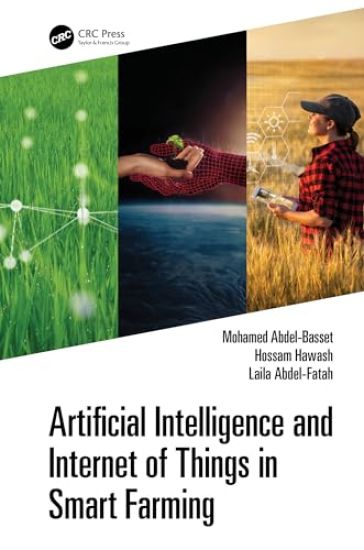
Artificial Intelligence and Internet of Things in Smart Farming

Artificial Intelligence and Internet of Things in Smart Farming

Mohamed Abdel-Basset; Hossam Hawash; Laila Abdel-Fatah

TAYLOR FRANCIS LTD
2026
nidottu
This book provides a broad overview of the areas of artificial intelligence (AI) that can be used for smart farming applications, through either successful engineering or ground-breaking research. Among them, the highlighted tactics are soil management, water management, crop management, livestock management, harvesting, and the integration of Internet of Things (IoT) in smart farming. Artificial Intelligence and Internet of Things in Smart Farming explores different types of smart framing systems for achieving sustainability goals in the real environment. The authors discuss the benefits of smart harvesting systems over traditional harvesting methods, including decreased labor requirements, increased crop yields, increased probabilities of successful harvests, enhanced visibility into crop health, and lower overall harvest and production costs. It explains and describes big data in terms of its potential five dimensions—volume, velocity, variety, veracity, and valuation—within the framework of smart farming. The authors also discuss the recent IoT technologies, such as fifth-generation networks, blockchain, and digital twining, to improve the sustainability and productivity of smart farming systems. The book identifies numerous issues that call for conceptual innovation and has the potential to progress machine learning (ML), resulting in significant impacts. As an illustration, the authors point out how smart farming offers an intriguing field for interpretable ML. The book then delves into the function of AI techniques, such as AI in accelerating the development of nano-enabled agriculture, thereby facilitating safe-by-design nanomaterials for various consumer products and medical applications. This book is for undergraduate students, graduate students, researchers, and AI engineers who pursue a strong understanding of the practical methods of machine learning in the agriculture domain. Practitioners and stakeholders would be able to follow this book to understand the potential of ML in their farming projects and agricultural solutions. Features: • Explores different types of smart framing systems for achieving sustainability goals in the real environment • Explores ML-based analytics such as generative adversarial networks (GAN), autoencoders, computational imaging, and quantum computing • Examines the development of intelligent machines to provide solutions to real-world problems, emphasizing smart farming applications, which are not modeled or are extremely difficult to model mathematically • Emphasizes methods for better managing crops, soils, water, and livestock, urging investors and businesspeople to occupy the existing vacant market area • Discusses AI-empowered Nanotechnology for smart farming
Explainable Artificial Intelligence for Trustworthy Internet of Things

Explainable Artificial Intelligence for Trustworthy Internet of Things

Mohamed Abdel-Basset; Nour Moustafa; Hossam Hawash; Albert Y. Zomaya

INSTITUTION OF ENGINEERING AND TECHNOLOGY
2024
sidottu
A major challenge for machine learning solutions is that their efficiency in real-world applications is constrained by the current lack of ability of the machine to explain its decisions and activities to human users. Biases based on race, gender, age or location have been a long-standing risk in training AI models. Furthermore, AI model performance can degrade because production data differs from training data. Explainable AI (XAI) is the practice of interpreting how and why a machine learning algorithm estimates its predictions. It can also help machine learning practitioners and data scientists understand and interpret a model's behaviour. XAI supports end-users to trust a model's auditability and the productive use of AI. It also mitigates AI compliance, legal, security and reputational risks. Among these applications, the security of IoT infrastructures is vitally essential for improving trust in broad-scale applications such as smart healthcare, smart manufacturing, smart agriculture and smart transportation. This comprehensive co-authored book offers a complete study of explainable artificial intelligence (XAI) for securing the Internet of things (IoT). The authors present innovative XAI solutions for securing IoT infrastructures against security attacks and privacy threats and cover advanced research topics including responsible security intelligence. Providing a systematic and thorough overview of the field, this book will be a valuable resource for ICT researchers, AI and data science engineers, security analysts, undergraduate and graduate students and professionals who wish to gain a fundamental understanding of intelligent security solutions.
Artificial Intelligence and Internet of Things in Smart Farming

Artificial Intelligence and Internet of Things in Smart Farming

Mohamed Abdel-Basset; Hossam Hawash; Laila Abdel-Fatah

TAYLOR FRANCIS LTD
2024
sidottu
This book provides a broad overview of the areas of artificial intelligence (AI) that can be used for smart farming applications, through either successful engineering or ground-breaking research. Among them, the highlighted tactics are soil management, water management, crop management, livestock management, harvesting, and the integration of Internet of Things (IoT) in smart farming.Artificial Intelligence and Internet of Things in Smart Farming explores different types of smart framing systems for achieving sustainability goals in the real environment. The authors discuss the benefits of smart harvesting systems over traditional harvesting methods, including decreased labor requirements, increased crop yields, increased probabilities of successful harvests, enhanced visibility into crop health, and lower overall harvest and production costs. It explains and describes big data in terms of its potential five dimensions—volume, velocity, variety, veracity, and valuation—within the framework of smart farming. The authors also discuss the recent IoT technologies, such as fifth-generation networks, blockchain, and digital twining, to improve the sustainability and productivity of smart farming systems. The book identifies numerous issues that call for conceptual innovation and has the potential to progress machine learning (ML), resulting in significant impacts. As an illustration, the authors point out how smart farming offers an intriguing field for interpretable ML. The book then delves into the function of AI techniques, such as AI in accelerating the development of nano-enabled agriculture, thereby facilitating safe-by-design nanomaterials for various consumer products and medical applications.This book is for undergraduate students, graduate students, researchers, and AI engineers who pursue a strong understanding of the practical methods of machine learning in the agriculture domain. Practitioners and stakeholders would be able to follow this book to understand the potential of ML in their farming projects and agricultural solutions.Features:• Explores different types of smart framing systems for achieving sustainability goals in the real environment • Explores ML-based analytics such as generative adversarial networks (GAN), autoencoders, computational imaging, and quantum computing • Examines the development of intelligent machines to provide solutions to real-world problems, emphasizing smart farming applications, which are not modeled or are extremely difficult to model mathematically • Emphasizes methods for better managing crops, soils, water, and livestock, urging investors and businesspeople to occupy the existing vacant market area • Discusses AI-empowered Nanotechnology for smart farming
Responsible Graph Neural Networks

Responsible Graph Neural Networks

Mohamed Abdel-Basset; Nour Moustafa; Hossam Hawash; Zahir Tari

TAYLOR FRANCIS LTD
2023
nidottu
More frequent and complex cyber threats require robust, automated, and rapid responses from cyber-security specialists. This book offers a complete study in the area of graph learning in cyber, emphasizing graph neural networks (GNNs) and their cyber-security applications.Three parts examine the basics, methods and practices, and advanced topics. The first part presents a grounding in graph data structures and graph embedding and gives a taxonomic view of GNNs and cyber-security applications. The second part explains three different categories of graph learning, including deterministic, generative, and reinforcement learning and how they can be used for developing cyber defense models. The discussion of each category covers the applicability of simple and complex graphs, scalability, representative algorithms, and technical details.Undergraduate students, graduate students, researchers, cyber analysts, and AI engineers looking to understand practical deep learning methods will find this book an invaluable resource.
Responsible Graph Neural Networks

Responsible Graph Neural Networks

Mohamed Abdel-Basset; Nour Moustafa; Hossam Hawash; Zahir Tari

TAYLOR FRANCIS LTD
2023
sidottu
More frequent and complex cyber threats require robust, automated, and rapid responses from cyber-security specialists. This book offers a complete study in the area of graph learning in cyber, emphasizing graph neural networks (GNNs) and their cyber-security applications.Three parts examine the basics, methods and practices, and advanced topics. The first part presents a grounding in graph data structures and graph embedding and gives a taxonomic view of GNNs and cyber-security applications. The second part explains three different categories of graph learning, including deterministic, generative, and reinforcement learning and how they can be used for developing cyber defense models. The discussion of each category covers the applicability of simple and complex graphs, scalability, representative algorithms, and technical details.Undergraduate students, graduate students, researchers, cyber analysts, and AI engineers looking to understand practical deep learning methods will find this book an invaluable resource.
Deep Learning Techniques for IoT Security and Privacy

Deep Learning Techniques for IoT Security and Privacy

Mohamed Abdel-Basset; Nour Moustafa; Hossam Hawash; Weiping Ding

Springer Nature Switzerland AG
2022
nidottu
This book states that the major aim audience are people who have some familiarity with Internet of things (IoT) but interested to get a comprehensive interpretation of the role of deep Learning in maintaining the security and privacy of IoT. A reader should be friendly with Python and the basics of machine learning and deep learning. Interpretation of statistics and probability theory will be a plus but is not certainly vital for identifying most of the book's material.
Deep Learning Approaches for Security Threats in IoT Environments

Deep Learning Approaches for Security Threats in IoT Environments

Mohamed Abdel-Basset; Nour Moustafa; Hossam Hawash

JOHN WILEY SONS INC
2022
sidottu
Deep Learning Approaches for Security Threats in IoT Environments An expert discussion of the application of deep learning methods in the IoT security environment In Deep Learning Approaches for Security Threats in IoT Environments, a team of distinguished cybersecurity educators deliver an insightful and robust exploration of how to approach and measure the security of Internet-of-Things (IoT) systems and networks. In this book, readers will examine critical concepts in artificial intelligence (AI) and IoT, and apply effective strategies to help secure and protect IoT networks. The authors discuss supervised, semi-supervised, and unsupervised deep learning techniques, as well as reinforcement and federated learning methods for privacy preservation. This book applies deep learning approaches to IoT networks and solves the security problems that professionals frequently encounter when working in the field of IoT, as well as providing ways in which smart devices can solve cybersecurity issues. Readers will also get access to a companion website with PowerPoint presentations, links to supporting videos, and additional resources. They’ll also find: A thorough introduction to artificial intelligence and the Internet of Things, including key concepts like deep learning, security, and privacy Comprehensive discussions of the architectures, protocols, and standards that form the foundation of deep learning for securing modern IoT systems and networks In-depth examinations of the architectural design of cloud, fog, and edge computing networks Fulsome presentations of the security requirements, threats, and countermeasures relevant to IoT networks Perfect for professionals working in the AI, cybersecurity, and IoT industries, Deep Learning Approaches for Security Threats in IoT Environments will also earn a place in the libraries of undergraduate and graduate students studying deep learning, cybersecurity, privacy preservation, and the security of IoT networks.
Deep Learning Techniques for IoT Security and Privacy

Deep Learning Techniques for IoT Security and Privacy

Mohamed Abdel-Basset; Nour Moustafa; Hossam Hawash; Weiping Ding

Springer Nature Switzerland AG
2021
sidottu
This book states that the major aim audience are people who have some familiarity with Internet of things (IoT) but interested to get a comprehensive interpretation of the role of deep Learning in maintaining the security and privacy of IoT. A reader should be friendly with Python and the basics of machine learning and deep learning. Interpretation of statistics and probability theory will be a plus but is not certainly vital for identifying most of the book's material.