

Kirjailija
Howard Giles
Kirjat ja teokset yhdessä paikassa: 6 kirjaa, julkaisuja vuosilta 1991-2025, suosituimpien joukossa Communication for Successful Aging. Vertaile teosten hintoja ja tarkista saatavuus suomalaisista kirjakaupoista.
6 kirjaa
Kirjojen julkaisuhaarukka 1991-2025.

Communication for Successful Aging
Howard Giles; Jessica Gasiorek; Shardé M. Davis; Jane Giles
Routledge
2021
sidottu
The Biennial Jake Harwood Outstanding Book Award 2024National Communication Association Communication and Ageing Division, Outstanding Book Award 2023This essential volume explores the vital role of communication in the aging process and how this varies for different social groups and cultural communities. It reveals how communication can empower people in the process of aging, and that how we communicate about age is critically important to – and is at the heart of – aging successfully.Giles et al. confront the uncertainty and negativity surrounding "aging" – a process with which we all have to cope – by expertly placing communication at the core of the process. They address the need to avoid negative language, discuss the lifespan as an evolving adventure, and introduce a new theory of successful aging – the communication ecology model of successful aging (CEMSA). They explore the research on key topics including: age stereotypes, age identities, and messages of ageism; the role of culture, gender, ethnicity, and being a member of marginalized groups; the ingredients of intergenerational communication; depiction of aging and youth in the media; and how and why talk about death and dying can be instrumental in promoting control over life’s demands. Communication for Successful Aging is essential reading for graduate students of psychology, human development, gerontology, and communication, scholars in the social sciences, and all of us concerned with this complex academic and highly personal topic.
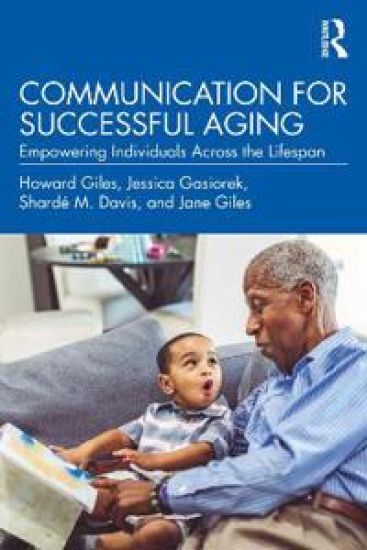
Communication for Successful Aging
Howard Giles; Jessica Gasiorek; Shardé M. Davis; Jane Giles
Routledge
2021
nidottu
The Biennial Jake Harwood Outstanding Book Award 2024National Communication Association Communication and Ageing Division, Outstanding Book Award 2023This essential volume explores the vital role of communication in the aging process and how this varies for different social groups and cultural communities. It reveals how communication can empower people in the process of aging, and that how we communicate about age is critically important to – and is at the heart of – aging successfully.Giles et al. confront the uncertainty and negativity surrounding "aging" – a process with which we all have to cope – by expertly placing communication at the core of the process. They address the need to avoid negative language, discuss the lifespan as an evolving adventure, and introduce a new theory of successful aging – the communication ecology model of successful aging (CEMSA). They explore the research on key topics including: age stereotypes, age identities, and messages of ageism; the role of culture, gender, ethnicity, and being a member of marginalized groups; the ingredients of intergenerational communication; depiction of aging and youth in the media; and how and why talk about death and dying can be instrumental in promoting control over life’s demands. Communication for Successful Aging is essential reading for graduate students of psychology, human development, gerontology, and communication, scholars in the social sciences, and all of us concerned with this complex academic and highly personal topic.

The Oxford Encyclopedia of Intergroup Communication
Howard Giles; Jake Harwood
Oxford University Press Inc
2018
sidottu
The Oxford Encyclopedia of Intergroup Communication is the first dedicated to this burgeoning field within communication studies. The essays in this collection explore geographic regions, communication processes, theories, and applied areas of interest, all pertaining to how human communication processes are influenced by, and themselves influence, the groups to which we all belong. In an authoritative volume, the project brings together research, theory, and application on both well-established and newly explored intergroup communication situations. The new perspectives not covered in earlier works include: - how word order affects social status - how metaphors shape intergroup relations - how sexual orientation is communicated - how interpersonal and intergroup communication intersect - what neuroscience contributes to intergroup communication - and how intergroup communication operates in previously unacknowledged settings such as the military or in the political arena. Given that the "intergroup umbrella" essentially integrates and transcends many of the traditional conceptual boundaries in communication (such as media, health, intercultural, organizational and so forth), The Oxford Encyclopedia of Intergroup Communication provides an intriguing window into the communicative world of intergroup relations so integral to other social sciences. The encyclopedia will be an essential reference for anyone interested in intergroup communication issues, particularly research scholars and graduate students.
Language, Society and the Elderly
Nikolas Coupland; Justine Coupland; Howard Giles
Blackwell Publishers
1991
nidottu
Language, Society and the Elderly is the first concerted attempt to give a social account of language and interaction in later life. The book gives a detailed critique of the cognitive bias of existing studies of elderly people's language. In its place, the authors propose a socially-based approach which explains how older people's life circumstances, concerns, goals and beliefs influence their styles of interaction. But social stereotypes of old age and a generally ageist social climate limit the roles available to elderly people. In detailed analyses of talk between elderly people and younger adults, the authors show how age and health identifies are negotiated. They look particularly at sequences of troubles-telling and moments of painful self-disclosure by elderly people, examining how even "supportive" talk to the elderly can threaten identity and reinforce social divisions. "Language, Society and the Elderly" opens up an entirely new field for sociolinguistics. It also shows how studies of language and interaction can contribute to theory in social gerontology, and to policy and practice in medical and caring contexts.