
Kirjailija
Howard Jones
Kirjat ja teokset yhdessä paikassa: 35 kirjaa, julkaisuja vuosilta 1962-2025, suosituimpien joukossa Eyes on the Stars and Feet on the Ground. Vertaile teosten hintoja ja tarkista saatavuus suomalaisista kirjakaupoista.
35 kirjaa
Kirjojen julkaisuhaarukka 1962-2025.

In January 1959, as Fidel Castro entered Havana in triumph, Americans hailed the revolutionary as a hero. Then came Castro's increasingly anti-American talk, the rise in his regime of the openly Marxist Che Guevara and Raúl Castro, and seizures of American-owned assets. In little more than a year, President Dwight D. Eisenhower concluded that Castro must go. In The Bay of Pigs, Howard Jones provides a concise, incisive, and dramatic account of the disastrous attempt to overthrow Castro. He deftly examines the train of missteps and self-deceptions that led to the invasion of U.S.-trained exiles at the Bay of Pigs. Ignoring warnings from the ambassador to Cuba, the Eisenhower administration put in motion an operation that proved nearly unstoppable even after the inauguration of John F. Kennedy. Meanwhile, the CIA and Pentagon both voiced confidence in the outcome of the invasion, especially after coordinating previous successful coups in Guatemala and Iran. As a vital part of the Cuban effort, the CIA sought to incite a popular insurrection by recruiting the Mafia's help in engineering Castro's assassination on the eve of the invasion. And so the Kennedy administration launched the exile force toward its doom in Cochinos Bay on April 17, 1961. Jones gives a riveting account of the battle--and the confusion in the White House--before moving on to explore its implications. The Bay of Pigs, he writes, set the course of Kennedy's foreign policy. It was a humiliation for the administration that fueled fears of Communist domination and pushed Kennedy toward a hard-line "cold warrior" stance. But at the same time, the failed attack left him deeply skeptical of CIA and military advisers and influenced his later actions during the Cuban missile crisis. Richly researched, vividly written, The Bay of Pigs offers an engaging and thoughtful account of the turning point in Kennedy's foreign policy and indeed in foreign policy for decades to come.


Norman Churches in the Canterbury Diocese
Mary Berg; Howard Jones; Eric Fernie
The History Press Ltd
2009
nidottu
In 1066 William the Conqueror defeated the Anglo-Saxon army and became King of England. This change in ruler brought with it a significant transformation of English society and this is reflected in the architecture of the time. Nowhere more visibly is this change reflected than in church architecture, particularly in the Canterbury diocese of East Kent, an area rich in parish churches of the Norman period. With a foreword by Eric Fernie, it is richly illustrated with detailed plans, line-drawings and photographs, tracing not only the history and development of over 120 churches in this diocese, but also the story of the Anglo-Norman families who were patrons of these churches and paid for the building of these monuments.

Crucible of Power: A History of American Foreign Relations to 1913 presents a straightforward, balanced, and comprehensive history of American international relations from the American Revolution to 1913. Howard Jones demonstrates the complexities of the decision-making process that led to the rise and decline of the United States (relative to the ascent of other nations) in world power status. Howard Jones focuses on the personalities, security interests, and expansionist tendencies behind the formulation and implementation of U.S. foreign policy and highlights the intimate relationship between foreign and domestic policy. This updated edition includes revisions and additions aimed at making the book more attractive to students, teachers, and general readers.

King Cotton Diplomacy
Frank Lawrence Owsley; Howard Jones
The University of Alabama Press
2008
nidottu
This is the exhaustive, definitive study of Southern attempts to gain international support for the Confederacy by leveraging the cotton supply for European intervention during the Civil War. Using previously untapped sources from Britain and France, along with documents from the Confederacy's state department, ""King Cotton Diplomacy"" is the first archival-based study of Confederate diplomacy.
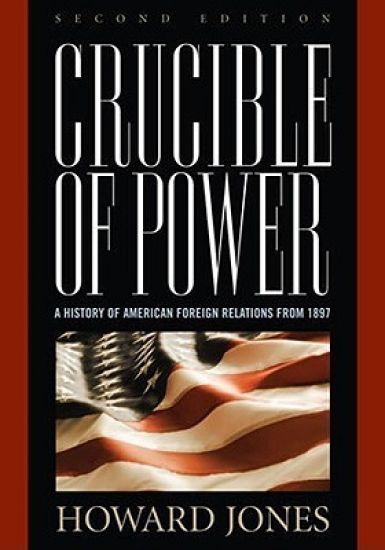
In this updated edition of Crucible of Power, Howard Jones draws on his remarkable breadth as a historian of U.S. foreign relations to produce a distinguished survey of America's growth from an emerging power in the 1890s to its present day position of global preeminence. Comprehensive, tempered, and highly accessible, Jones demonstrates the complexities facing U.S. policy makers and the limitations on their actions. The balanced and thoughtful approach to controversial issues and situations makes this book exceptional for classroom use. This new edition includes a number of revisions and additions aimed at making the volume more attractive to students, teachers, and general readers. A new final chapter brings the story of America's foreign relations as close to the present as possible by focusing on President George W. Bush and his dealing with 9/11, the wars in Afghanistan and Iraq, and the Global War on Terrorism. Among other changes, new materials on the Bay of Pigs invasion reveal the CIA's collaboration with the Mafia in trying to assassinate Fidel Castro as the spark setting off a popular insurrection. Also new to this edition: Every chapter now has at least one excerpt from a key document of the period, thus allowing the reader to examine historical evidence firsthand in hopes of providing a feel for the period involved, promoting an understanding of history through the eyes of its participants, and showing how the historian determines the important facts relevant to reconstructing a meaningful narrative.

Tao of Holism, The – A Blueprint for 21st Century Living
Howard Jones
John Hunt Publishing
2008
nidottu
With current corporate economics, the environment is being depleted and destroyed at an unsustainable rate, but abandoning the quality of life offered by advances in science and technology to return to some primitive lifestyle, is not a realistic option. "The Tao of Holism", a blueprint for 21st century living, is a source of factual and statistical data on many topics of widespread concern - health, nutrition, education, economics, religion, breakdown of society, depletion of the environment's resources and exploitation of third world communities, with opinions from a number of experts in each field. This book aims to inform opinion makers to influence society and governments and empower people to live within our environmental resources, outlining the steps we must take as individuals and societies to live holistically and safeguard the planet to ensure economic stability and environmental preservation.

When John F. Kennedy was shot, millions were left to wonder how America, and the world, would have been different had he lived to fulfill the enormous promise of his presidency. For many historians and political observers, what Kennedy would and would not have done in Vietnam has been a source of enduring controversy. Now, based on convincing new evidence--including a startling revelation about the Kennedy administration's involvement in the assassination of Premier Diem--Howard Jones argues that Kennedy intended to withdraw the great bulk of American soldiers and pursue a diplomatic solution to the crisis in Vietnam. Drawing upon recently declassified hearings by the Church Committee on the U.S. role in assassinations, newly released tapes of Kennedy White House discussions, and interviews with John Kenneth Galbraith, Robert McNamara, Dean Rusk, and others from the president's inner circle, Jones shows that Kennedy firmly believed that the outcome of the war depended on the South Vietnamese. In the spring of 1962, he instructed Secretary of Defense McNamara to draft a withdrawal plan aimed at having all special military forces home by the end of 1965. The "Comprehensive Plan for South Vietnam" was ready for approval in early May 1963, but then the Buddhist revolt erupted and postponed the program. Convinced that the war was not winnable under Diem's leadership, President Kennedy made his most critical mistake--promoting a coup as a means for facilitating a U.S. withdrawal. In the cruelest of ironies, the coup resulted in Diem's death followed by a state of turmoil in Vietnam that further obstructed disengagement. Still, these events only confirmed Kennedy's view about South Vietnam's inability to win the war and therefore did not lessen his resolve to reduce the U.S. commitment. By the end of November, however, the president was dead and Lyndon Johnson began his campaign of escalation. Jones argues forcefully that if Kennedy had not been assassinated, his withdrawal plan would have spared the lives of 58,000 Americans and countless Vietnamese. Written with vivid immediacy, supported with authoritative research, Death of a Generation answers one of the most profoundly important questions left hanging in the aftermath of John F. Kennedy's death.

In Abraham Lincoln and a New Birth of Freedom, Howard Jones explores the relationship between President Lincoln's wartime diplomacy and his interrelated goals of forming a more perfect Union and abolishing slavery. From the outset of the Civil War, Lincoln's central purpose was to save the Union by defeating the South on the battlefield. No less important was his need to prevent a European intervention that would have facilitated the South's move for independence. Lincoln's goal of preserving the Union, however, soon evolved into an effort to form a more perfect Union, one that rested on the natural rights principles of the Declaration of Independence and thus necessitated emancipation.

In the aftermath of the Second World War, civil war erupted in Greece between Western-orientated government forces and Communist rebels. The Truman administration subsequently became heavily involved in the internal conflict, including the establishment of an American military presence on Greek soil and regular arms shipments. This early containment policy, focusing on Greece as a crucial outpost in the Mediterranean arena, was symbolic of "America's Commitment to Free World Principles", and her fear that the Soviet's ultimate goal was world domination.

During the 1840s the United States and England were in conflict over two unsettled territories along the undefined Canadian-American border. This riveting account of the Maine and Oregon boundary treaties is brought to life masterfully by Professors Howard Jones and Donald Rakestraw. The events in this story paved the way for one of the most far-reaching developments in American history: the age of expansion. The United States gradually came to believe in manifest destiny, the irreversible expansion of the States across the continent. The country?s success with England in resolving the two territorial disputes marked the dawn of this new era. Complicating the U.S.-English situation in the 1840s was a border conflict brewing with Mexico. Failure to resolve the disputes with England might have led the United States to war with two nations at once. Careful negotiations led to settlements with England instead of war. But the United States went to war with Mexico from 1846 to 1848. Prologue to Manifest Destiny offers a rare, detailed look at the tense Anglo-American relationship during the 1840s and the two agreements reached regarding the land in the Northeast and the Northwest. Presidents John Tyler and James Polk and the robust master of diplomacy, Daniel Webster, were among the American actors who played center stage in the drama, as well as Britain?s Lord Ashburton, who worked closely with Webster to keep the turbulent conflict over the Northeast territory from escalating into war. This gripping frontier story will fascinate as it educates. Prologue to Manifest Destiny is perfect for courses in American history, international relations, and diplomatic history.

Published for the first time in the UK to coincide with Steven Spielberg's forthcoming movie Amistad, Mutiny on the Amistad presents the first full-scale treatment of the only instance in history where African blacks, seized by slave dealers, won their freedom and returned home. Howard Jones describes how, in 1839, Joseph Cinqué led a revolt on the Spanish slave ship, the Amistad, in the Caribbean. Allowing only the captain and first mate to live in order to steer the ship back to Sierra Leone, the Africans were tricked and taken to New York. The seizure of the ship by an American naval vessel near Montauk, Long Island, the arrest of the Africans in Connecticut, and the Spanish protest against the violation of their property rights created an international controversy. The Amistad affair united Lewis Tappan and other abolitionists who put the `law of nature' on trial in the United States by their refusal to accept a legal system that claimed to dispense justice while permitting artificial distinctions based on race or colour. The mutiny resulted in a trial before the U.S. Supreme Court that pitted former President John Quincy Adams against the federal government. Jones vividly recaptures this compelling drama--the most famous slavery case before Dred Scott--that climaxed in the court's ruling to free the captives and allow them to return to Africa.
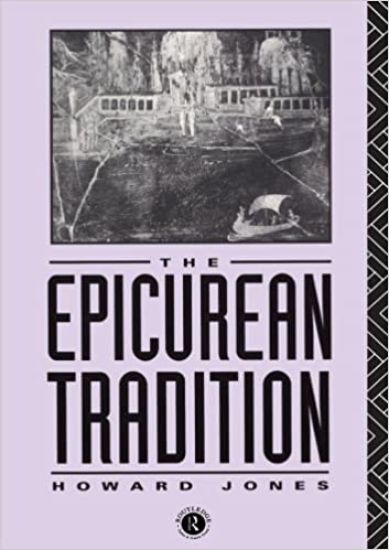
First published in 1992. Epicureanism has had a long and complex history. This book is the first to chronicle this history, from its beginnings in Greece in the fourth century BC to its role in the development of philosophy and science in the sixteenth and seventeenth centuries. Divided equally between the classical and post-classical worlds, The Epicurean Tradition is a notable contribution to classical scholarship and to the history of ideas.

The University and the New World
Howard Jones; David Riesman; Robert Ulich
University of Toronto Press
1962
pokkari
This is the first volume in the Invitation Lecture Series of York University and it is an auspicious beginning. Three leaders in higher education in the United States here present their thoughts on challenging questions of enrolment, curriculum, and standards which today confront the ever expanding universities of North America. Professor Jones describes "The Idea of a University Once More"; Professor Riesman outlines and comments on some significant recent "Experiments in Higher Education"; Professor Ulich discusses a theme which is vitally important for the effect of university education, "Creativity."