Kirjojen hintavertailu. Mukana 12 657 676 kirjaa ja 12 kauppaa.
Kirjailija
Howard Kunreuther
Kirjat ja teokset yhdessä paikassa: 13 kirjaa, julkaisuja vuosilta 1995-2021, suosituimpien joukossa Insurance Decision Making and Market Behavior. Vertaile teosten hintoja ja tarkista saatavuus suomalaisista kirjakaupoista.
When Congress passed the Nuclear Waste Policy Act of 1982, it directed the Department of Energy to locate, study, license, and develop a deep underground repository for high-level nuclear wastes. As the authors of this study show, by 1987 the program was in shambles, beset by opposition from every state that had a potential storage site. Congress p
A profound and insightful look at how company leaders prepare for and respond to shocks and crises that threaten their business. Successful firms strategically manage and are more accurate in their assessment of large-scale risks. Doing so is increasingly challenging given the pace of change, whether financial, technological, regulatory, or environmental. Mastering Catastrophic Risk provides real-world practical insights into how large companies are responding to this new reality and develops a framework for smarter thinking about events that can damage a business. As leading authorities on risk management, strategy, and company leadership, Howard Kunreuther and Michael Useem take us on a groundbreaking tour of firms' decision making process. They demonstrate how improving readiness for and resilience against future shocks is now an integral part of company strategy. Using the "DISRUPT" model they have developed, they highlight the seven primary Drivers of disruption: Interdependencies increase exposure; Short-term focus results in limited vision; Regulations require change and constrain opportunities; Urbanization increases the costs of disasters; Probabilities of disasters have increased; and Transparency has enhanced public awareness of problems and impacts on firms' reputations. This updated paperback edition includes a new preface to address threats to business that have emerged or intensified in the past two years including existential threats like the coronavirus, self-inflicted calamities like the Wells Fargo customer account scandal, and natural disasters like the West Coast wildfires and hurricanes on the Atlantic. Some disruptions can be anticipated, while others arrive without warning. Their onset stresses decision makers, impairs company operations, and may even put the enterprise at risk. The bottom-line: business leaders and their governing boards face ever more challenging disruptions and must be ever more on guard. If your company is hit tomorrow, will it bounce back, or drown?
Time is both the ally of high-level nuclear waste (HLNW) managers and the enemy. It is the ally because the radioactivity in elements and isotopes decreases with age, making the waste progressively less dangerous to human health and safety and the environment. This rate of radioactive decline varies, in some cases diminishing by half (the half life) in seconds, minutes, hours, days, weeks, months, or years. In other cases the decay process takes centuries or hundreds of thousands of years before the wastes are safe for human contact. The problem as now conceptualized for HLNW managers is simple to state if not easy to achieve. The HLNW needs to be secured in some fashion until it decays, by virtue of its physical nature, to safe levels. Another possible future solution, not currently available, might be to change the ~~ructure of HLNW through high-technology processing and thus decompose the waste into units with different and less lengthy radioactivity. Learning whether this processing is a future option will require patience and generous amounts of time for research.
Addresses the question of how potential insurance buyers make decisions like these by considering the conceptual and empirical evidence that address the following theoretical and behavioral issues: the extent that consumers tend to follow the multiperiod decision rules based on expected utility [E(U)] maximization; and the factors that influence their choices when they do not behave as if they are maximizing E(U).The principal contribution of this monograph is to demonstrate that emotions play a role in predicting departures from expected utility maximization for making insurance purchasing decisions over time. The authors highlight the conceptual issues and alternative theories of behavior about repeat insurance purchasing over time and the empirical literature on the proportion of consumers that buy coverage after loss-producing events only to cancel their insurance as those events become more distant in time.The monograph then details the findings from novel web-based experiments that seek to determine whether people change their insurance decisions after experiencing a loss when offered a relatively high, medium or low premium relative to the expected loss. Section 2 reviews the empirical evidence on deviations from rational thinking, especially as they relate to choices about repeated purchase over time. It also discusses the interplay between cognitive biases generated by intuitive thinking and emotions in changing insurance purchase decisions over time. Section 3 details an experiment in the context of hypothetical hurricane damage where individuals are told that loss probabilities and premiums remain the same from period to period. Section 4 details an experiment where participants must choose between high-deductible health insurance at a given premium and low-deductible health insurance at a higher premium, and explores whether they will switch from one policy to the other over time. Section 5 draws together the findings, and provides guiding principles of insurance and recommendations for public-private partnerships to address the cognitive biases noted in Section 2 via a behavioral risk audit that encourages more deliberative thinking with respect to insurance-related choices.
A profound and insightful look at how company leaders prepare for and respond to shocks and crises that threaten their business. Successful firms strategically manage and are more accurate in their assessment of large-scale risks. Doing so is increasingly challenging given the pace of change, whether financial, technological, regulatory, or environmental. Mastering Catastrophic Risk provides real-world practical insights into how large companies are responding to this new reality and develops a framework for smarter thinking about events that can damage a business. As leading authorities on risk management, strategy, and company leadership, Howard Kunreuther and Michael Useem take us on a groundbreaking tour of firms' decision making process. They demonstrate how improving readiness for and resilience against future shocks is now an integral part of company strategy. Using the "DISRUPT" model they have developed, they highlight the seven primary Drivers of disruption: Interdependencies increase exposure; Short-term focus results in limited vision; Regulations require change and constrain opportunities; Urbanization increases the costs of disasters; Probabilities of disasters have increased; and Transparency has enhanced public awareness of problems and impacts on firms' reputations. Some disruptions can be anticipated, while others arrive without warning. Their onset stresses decision makers, impairs company operations, and may even put the enterprise at risk. The bottom-line: business leaders and their governing boards face ever more challenging disruptions and must be ever more on guard. If your company is hit tomorrow, will it bounce back, or drown?
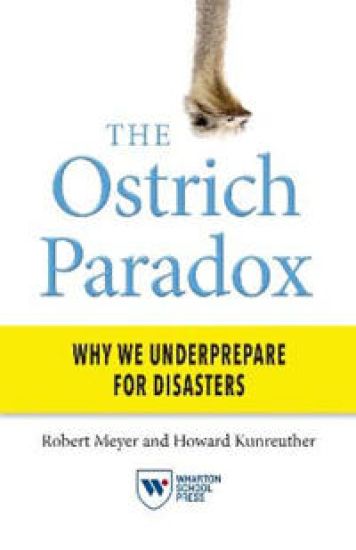
"The Ostrich Paradox boldly addresses a key question of our time: Why are we humans so poor at dealing with disastrous risks, and what can we humans do about it? It is a must-read for everyone who cares about risk." —Daniel Kahneman, winner of the Nobel Prize in Economics and author of Thinking, Fast and Slow We fail to evacuate when advised. We rebuild in flood zones. We don't wear helmets. We fail to purchase insurance. We would rather avoid the risk of "crying wolf" than sound an alarm. Our ability to foresee and protect against natural catastrophes has never been greater; yet, we consistently fail to heed the warnings and protect ourselves and our communities, with devastating consequences. What explains this contradiction? In The Ostrich Paradox, Wharton professors Robert Meyer and Howard Kunreuther draw on years of teaching and research to explain why disaster preparedness efforts consistently fall short. Filled with heartbreaking stories of loss and resilience, the book addresses: •How people make decisions when confronted with high-consequence, low-probability events—and how these decisions can go awry •The 6 biases that lead individuals, communities, and institutions to make grave errors that cost lives •The Behavioral Risk Audit, a systematic approach for improving preparedness by recognizing these biases and designing strategies that anticipate them •Why, if we are to be better prepared for disasters, we need to learn to be more like ostriches, not less Fast-reading and critically important, The Ostrich Paradox is a must-read for anyone who wants to understand why we consistently underprepare for disasters, as well as private and public leaders, planners, and policy-makers who want to build more prepared communities.
"The Ostrich Paradox boldly addresses a key question of our time: Why are we humans so poor at dealing with disastrous risks, and what can we humans do about it? It is a must-read for everyone who cares about risk." —Daniel Kahneman, winner of the Nobel Prize in Economics and author of Thinking, Fast and Slow We fail to evacuate when advised. We rebuild in flood zones. We don't wear helmets. We fail to purchase insurance. We would rather avoid the risk of "crying wolf" than sound an alarm. Our ability to foresee and protect against natural catastrophes has never been greater; yet, we consistently fail to heed the warnings and protect ourselves and our communities, with devastating consequences. What explains this contradiction? In The Ostrich Paradox, Wharton professors Robert Meyer and Howard Kunreuther draw on years of teaching and research to explain why disaster preparedness efforts consistently fall short. Filled with heartbreaking stories of loss and resilience, the book addresses: •How people make decisions when confronted with high-consequence, low-probability events—and how these decisions can go awry •The 6 biases that lead individuals, communities, and institutions to make grave errors that cost lives •The Behavioral Risk Audit, a systematic approach for improving preparedness by recognizing these biases and designing strategies that anticipate them •Why, if we are to be better prepared for disasters, we need to learn to be more like ostriches, not less Fast-reading and critically important, The Ostrich Paradox is a must-read for anyone who wants to understand why we consistently underprepare for disasters, as well as private and public leaders, planners, and policy-makers who want to build more prepared communities.
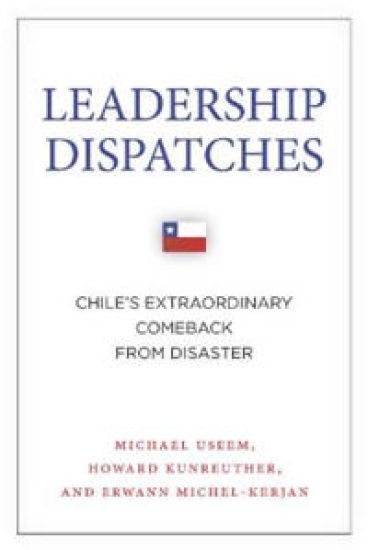
On February 27, 2010, Chile was rocked by a violent earthquake five hundred times more powerful than the one that hit Haiti just six weeks prior. The Chilean earthquake devastated schools, hospitals, roads, and homes, paralyzing the country for weeks and causing economic damage that was equal to 18 percent of Chile's GDP. This calamity hit just as an incumbent political regime was packing its bags and a new administration was preparing to take office. For most countries, it would have taken years, if not decades, to recover from such an event. Yet, only one year later, Chile's economy had reached a six percent annual growth rate. In Leadership Dispatches, Michael Useem, Howard Kunreuther, and Erwann Michel-Kerjan look at how the nation's leaders—in government, business, religion, academia, and beyond—facilitated Chile's recovery. They attribute Chile's remarkable comeback to a two-part formula consisting of strong national leadership on the one hand, and deeply rooted institutional practices on the other. Coupled with strategic, deliberative thinking, these levers enabled Chile to bounce back quickly and exceed its prior national performance. The authors make the case that the Chilean story contains lessons for a broad range of organizations and governments the world over. Large-scale catastrophes of many kinds—from technological meltdowns to disease pandemics—have been on the rise in recent years. Now is the time to seek ideas and guidance from other leaders who have triumphed in the wake of a disaster. In this vein, Leadership Dispatches is both a remarkable story of resilience and an instructive look at how those with the greatest responsibility for a country, company, or community should lead.
Can insurance be used as a means to obtain compliance with environmental policy? Answering this question requires examination of a broad mosaic of academic issues, including current systems available for providing compensation and deterrence, use of contracts (including insurance) as substitutes for tort law, limitations of regulatory policy-making by government agencies, pre-conditions for creation of insurance products, and market mechanisms necessary for insurance to be purchased or sold. The purpose of Managing Environmental Risk Through Insurance is to highlight the potential role that insurance and performance standards can play in managing environmental risk. Insurance can play a significant role in dealing with one of the most problematic issues facing society today - how to compensate for environmental exposures. This book analyzes the ability of insurance to play a role in managing environmental risk. It begins by outlining the role insurance plays in society in contrast to other societal tools for addressing risk: government benefit programs and imposition of involuntary liability using the court system. By so doing, the book describes the comparative advantages of insurance. The book then analyzes the insurability of the risks. Finally, the book applies the insurability analysis to three concrete environmental examples.
Considerable evidence suggests that many people for whom insurance is worth purchasing do not have coverage and others who appear not to need financial protection against certain events actually have purchased coverage. There are certain types of events for which one might expect to see insurance widely marketed are now viewed today by insurers as uninsurable and there are other policies one might not expect to be successfully marketed that exist on a relatively large scale. In addition, evidence suggests that cost-effective preventive measures are sometimes rewarded by insurers in ways that could change their clients' behaviour. These examples reveal that insurance purchasing and marketing activities do not always produce results that are in the best interest of individuals at risk. Insurance Decision Making and Market Behavior discusses such behaviour with the intent of categorizing these insurance "anomalies". It represents a first step in constructing a theory of insurance decision making to explain behaviour that does not conform to standard economic models of choice and decision-making. Finally, the authors propose a set of prescriptive solutions for improving insurance decision-making.
Can insurance be used as a means to obtain compliance with environmental policy? Answering this question requires examination of a broad mosaic of academic issues, including current systems available for providing compensation and deterrence, use of contracts (including insurance) as substitutes for tort law, limitations of regulatory policy-making by government agencies, pre-conditions for creation of insurance products, and market mechanisms necessary for insurance to be purchased or sold. The purpose of Managing Environmental Risk Through Insurance is to highlight the potential role that insurance and performance standards can play in managing environmental risk. Insurance can play a significant role in dealing with one of the most problematic issues facing society today - how to compensate for environmental exposures. This book analyzes the ability of insurance to play a role in managing environmental risk. It begins by outlining the role insurance plays in society in contrast to other societal tools for addressing risk: government benefit programs and imposition of involuntary liability using the court system. By so doing, the book describes the comparative advantages of insurance. The book then analyzes the insurability of the risks. Finally, the book applies the insurability analysis to three concrete environmental examples.
This book explores siting dilemmas - situations in which an "authority" (e.g., Congress, a consortium of utilities) deems it in the best interest of society to build a facility such as an incinerator, but opponents living near the proposed site thwart the plan. Facility developers typically attribute local opposition to selfishness or radically inaccurate views of the risks posed by the facility. We examine the validity of these conclusions by looking in depth at the psychological response that arises when residents are faced with the prospect of living near waste disposal facilities. The particular siting dilemma considered in this book is the problem of how to "dispose" of the high-level nuclear wastes accumulating at nuclear power plants in the United States. These wastes, in the form of "spent" fuel rods, will emit dangerous levels of radioactivity for thousands of years - anywhere between 10,000 and 100,000 years, depending on the margin of safety one adopts. The current proposal is to encase the spent fuel in corrosion-resistant canisters and then to bury these canisters deep underground in a geologic repository. The two of us became involved with the high-level waste issue in 1986 as part of an interdisciplinary research team hired by the State of Nevada. The charge of this team was to estimate the socioeconomic impacts that would accompany a repository if it were built at Yucca Mountain, approximately 100 miles northwest of Las Vegas.
This book explores siting dilemmas - situations in which an "authority" (e.g., Congress, a consortium of utilities) deems it in the best interest of society to build a facility such as an incinerator, but opponents living near the proposed site thwart the plan. Facility developers typically attribute local opposition to selfishness or radically inaccurate views of the risks posed by the facility. We examine the validity of these conclusions by looking in depth at the psychological response that arises when residents are faced with the prospect of living near waste disposal facilities. The particular siting dilemma considered in this book is the problem of how to "dispose" of the high-level nuclear wastes accumulating at nuclear power plants in the United States. These wastes, in the form of "spent" fuel rods, will emit dangerous levels of radioactivity for thousands of years - anywhere between 10,000 and 100,000 years, depending on the margin of safety one adopts. The current proposal is to encase the spent fuel in corrosion-resistant canisters and then to bury these canisters deep underground in a geologic repository. The two of us became involved with the high-level waste issue in 1986 as part of an interdisciplinary research team hired by the State of Nevada. The charge of this team was to estimate the socioeconomic impacts that would accompany a repository if it were built at Yucca Mountain, approximately 100 miles northwest of Las Vegas.