Kirjojen hintavertailu. Mukana 12 211 845 kirjaa ja 12 kauppaa.

Kirjailija

Howard S. Schwartz

Kirjat ja teokset yhdessä paikassa: 6 kirjaa, julkaisuja vuosilta 1992-2019, suosituimpien joukossa Political Correctness and the Destruction of Social Order. Vertaile teosten hintoja ja tarkista saatavuus suomalaisista kirjakaupoista.

6 kirjaa

Kirjojen julkaisuhaarukka 1992-2019.

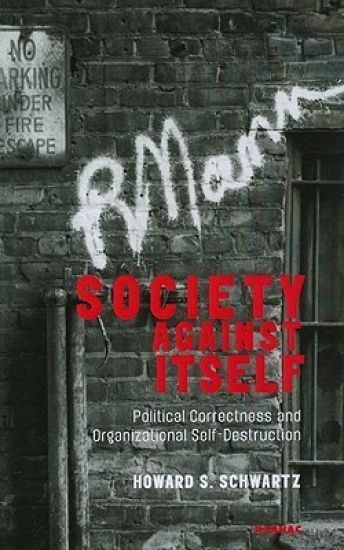
Society Against Itself

Society Against Itself

Howard S. Schwartz

Routledge
2019
sidottu
"Political correctness" involves much more than a restriction of speech. It represents a broad cultural transformation, a shift in the way people understand things and organize their lives; a change in the way meaning is made. The problem addressed in this book is that, for reasons the author explores, some ways of making "meaning" support the creation and maintenance of organization, while others do not. Organizations are cultural products and rely upon psychological roots that go very deep. The basic premise of this book is that organizations are made up of the rules, common understandings, and obligations that "the father" represents, and which are given meaning in the oedipal dynamic. In anti-oedipal psychology, however, they are seen as locuses of deprivation and structures of oppression. Anti-oedipal meaning, then, is geared toward the destruction of organization.

Political Correctness and the Destruction of Social Order

Political Correctness and the Destruction of Social Order

Howard S. Schwartz

Springer International Publishing AG
2018
nidottu
This book develops a psychoanalytic theory of political correctness and the pristine self, which is defined as a self touched by nothing but love. It explores the damage that political correctness can do to social order. Applications include the breakdown of social capital, the financial crisis, and Occupy Wall Street. Long an issue for conservatives, alarm over political correctness has now spread to the liberal side of the political spectrum. As Schwartz argues, all have reason to be concerned. The psychology that underlies political correctness has the potential to be extremely destructive to social organization on every level. Schwartz discusses the primitive roots of political correctness and, through the use of case studies, shows its capacity for ruination. The book focuses on a transformation in the idea of the self, and specifically the rise of the pristine self. The problem is that, in truth, the world does not love us. This puts the pristine self at war with objective reality.
Political Correctness and the Destruction of Social Order

Political Correctness and the Destruction of Social Order

Howard S. Schwartz

Springer International Publishing AG
2016
sidottu
This book develops a psychoanalytic theory of political correctness and the pristine self, which is defined as a self touched by nothing but love. It explores the damage that political correctness can do to social order. Applications include the breakdown of social capital, the financial crisis, and Occupy Wall Street. Long an issue for conservatives, alarm over political correctness has now spread to the liberal side of the political spectrum. As Schwartz argues, all have reason to be concerned. The psychology that underlies political correctness has the potential to be extremely destructive to social organization on every level. Schwartz discusses the primitive roots of political correctness and, through the use of case studies, shows its capacity for ruination. The book focuses on a transformation in the idea of the self, and specifically the rise of the pristine self. The problem is that, in truth, the world does not love us. This puts the pristine self at war with objective reality.
Society Against Itself

Society Against Itself

Howard S. Schwartz

Karnac Books
2010
nidottu
"Political correctness" involves much more than a restriction of speech. It represents a broad cultural transformation, a shift in the way people understand things and organize their lives; a change in the way meaning is made. The problem addressed in this book is that, for reasons the author explores, some ways of making "meaning" support the creation and maintenance of organization, while others do not. Organizations are cultural products and rely upon psychological roots that go very deep. The basic premise of this book is that organizations are made up of the rules, common understandings, and obligations that "the father" represents, and which are given meaning in the oedipal dynamic. In anti-oedipal psychology, however, they are seen as locuses of deprivation and structures of oppression. Anti-oedipal meaning, then, is geared toward the destruction of organization.
The Revolt of the Primitive

The Revolt of the Primitive

Howard S. Schwartz

Praeger Publishers Inc
2001
sidottu
Perceptions of men as abusers, sexual predators, and deadbeat dads have become firmly entrenched in our culture. Schwartz aims to dispel some of these negative images by delving into the psychological dynamics that have caused them. Revealing the hard facts about how we view men and women in our society, this work explores why the gender war and political correctness continue to be part of our culture.This work explores the psychological dynamics of the gender war and political correctness. Perceptions of men as abusers, sexual predators, and deadbeat dads have become firmly entrenched in our culture, Schwartz argues, based on bogus information and not on solid objective facts. Aiming to dispel some of these negative images by delving into the psychological dynamics that have caused them and revealing the hard facts about how we view men and women in our society, Schwartz questions the current gender war. This book will be of interest to scholars and students in the areas of psychology, women's and men's studies, social policy, child development, and family therapists.
Narcissistic Process and Corporate Decay

Narcissistic Process and Corporate Decay

Howard S. Schwartz

New York University Press
1992
pokkari
Howard S. Schwartz shows how American industry is in a process of decay unable to cope with foreign competition and stagnant in technological development. He attributes this Organizational Decay to a reluctance in the part of corporate members to deal with reality.