

Kirjailija
Howard Thomas
Kirjat ja teokset yhdessä paikassa: 28 kirjaa, julkaisuja vuosilta 1984-2026, suosituimpien joukossa The Marble Index. Vertaile teosten hintoja ja tarkista saatavuus suomalaisista kirjakaupoista.
28 kirjaa
Kirjojen julkaisuhaarukka 1984-2026.

Global Business Education
Paul R. Carlile; Steven H. Davidson; Howard Thomas
TAYLOR FRANCIS LTD
2025
sidottu
How can business education enhance value for students, employers, and the rest of society? How will technology continue to challenge the model of business education? And how can academia and industry collaborate to make sure that students develop important leadership and management competencies? These are just some of the critical questions facing business school leaders, educators, and industry experts today. This book, the first in a two-book series to articulate the rationale and method for developing a series of global conversations through a Jam process to address the most pressing issues in business education today, looks specifically at the issue of regional requirements and necessary contextual variation in approaches.With insights from some of the leading business school deans and educators, Global Business Education: An Innovative Dialogue focuses on the discussion and paths taken that led to the creation of the innovative concept of a distributed, regional model of jams. This will include the background on the first Jam; the rationale and design of the regional jams; and present the outcomes of the 10 global dialogues.This book is important for all business school leaders and educators who wish to gain insight into innovative methods for determining new directions in business education.

Global Business Education
Paul R. Carlile; Steven H. Davidson; Howard Thomas
TAYLOR FRANCIS LTD
2025
nidottu
How can business education enhance value for students, employers, and the rest of society? How will technology continue to challenge the model of business education? And how can academia and industry collaborate to make sure that students develop important leadership and management competencies? These are just some of the critical questions facing business school leaders, educators, and industry experts today. This book, the first in a two-book series to articulate the rationale and method for developing a series of global conversations through a Jam process to address the most pressing issues in business education today, looks specifically at the issue of regional requirements and necessary contextual variation in approaches.With insights from some of the leading business school deans and educators, Global Business Education: An Innovative Dialogue focuses on the discussion and paths taken that led to the creation of the innovative concept of a distributed, regional model of jams. This will include the background on the first Jam; the rationale and design of the regional jams; and present the outcomes of the 10 global dialogues.This book is important for all business school leaders and educators who wish to gain insight into innovative methods for determining new directions in business education.

Leading a Business School
Julie Davies; Howard Thomas; Eric Cornuel; Rolf D. Cremer
TAYLOR FRANCIS LTD
2023
nidottu
Business schools are critical players in higher education, educating current and future leaders to make a difference in the world. Yet we know surprisingly little about the leaders of business schools. Leading a Business School demystifies this complex and dynamic role, offering international insights into deans’ dilemmas in different contexts and situations. It highlights the importance of deans creating challenging and supportive learning cultures to enhance business and management education, organizations and society more broadly. Written by renowned experts on the role of the dean, Julie Davies, Howard Thomas, Eric Cornuel and Rolf D. Cremer, the book traces the historical evolution of the business school deanship, the current challenges and future sources of disruption. The leadership characteristics and styles of business school deans are presented based on an examination of different dimensions of their roles. These include issues of strategic positioning, such as financial viability, prestige, size, mission, age, location and programme portfolios, as well as the influences of rankings, sector accreditations, governance structures, networks and national policies on strategy implementation. Drawing on international case studies and deans’ development programmes globally, the authors explore constraints on deans’ autonomy, university and external relations, and how business school deans add value over the period of their tenures. This candid and well-researched book is essential reading for aspiring business school leaders, those hiring and working with deans, and other higher education leaders.The Open Access version of this book, available at http://www.taylorfrancis.com, has been made available under a Creative Commons Attribution-Non Commercial-No Derivatives (CC-BY-NC-ND) 4.0 license. Funded by EFMD Global.

Leading a Business School
Julie Davies; Howard Thomas; Eric Cornuel; Rolf D. Cremer
TAYLOR FRANCIS LTD
2023
sidottu
Business schools are critical players in higher education, educating current and future leaders to make a difference in the world. Yet we know surprisingly little about the leaders of business schools. Leading a Business School demystifies this complex and dynamic role, offering international insights into deans’ dilemmas in different contexts and situations. It highlights the importance of deans creating challenging and supportive learning cultures to enhance business and management education, organizations and society more broadly. Written by renowned experts on the role of the dean, Julie Davies, Howard Thomas, Eric Cornuel and Rolf D. Cremer, the book traces the historical evolution of the business school deanship, the current challenges and future sources of disruption. The leadership characteristics and styles of business school deans are presented based on an examination of different dimensions of their roles. These include issues of strategic positioning, such as financial viability, prestige, size, mission, age, location and programme portfolios, as well as the influences of rankings, sector accreditations, governance structures, networks and national policies on strategy implementation. Drawing on international case studies and deans’ development programmes globally, the authors explore constraints on deans’ autonomy, university and external relations, and how business school deans add value over the period of their tenures. This candid and well-researched book is essential reading for aspiring business school leaders, those hiring and working with deans, and other higher education leaders.The Open Access version of this book, available at http://www.taylorfrancis.com, has been made available under a Creative Commons Attribution-Non Commercial-No Derivatives (CC-BY-NC-ND) 4.0 license. Funded by EFMD Global.

Creating a New Management University
Howard Thomas; Alex Wilson; Michelle P. Lee
TAYLOR FRANCIS LTD
2022
sidottu
This book provides an in-depth exploration of one of the most significant success stories of the development of an entrepreneurial university in recent times as well as its role within society and the economy. Written by leading business school Dean and scholar, Howard Thomas, and Alex Wilson and Michelle Lee, the book tracks the genesis of the idea of a third local university in Singapore to its fruition as Singapore Management University (SMU). It provides important insight and lessons for senior university and business school leaders, as well as regional and national governments. The increasing emphasis on the importance of innovative, entrepreneurial universities for social and economic growth has prompted this review of the strategy and impact of SMU. The book addresses the strategic evolution of SMU itself, from its origins as a single business school, into a multi-school, social science-focused school of management. It examines whether it has fulfilled its promise as an entrepreneurial university and a change agent in the context of Singapore’s strong economic growth and educational strategy. More broadly, it explores how investment in education, and entrepreneurial universities such as SMU, can facilitate and enhance economic growth. University leadership teams, policy analysts, faculty and students of entrepreneurship education, education management and policy in general, and business education in particular, will find this book an invaluable insight into building a genuinely entrepreneurial university.
Creating a New Management University
Howard Thomas; Alex Wilson; Michelle P. Lee
TAYLOR FRANCIS LTD
2022
nidottu
This book provides an in-depth exploration of one of the most significant success stories of the development of an entrepreneurial university in recent times as well as its role within society and the economy. Written by leading business school Dean and scholar, Howard Thomas, and Alex Wilson and Michelle Lee, the book tracks the genesis of the idea of a third local university in Singapore to its fruition as Singapore Management University (SMU). It provides important insight and lessons for senior university and business school leaders, as well as regional and national governments. The increasing emphasis on the importance of innovative, entrepreneurial universities for social and economic growth has prompted this review of the strategy and impact of SMU. The book addresses the strategic evolution of SMU itself, from its origins as a single business school, into a multi-school, social science-focused school of management. It examines whether it has fulfilled its promise as an entrepreneurial university and a change agent in the context of Singapore’s strong economic growth and educational strategy. More broadly, it explores how investment in education, and entrepreneurial universities such as SMU, can facilitate and enhance economic growth. University leadership teams, policy analysts, faculty and students of entrepreneurship education, education management and policy in general, and business education in particular, will find this book an invaluable insight into building a genuinely entrepreneurial university.
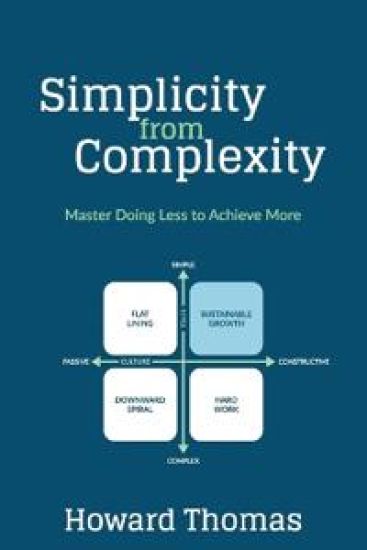
Creatively chasing efficiency and productivity through subject mastery lie at the top of the spiral in our logo. This is the tale of one company's journey.Achieving more by doing less.Adding ever increasing management systems and compliance to a passive organisation will cause productivity to spiral down.Achieving less by doing more.Subsequent efforts to reduce cost by headcount reduction will only accelerate the downward spiral.The choice is yours. Howard is a unique individual with many attributes that enable him to quickly gain people's respect across a broad range of technical and commercial areas. Howard has passion, drive and enthusiasm to add value in everything he does from the front line right up to board level.Steve Wright, Chairman ARC Marine LtdHoward is a superb facilitator, combining in-depth technical, operations and strategy knowledge with inclusive communication skills and a frank and open approach to participant engagement.Steve Ciccone, Regional Director, Wood
Latin America
Gabriela Alvarado; Howard Thomas; Lynne Thomas; Alexander Wilson
Emerald Publishing Limited
2020
nidottu
Latin American business schools have grown in scale and quality in recent decades, yet they have received a relatively low level of attention globally when compared to schools from other parts of the world. This book seeks to address this dearth of attention and provide an in-depth examination of management education in the region. The book examines the main historical, cultural, social, political, and economic aspects of the Latin American continent and describes the evolutionary path of business education in the region until its current state. It analyzes and interprets the major events, key issues, impact of different actors, main changes, and "blind spots" in the evolution of management education in Latin America over the last 10 years. It then identifies the biggest on-going challenges confronting business education on the continent and discusses whether a Latin American model for management education is a realistic proposition. Finally, the book explores how the competitive environment of business education in the region will evolve over the next 10 years, and how these changes will influence the critical issues facing Latin American management education.
Rethinking the Business Models of Business Schools
Kai Peters; Richard R. Smith; Howard Thomas
Emerald Publishing Limited
2020
nidottu
Management education growth and the rise in accompanying business schools over the last few decades are fuelled by global economic development, coupled with the promise of success in business careers. Recently, questions have been raised about the value and relevance of a traditional business school education – so what does the future hold for traditional business schools? In this book, we examine the current model and the pressure points of business schools by considering the evolution of – and the various value chains that are associated with – business school offerings (including MBA, undergraduate, pre-experienced and executive programmes). We also offer insight on funding and value orientation, and the potential challenges these may raise for some schools. To highlight these challenges, we provide a strategic group framework for business schools and review the implications of future strategies for these groups. Finally, after reviewing the current landscape of business school mergers, alliances and failures, we reflect on innovation considerations for the business school business model. Management education is changing, and business schools must be ready to re-evaluate their strategies for growth… and, in some cases, survival.

The Liberal Arts and Management Education
Stefano Harney; Howard Thomas
Cambridge University Press
2020
sidottu
Calling for the transformation of undergraduate education, Thomas and Harney argue that the liberal arts should be integrated into the traditional management curriculum to blend technical and analytic acumen with creativity, critical thinking, and ethical intelligence. In describing their vision for a new liberal management education, the authors demonstrate how a holistic pedagogy that does not sacrifice one wealth of learning for another instead encourages participation and integration to the benefit of students and society. Global in sweep, the book provides case studies of successfully implemented experimental courses in Asia and Britain, as well as a speculative chapter on how an African liberal management education could take shape, based on African-centred principles and histories. Finally, the book argues that the stakes of this agenda go beyond mere curricular reform and pedagogical innovation and speak directly to the environmental, business, political, and social challenges we face today.

Piggy - Love, Cults, Crime & Corruption: The True Story - Part I
Howard Thomas
Independently Published
2019
nidottu
This is an unbelievable yet completely true story that continues to this day. An epic story like no other. Love, cults, crime and corruption. Plus passion, hope, trust, indoctrination, incompetence of courts and police, abuse of women, terror, violence, fear, prison, perjury, fraud, happiness, mystery, magic and peace. To use only a handful of words. This is the first of a trilogy of books that tell the story from the first moment that I met a certain very special girl. But the story hasn't finished, it continues to the very day that you read this. As a reader, and the literary world as a whole, you have the chance to directly influence the end of the trilogy through taking real life action to ensure that this story (nightmare) never occurs again. To ensure various organisations and authorities are brought to justice for their crimes, incompetence and allowing the destruction of two innocent lives. To stop the future abuse and indoctrination of various girls and young women across Europe and North America. To directly stop a cancer that is infecting Europe and North America and change the entire structure of a country. Perhaps also to ensure the future happiness of a young couple whose innocent young love was subjected to a myriad of crimes and insanity.You are about to step into the eyes of this girl, this angel, from the first moment that I met her, some thirteen years ago. As quickly as love blossoms so the flower starts to wilt. Just when you think the situation can't get worse it most certainly does, and the sheer lunacy goes well beyond insanity as the crimes become increasingly desperate. Perhaps you, as the reader, can help to save the life of this girl and others like her. I have tried and continue to try to this day but I'm struggling. I hope with these books that perhaps others will help. I live in hope and my trust in this girl. They are all I have left.
Inclusive growth ensures the benefits of a growing economy extend to all segments of society. Unleashing people’s economic potential starts with connecting them to the vital networks that power the modern economy. Implementing inclusive growth is a means of democratizing productivity and it is essential to reduce the widening gap between the wealthy and the poor in both developed and developing economies. This book arose out of a research partnership between the Mastercard Center for Inclusive Growth and Singapore Management University (SMU). It demonstrates the logic of inclusive growth, explaining its principles and the enabling models that define it. It also examines the means to creatively address financial and social inclusion and thus improve social equality. The focus is to provide basic rights for all in society to access and participate in the vital networks of services and know-how that are the indispensable enablers of increasing productivity in modern economic production. Business, government, and civil society must devise implement effective initiatives so that inclusive growth is achieved through the global democratization of productivity. Inclusive Growth: The Global Challenges of Social Inequality and Financial Inclusion will appeal to researchers and faculty in management and business schools, leaders with a moral and ethical sense of social responsibility, as well as academics interested in economics, economic policy, and economic development.

Latin America
Gabriela Alvarado; Howard Thomas; Lynne Thomas; Alexander Wilson
Emerald Publishing Limited
2018
sidottu
Latin American business schools have grown in scale and quality in recent decades, yet they have received a relatively low level of attention globally when compared to schools from other parts of the world. This book seeks to address this dearth of attention and provide an in-depth examination of management education in the region. The book examines the main historical, cultural, social, political, and economic aspects of the Latin American continent and describes the evolutionary path of business education in the region until its current state. It analyzes and interprets the major events, key issues, impact of different actors, main changes, and "blind spots" in the evolution of management education in Latin America over the last 10 years. It then identifies the biggest on-going challenges confronting business education on the continent and discusses whether a Latin American model for management education is a realistic proposition. Finally, the book explores how the competitive environment of business education in the region will evolve over the next 10 years, and how these changes will influence the critical issues facing Latin American management education.
Rethinking the Business Models of Business Schools
Kai Peters; Richard R. Smith; Howard Thomas
Emerald Publishing Limited
2018
sidottu
Management education growth and the rise in accompanying business schools over the last few decades are fuelled by global economic development, coupled with the promise of success in business careers. Recently, questions have been raised about the value and relevance of a traditional business school education – so what does the future hold for traditional business schools? In this book, we examine the current model and the pressure points of business schools by considering the evolution of – and the various value chains that are associated with – business school offerings (including MBA, undergraduate, pre-experienced and executive programmes). We also offer insight on funding and value orientation, and the potential challenges these may raise for some schools. To highlight these challenges, we provide a strategic group framework for business schools and review the implications of future strategies for these groups. Finally, after reviewing the current landscape of business school mergers, alliances and failures, we reflect on innovation considerations for the business school business model. Management education is changing, and business schools must be ready to re-evaluate their strategies for growth… and, in some cases, survival.

Africa
Howard Thomas; Michelle Lee; Lynne Thomas; Alexander Wilson
Emerald Publishing Limited
2017
sidottu
Africa is commonly perceived as a global growth region and a continent on the move, with a huge demand for managerial skills to ensure sustainable economic growth. In order to gain a comprehensive understanding of the challenges to management education development in Africa, it is important to understand the diverse cultures, histories and contexts underlying the 54 member states. With this is mind, this book explores the future of management education, considering the differing scenarios for change and the practical realities of developing management education in VUCA (volatile, uncertain, complex and ambiguous) environments. This is the second of two volumes, written with strong support from the EFMD (European Foundation for Management Development) and the GMAC (Graduate Management Admission Council), aimed at understanding and examining the challenges of developing management education across Africa. The authors, through a fine-tuned, face-to-face interview process, explore the perspectives and interactions between management educators and other business and government stakeholders as they look to the future of management education in Africa.

Process and Experience in the Language Classroom
Michael Legutke; Howard Thomas; Christopher N. Candlin
Routledge
2017
sidottu
Process and Experience in the Language Classroom argues the case for communicative language teaching as an experiential and task driven learning process. The authors raise important questions regarding the theoretical discussion of communicative competence and current classroom practice. They propose ways in which Communicative Language Teaching should develop within an educational model of theory and practice, incorporating traditions of experimental and practical learning and illustrated from a wide range of international sources. Building on a critical review of recent language teaching principles and practice, they provide selection criteria for classroom activities based on a typology of communicative tasks drawn from classroom experience. The authors also discuss practical attempts to utilise project tasks both as a means of realising task based language learning and of redefining the roles of teacher and learner within a jointly constructed curriculum.
Reimagining Business Education
Paul R. Carlile; Steven H. Davidson; Kenneth W. Freeman; Howard Thomas; N. Venkatraman
Emerald Publishing Limited
2016
sidottu
'Reimagining Business Education’ discusses the rationale for, and design of, the first Business Education Jam. It reviews key challenges facing business education and articulates a vision for how the role and delivery of business education could be reimagined. This book is critically important during a time when business schools, as an industry, struggle to identify the innovations necessary to meet the needs of a changing world. The Jam was the first open platform for dialogue of its kind for business education and continues to make an impact - including use by Schools and Deans around the world to guide strategic planning efforts; program directors as they drive innovation in their programs; and industry executives as they identify ways to better engage with business education. This book takes this collaborative effort a step further to break down traditional models and structures as we seek to reimagine the future of business education in a more open and connected world.

Securing the Future of Management Education
Howard Thomas; Michelle Lee; Lynne Thomas; Alexander Wilson
Emerald Publishing Limited
2014
nidottu
This is the second of two volumes written to celebrate the 40th anniversary of EFMD. Drawing on interviews conducted with leaders in the world of management education, the first volume took a retrospective view, focusing on the evolution of management education and providing the context that led management education to where it stands today. It also synthesized respondents' views on the strengths and weaknesses of the field, the challenges it faces, as well as lessons learned and not learned from the past. This second volume similarly draws on the very rich data provided by the same respondents, but is future-oriented and takes on the theme of change. It provides the reader with a sense of the challenges on the horizon, potential blind spots, and new realities of an increasingly competitive environment. It discusses a range of alternative future scenarios for management education, and urges the field to resist the lures of the dominant paradigm and to develop new models instead. The authors contend that, given the challenges ahead, it is only through transformations and innovations that the future of the field can be secured.

Human Capital and Global Business Strategy
Howard Thomas; Smith Richard R.; Diez Fermin
Cambridge University Press
2013
pokkari
Human capital - the performance and the potential of people in an organisation - has become an increasingly urgent issue for business leaders. Dramatic demographic shifts, the globalisation of organisations, increasing business complexity, and generational differences are causing many organisations to place a more deliberate focus on human capital as a key element in strategic planning and execution. This book helps business leaders determine how to address human capital as part of their business strategy, to drive value and realise the potential of the organisation. Topics are presented clearly, allowing readers to quickly grasp and apply key concepts and ideas. The authors share both their academic research and practical experience from around the world, providing first-hand case studies and examples to help bring theoretical topics to life. With a strong practitioner focus, this book will provide business leaders and HR professionals with new insights into how to improve business performance through a unique, strategic approach to human capital.