Kirjojen hintavertailu. Mukana 12 595 353 kirjaa ja 12 kauppaa.

Kirjailija

Hugh F. Durrant-Whyte

Kirjat ja teokset yhdessä paikassa: 4 kirjaa, julkaisuja vuosilta 1987-2012, suosituimpien joukossa Integration, Coordination and Control of Multi-Sensor Robot Systems. Vertaile teosten hintoja ja tarkista saatavuus suomalaisista kirjakaupoista.

4 kirjaa

Kirjojen julkaisuhaarukka 1987-2012.

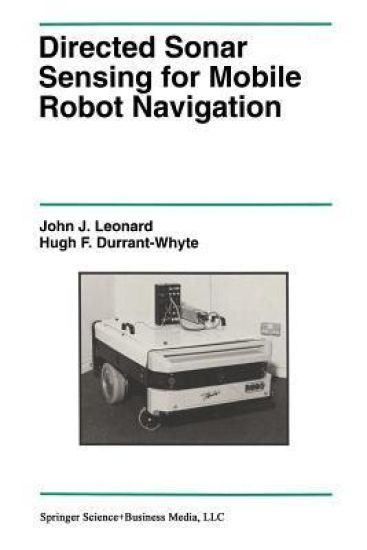
Directed Sonar Sensing for Mobile Robot Navigation

Directed Sonar Sensing for Mobile Robot Navigation

John J. Leonard; Hugh F. Durrant-Whyte

Springer-Verlag New York Inc.
2012
nidottu
This monograph is a revised version of the D.Phil. thesis of the first author, submitted in October 1990 to the University of Oxford. This work investigates the problem of mobile robot navigation using sonar. We view model-based navigation as a process of tracking naturally occurring environment features, which we refer to as "targets". Targets that have been predicted from the environment map are tracked to provide that are observed, but not predicted, vehicle position estimates. Targets represent unknown environment features or obstacles, and cause new tracks to be initiated, classified, and ultimately integrated into the map. Chapter 1 presents a brief definition of the problem and a discussion of the basic research issues involved. No attempt is made to survey ex­ haustively the mobile robot navigation literature-the reader is strongly encouraged to consult other sources. The recent collection edited by Cox and Wilfong [34] is an excellent starting point, as it contains many of the standard works of the field. Also, we assume familiarity with the Kalman filter. There are many well-known texts on the subject; our notation derives from Bar-Shalom and Fortmann [7]. Chapter 2 provides a detailed sonar sensor model. A good sensor model of our approach to navigation, and is used both for is a crucial component predicting expected observations and classifying unexpected observations.
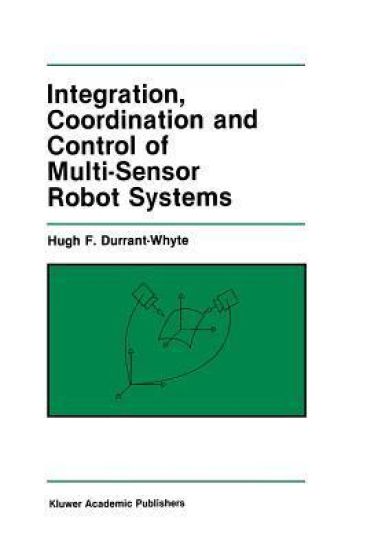
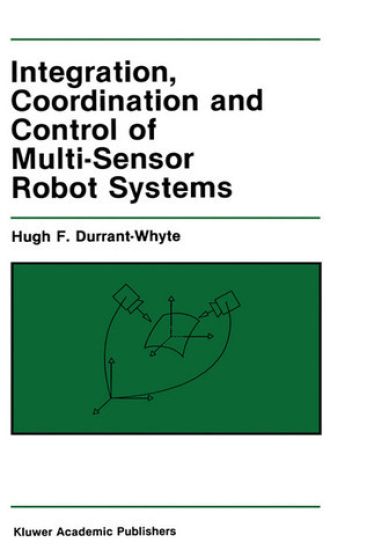
Integration, Coordination and Control of Multi-Sensor Robot Systems

Integration, Coordination and Control of Multi-Sensor Robot Systems

Hugh F. Durrant-Whyte

Springer-Verlag New York Inc.
2011
nidottu
Overview Recent years have seen an increasing interest in the development of multi-sensory robot systems. The reason for this interest stems from a realization that there are fundamental limitations on the reconstruction of environment descriptions using only a single source of sensor information. If robot systems are ever to achieve a degree of intelligence and autonomy, they must be capable of using many different sources of sensory information in an active and dynamic manner. The observations made by the different sensors of a multi-sensor system are always uncertain, usually partial, occasionally spuri9us or incorrect and often geographically or geometrically imcomparable with other sensor views. The sensors of these systems are characterized by the diversity of information that they can provide and by the complexity of their operation. It is the goal of a multi­ sensor system to combine information from all these different sources into a robust and consistent description of the environment.
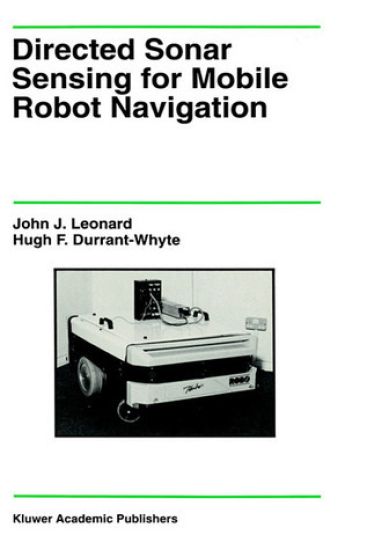
Directed Sonar Sensing for Mobile Robot Navigation

Directed Sonar Sensing for Mobile Robot Navigation

John J. Leonard; Hugh F. Durrant-Whyte

Springer
1992
sidottu
This monograph is a revised version of the D.Phil. thesis of the first author, submitted in October 1990 to the University of Oxford. This work investigates the problem of mobile robot navigation using sonar. We view model-based navigation as a process of tracking naturally occurring environment features, which we refer to as "targets". Targets that have been predicted from the environment map are tracked to provide that are observed, but not predicted, vehicle position estimates. Targets represent unknown environment features or obstacles, and cause new tracks to be initiated, classified, and ultimately integrated into the map. Chapter 1 presents a brief definition of the problem and a discussion of the basic research issues involved. No attempt is made to survey ex­ haustively the mobile robot navigation literature-the reader is strongly encouraged to consult other sources. The recent collection edited by Cox and Wilfong [34] is an excellent starting point, as it contains many of the standard works of the field. Also, we assume familiarity with the Kalman filter. There are many well-known texts on the subject; our notation derives from Bar-Shalom and Fortmann [7]. Chapter 2 provides a detailed sonar sensor model. A good sensor model of our approach to navigation, and is used both for is a crucial component predicting expected observations and classifying unexpected observations.
Integration, Coordination and Control of Multi-Sensor Robot Systems

Integration, Coordination and Control of Multi-Sensor Robot Systems

Hugh F. Durrant-Whyte

Kluwer Academic Publishers
1987
sidottu
Overview Recent years have seen an increasing interest in the development of multi-sensory robot systems. The reason for this interest stems from a realization that there are fundamental limitations on the reconstruction of environment descriptions using only a single source of sensor information. If robot systems are ever to achieve a degree of intelligence and autonomy, they must be capable of using many different sources of sensory information in an active and dynamic manner. The observations made by the different sensors of a multi-sensor system are always uncertain, usually partial, occasionally spuri9us or incorrect and often geographically or geometrically imcomparable with other sensor views. The sensors of these systems are characterized by the diversity of information that they can provide and by the complexity of their operation. It is the goal of a multi­ sensor system to combine information from all these different sources into a robust and consistent description of the environment.