Kirjojen hintavertailu. Mukana 12 595 353 kirjaa ja 12 kauppaa.

Kirjailija

Hung T. Nguyen

Kirjat ja teokset yhdessä paikassa: 16 kirjaa, julkaisuja vuosilta 1989-2023, suosituimpien joukossa Fundamentals of Statistics with Fuzzy Data. Vertaile teosten hintoja ja tarkista saatavuus suomalaisista kirjakaupoista.

16 kirjaa

Kirjojen julkaisuhaarukka 1989-2023.

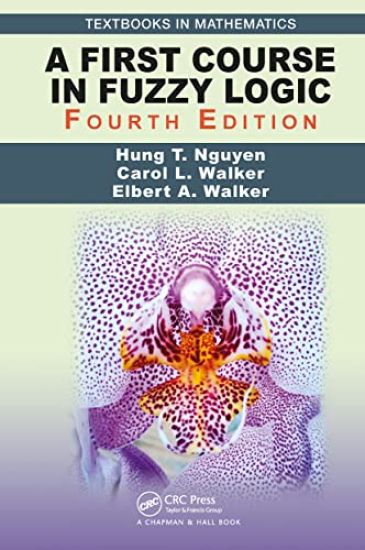
A First Course in Fuzzy Logic

A First Course in Fuzzy Logic

Hung T. Nguyen; Carol Walker; Elbert A. Walker

TAYLOR FRANCIS LTD
2023
nidottu
A First Course in Fuzzy Logic, Fourth Edition is an expanded version of the successful third edition. It provides a comprehensive introduction to the theory and applications of fuzzy logic.This popular text offers a firm mathematical basis for the calculus of fuzzy concepts necessary for designing intelligent systems and a solid background for readers to pursue further studies and real-world applications.New in the Fourth Edition: Features new results on fuzzy sets of type-2 Provides more information on copulas for modeling dependence structures Includes quantum probability for uncertainty modeling in social sciences, especially in economics With its comprehensive updates, this new edition presents all the background necessary for students, instructors and professionals to begin using fuzzy logic in its many—applications in computer science, mathematics, statistics, and engineering. About the Authors:Hung T. Nguyen is a Professor Emeritus at the Department of Mathematical Sciences, New Mexico State University. He is also an Adjunct Professor of Economics at Chiang Mai University, Thailand.Carol L. Walker is also a Professor Emeritus at the Department of Mathematical Sciences, New Mexico State University.Elbert A. Walker is a Professor Emeritus, Department of Mathematical Sciences, New Mexico State University.
An Introduction to Random Sets

An Introduction to Random Sets

Hung T. Nguyen

CRC Press
2019
nidottu
The study of random sets is a large and rapidly growing area with connections to many areas of mathematics and applications in widely varying disciplines, from economics and decision theory to biostatistics and image analysis. The drawback to such diversity is that the research reports are scattered throughout the literature, with the result that in science and engineering, and even in the statistics community, the topic is not well known and much of the enormous potential of random sets remains untapped. An Introduction to Random Sets provides a friendly but solid initiation into the theory of random sets. It builds the foundation for studying random set data, which, viewed as imprecise or incomplete observations, are ubiquitous in today's technological society. The author, widely known for his best-selling A First Course in Fuzzy Logic text as well as his pioneering work in random sets, explores motivations, such as coarse data analysis and uncertainty analysis in intelligent systems, for studying random sets as stochastic models. Other topics include random closed sets, related uncertainty measures, the Choquet integral, the convergence of capacity functionals, and the statistical framework for set-valued observations. An abundance of examples and exercises reinforce the concepts discussed. Designed as a textbook for a course at the advanced undergraduate or beginning graduate level, this book will serve equally well for self-study and as a reference for researchers in fields such as statistics, mathematics, engineering, and computer science.
A First Course in Fuzzy Logic

A First Course in Fuzzy Logic

Hung T. Nguyen; Carol Walker; Elbert A. Walker

CRC Press
2018
sidottu
A First Course in Fuzzy Logic, Fourth Edition is an expanded version of the successful third edition. It provides a comprehensive introduction to the theory and applications of fuzzy logic.This popular text offers a firm mathematical basis for the calculus of fuzzy concepts necessary for designing intelligent systems and a solid background for readers to pursue further studies and real-world applications.New in the Fourth Edition: Features new results on fuzzy sets of type-2 Provides more information on copulas for modeling dependence structures Includes quantum probability for uncertainty modeling in social sciences, especially in economicsWith its comprehensive updates, this new edition presents all the background necessary for students, instructors and professionals to begin using fuzzy logic in its many—applications in computer science, mathematics, statistics, and engineering. About the Authors:Hung T. Nguyen is a Professor Emeritus at the Department of Mathematical Sciences, New Mexico State University. He is also an Adjunct Professor of Economics at Chiang Mai University, Thailand.Carol L. Walker is also a Professor Emeritus at the Department of Mathematical Sciences, New Mexico State University.Elbert A. Walker is a Professor Emeritus, Department of Mathematical Sciences, New Mexico State University.
Stochastic Dominance and Applications to Finance, Risk and Economics

Stochastic Dominance and Applications to Finance, Risk and Economics

Songsak Sriboonchita; Wing-Keung Wong; Sompong Dhompongsa; Hung T. Nguyen

CRC Press
2017
nidottu
Drawing from many sources in the literature, Stochastic Dominance and Applications to Finance, Risk and Economics illustrates how stochastic dominance (SD) can be used as a method for risk assessment in decision making. It provides basic background on SD for various areas of applications. Useful Concepts and Techniques for Economics ApplicationsThe majority of the text presents a systematic exposition of SD, emphasizing rigor and generality. It covers utility theory, multivariate SD, quantile functions, risk modeling, Choquet integrals, other risk measures, statistical inference, nonparametric estimation, hypothesis testing, and econometrics. The remainder of the book explores new applications of SD in finance, risk, and economics. At the beginning of each economic concept, the authors clearly explain only the necessary mathematics so readers are not overburdened with learning nonessential, arduous mathematics.This accessible guide helps readers build a useful repertoire of mathematical tools in decision making under uncertainty, especially in investment science. It provides thorough coverage on the theory of SD, along with many applications to economics and other fields where risk is crucial.
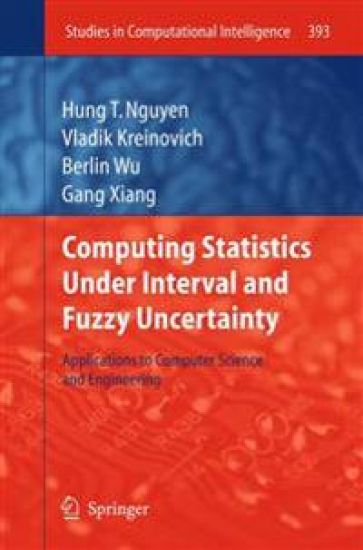
Computing Statistics under Interval and Fuzzy Uncertainty

Computing Statistics under Interval and Fuzzy Uncertainty

Hung T. Nguyen; Vladik Kreinovich; Berlin Wu; Gang Xiang

Springer-Verlag Berlin and Heidelberg GmbH Co. K
2014
nidottu
In many practical situations, we are interested in statistics characterizing a population of objects: e.g. in the mean height of people from a certain area. Most algorithms for estimating such statistics assume that the sample values are exact. In practice, sample values come from measurements, and measurements are never absolutely accurate. Sometimes, we know the exact probability distribution of the measurement inaccuracy, but often, we only know the upper bound on this inaccuracy. In this case, we have interval uncertainty: e.g. if the measured value is 1.0, and inaccuracy is bounded by 0.1, then the actual (unknown) value of the quantity can be anywhere between 1.0 - 0.1 = 0.9 and 1.0 + 0.1 = 1.1. In other cases, the values are expert estimates, and we only have fuzzy information about the estimation inaccuracy. This book shows how to compute statistics under such interval and fuzzy uncertainty. The resulting methods are applied to computer science (optimal scheduling of different processors), to information technology (maintaining privacy), to computer engineering (design of computer chips), and to data processing in geosciences, radar imaging, and structural mechanics.
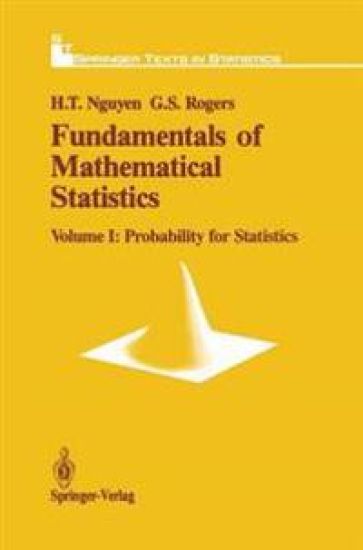
Fundamentals of Mathematical Statistics

Fundamentals of Mathematical Statistics

Hung T. Nguyen; Gerald S. Rogers

Springer-Verlag New York Inc.
2012
nidottu
This is the first half of a text for a two semester course in mathematical statistics at the senior/graduate level for those who need a strong background in statistics as an essential tool in their career. To study this text, the reader needs a thorough familiarity with calculus including such things as Jacobians and series but somewhat less intense familiarity with matrices including quadratic forms and eigenvalues. For convenience, these lecture notes were divided into two parts: Volume I, Probability for Statistics, for the first semester, and Volume II, Statistical Inference, for the second. We suggest that the following distinguish this text from other introductions to mathematical statistics. 1. The most obvious thing is the layout. We have designed each lesson for the (U.S.) 50 minute class; those who study independently probably need the traditional three hours for each lesson. Since we have more than (the U.S. again) 90 lessons, some choices have to be made. In the table of contents, we have used a * to designate those lessons which are "interesting but not essential" (INE) and may be omitted from a general course; some exercises and proofs in other lessons are also "INE". We have made lessons of some material which other writers might stuff into appendices. Incorporating this freedom of choice has led to some redundancy, mostly in definitions, which may be beneficial.
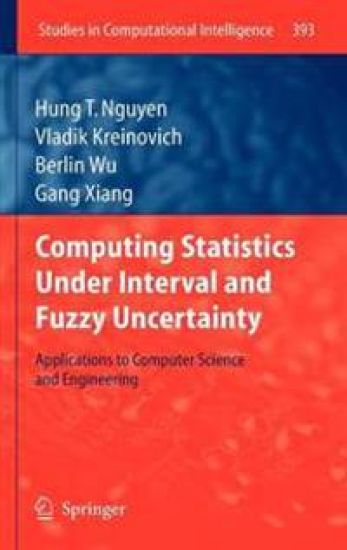
Computing Statistics under Interval and Fuzzy Uncertainty

Computing Statistics under Interval and Fuzzy Uncertainty

Hung T. Nguyen; Vladik Kreinovich; Berlin Wu; Gang Xiang

Springer-Verlag Berlin and Heidelberg GmbH Co. K
2011
sidottu
In many practical situations, we are interested in statistics characterizing a population of objects: e.g. in the mean height of people from a certain area. Most algorithms for estimating such statistics assume that the sample values are exact. In practice, sample values come from measurements, and measurements are never absolutely accurate. Sometimes, we know the exact probability distribution of the measurement inaccuracy, but often, we only know the upper bound on this inaccuracy. In this case, we have interval uncertainty: e.g. if the measured value is 1.0, and inaccuracy is bounded by 0.1, then the actual (unknown) value of the quantity can be anywhere between 1.0 - 0.1 = 0.9 and 1.0 + 0.1 = 1.1. In other cases, the values are expert estimates, and we only have fuzzy information about the estimation inaccuracy. This book shows how to compute statistics under such interval and fuzzy uncertainty. The resulting methods are applied to computer science (optimal scheduling of different processors), to information technology (maintaining privacy), to computer engineering (design of computer chips), and to data processing in geosciences, radar imaging, and structural mechanics.
Fundamentals of Mathematical Statistics

Fundamentals of Mathematical Statistics

Hung T. Nguyen; Gerald S. Rogers

Springer-Verlag New York Inc.
2011
nidottu
This is a text (divided into two volumes) for a two semester course in Mathematical Statistics at the Senior/Graduate level. The two main pedagogical aspects in these Volumes are: (i) the material is designed in lessons (each for a 50 minute class) with complementary exercises and home work. (ii) although the material is traditional, great care is exerted upon self-contained, rigorous and complete presentations. An elementary introduction to characteristic functions and probability measures and intergration, but not general measure theory in Volume I, allows a complete proof of some central limit theorems and a rigorous treatment of asymptotic of statistical inference. But students need to be familiar only with such things as Jacobians and eigenvalues of matrices. Volume II: Statistical Inference is designed for the second semester and contains a rigorous introduction to Mathematical Statistics, from random samples to asymptotic theory of statistical inference.
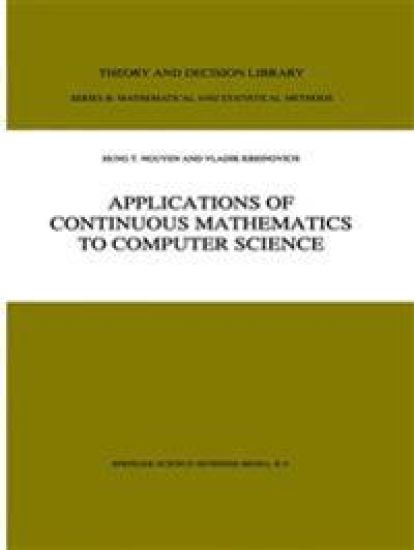
Applications of Continuous Mathematics to Computer Science
This volume is intended to be used as a textbook for a special topic course in computer science. It addresses contemporary research topics of interest such as intelligent control, genetic algorithms, neural networks, optimization techniques, expert systems, fractals, and computer vision. The work incorporates many new research ideas, and focuses on the role of continuous mathematics. Audience: This book will be valuable to graduate students interested in theoretical computer topics, algorithms, expert systems, neural networks, and software engineering.
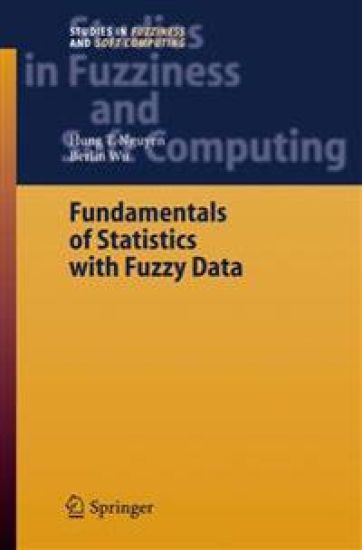
Fundamentals of Statistics with Fuzzy Data

Fundamentals of Statistics with Fuzzy Data

Hung T. Nguyen; Berlin Wu

Springer-Verlag Berlin and Heidelberg GmbH Co. K
2010
nidottu
This research monograph presents basic foundational aspects for a theory of statistics with fuzzy data, together with a set of practical applications. Fuzzy data are modeled as observations from random fuzzy sets. Theories of fuzzy logic and of random closed sets are used as basic ingredients in building statistical concepts and procedures in the context of imprecise data, including coarse data analysis. The monograph also aims at motivating statisticians to look at fuzzy statistics to enlarge the domain of applicability of statistics in general. Hung T. Nguyen is a professor of Mathematical Sciences at New Mexico State University, USA. Berlin Wu is a professor of Mathematical Sciences at National Chengchi University, Taipei, Taiwan.
Stochastic Dominance and Applications to Finance, Risk and Economics

Stochastic Dominance and Applications to Finance, Risk and Economics

Songsak Sriboonchita; Wing-Keung Wong; Sompong Dhompongsa; Hung T. Nguyen

Chapman Hall/CRC
2009
sidottu
Drawing from many sources in the literature, Stochastic Dominance and Applications to Finance, Risk and Economics illustrates how stochastic dominance (SD) can be used as a method for risk assessment in decision making. It provides basic background on SD for various areas of applications. Useful Concepts and Techniques for Economics ApplicationsThe majority of the text presents a systematic exposition of SD, emphasizing rigor and generality. It covers utility theory, multivariate SD, quantile functions, risk modeling, Choquet integrals, other risk measures, statistical inference, nonparametric estimation, hypothesis testing, and econometrics. The remainder of the book explores new applications of SD in finance, risk, and economics. At the beginning of each economic concept, the authors clearly explain only the necessary mathematics so readers are not overburdened with learning nonessential, arduous mathematics.This accessible guide helps readers build a useful repertoire of mathematical tools in decision making under uncertainty, especially in investment science. It provides thorough coverage on the theory of SD, along with many applications to economics and other fields where risk is crucial.
An Introduction to Random Sets

An Introduction to Random Sets

Hung T. Nguyen

Chapman Hall/CRC
2006
sidottu
The study of random sets is a large and rapidly growing area with connections to many areas of mathematics and applications in widely varying disciplines, from economics and decision theory to biostatistics and image analysis. The drawback to such diversity is that the research reports are scattered throughout the literature, with the result that in science and engineering, and even in the statistics community, the topic is not well known and much of the enormous potential of random sets remains untapped. An Introduction to Random Sets provides a friendly but solid initiation into the theory of random sets. It builds the foundation for studying random set data, which, viewed as imprecise or incomplete observations, are ubiquitous in today's technological society. The author, widely known for his best-selling A First Course in Fuzzy Logic text as well as his pioneering work in random sets, explores motivations, such as coarse data analysis and uncertainty analysis in intelligent systems, for studying random sets as stochastic models. Other topics include random closed sets, related uncertainty measures, the Choquet integral, the convergence of capacity functionals, and the statistical framework for set-valued observations. An abundance of examples and exercises reinforce the concepts discussed. Designed as a textbook for a course at the advanced undergraduate or beginning graduate level, this book will serve equally well for self-study and as a reference for researchers in fields such as statistics, mathematics, engineering, and computer science.
Fundamentals of Statistics with Fuzzy Data

Fundamentals of Statistics with Fuzzy Data

Hung T. Nguyen; Berlin Wu

Springer-Verlag Berlin and Heidelberg GmbH Co. K
2006
sidottu
This research monograph presents basic foundational aspects for a theory of statistics with fuzzy data, together with a set of practical applications. Fuzzy data are modeled as observations from random fuzzy sets. Theories of fuzzy logic and of random closed sets are used as basic ingredients in building statistical concepts and procedures in the context of imprecise data, including coarse data analysis. The monograph also aims at motivating statisticians to look at fuzzy statistics to enlarge the domain of applicability of statistics in general. Hung T. Nguyen is a professor of Mathematical Sciences at New Mexico State University, USA. Berlin Wu is a professor of Mathematical Sciences at National Chengchi University, Taipei, Taiwan.
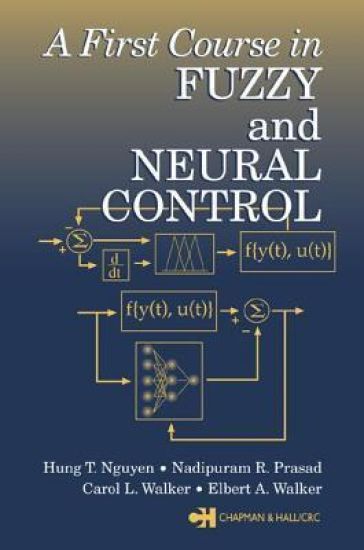
A First Course in Fuzzy and Neural Control

A First Course in Fuzzy and Neural Control

Hung T. Nguyen; Nadipuram R. Prasad; Carol L. Walker; Elbert A. Walker

Chapman Hall/CRC
2002
sidottu
Although the use of fuzzy control methods has grown nearly to the level of classical control, the true understanding of fuzzy control lags seriously behind. Moreover, most engineers are well versed in either traditional control or in fuzzy control-rarely both. Each has applications for which it is better suited, but without a good understanding of both, engineers cannot make a sound determination of which technique to use for a given situation. A First Course in Fuzzy and Neural Control is designed to build the foundation needed to make those decisions. It begins with an introduction to standard control theory, then makes a smooth transition to complex problems that require innovative fuzzy, neural, and fuzzy-neural techniques. For each method, the authors clearly answer the questions: What is this new control method? Why is it needed? How is it implemented? Real-world examples, exercises, and ideas for student projects reinforce the concepts presented. Developed from lecture notes for a highly successful course titled The Fundamentals of Soft Computing, the text is written in the same reader-friendly style as the authors' popular A First Course in Fuzzy Logic text. A First Course in Fuzzy and Neural Control requires only a basic background in mathematics and engineering and does not overwhelm students with unnecessary material but serves to motivate them toward more advanced studies.
Applications of Continuous Mathematics to Computer Science
This volume is intended to be used as a textbook for a special topic course in computer science. It addresses contemporary research topics of interest such as intelligent control, genetic algorithms, neural networks, optimization techniques, expert systems, fractals, and computer vision. The work incorporates many new research ideas, and focuses on the role of continuous mathematics. Audience: This book will be valuable to graduate students interested in theoretical computer topics, algorithms, expert systems, neural networks, and software engineering.
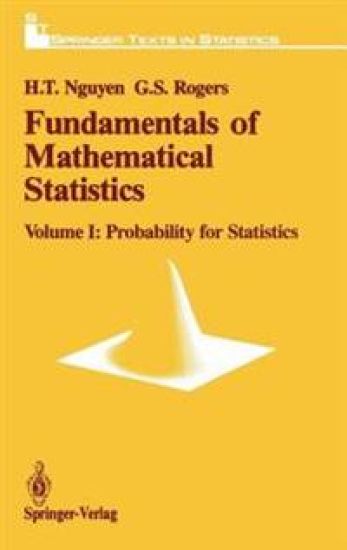
Fundamentals of Mathematical Statistics

Fundamentals of Mathematical Statistics

Hung T. Nguyen; Gerald S. Rogers

Springer-Verlag New York Inc.
1989
sidottu
This is the first half of a text for a two semester course in mathematical statistics at the senior/graduate level for those who need a strong background in statistics as an essential tool in their career. To study this text, the reader needs a thorough familiarity with calculus including such things as Jacobians and series but somewhat less intense familiarity with matrices including quadratic forms and eigenvalues. For convenience, these lecture notes were divided into two parts: Volume I, Probability for Statistics, for the first semester, and Volume II, Statistical Inference, for the second. We suggest that the following distinguish this text from other introductions to mathematical statistics. 1. The most obvious thing is the layout. We have designed each lesson for the (U.S.) 50 minute class; those who study independently probably need the traditional three hours for each lesson. Since we have more than (the U.S. again) 90 lessons, some choices have to be made. In the table of contents, we have used a * to designate those lessons which are "interesting but not essential" (INE) and may be omitted from a general course; some exercises and proofs in other lessons are also "INE". We have made lessons of some material which other writers might stuff into appendices. Incorporating this freedom of choice has led to some redundancy, mostly in definitions, which may be beneficial.