
Kirjailija
Hyo-Sung Ahn
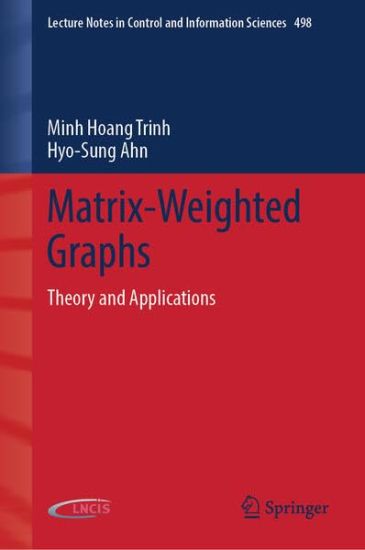
Kirjat ja teokset yhdessä paikassa: 6 kirjaa, julkaisuja vuosilta 2007-2026, suosituimpien joukossa Matrix-Weighted Graphs. Vertaile teosten hintoja ja tarkista saatavuus suomalaisista kirjakaupoista.
6 kirjaa
Kirjojen julkaisuhaarukka 2007-2026.

Control of Multi-agent Systems
Masaaki Nagahara; Shun-Ichi Azuma; Hyo-Sung Ahn
Springer International Publishing AG
2025
nidottu

Control of Multi-agent Systems
Masaaki Nagahara; Shun-Ichi Azuma; Hyo-Sung Ahn
Springer International Publishing AG
2024
sidottu
This textbook teaches control theory for multi-agent systems. Readers will learn the basics of linear algebra and graph theory, which are then developed to describe and solve multi-agent control problems. The authors address important and fundamental problems including: • consensus control; • coverage control; • formation control; • distributed optimization; and • the viral spreading phenomenon. Students' understanding of the core theory for multi-agent control is enhanced through worked examples and programs in the popular Python language. End-of-chapter exercises are provided to help assess learning progress. Instructors who adopt the book for their courses can download a solutions manual and the figures in the book for lecture slides. Additionally, the Python programs are available for download and can be used for experiments by students in advanced undergraduate or graduate courses based on this text. The broad spectrum of applications relevant to this material includes the Internet of Things, cyber-physical systems, robot swarms, communications networks, smart grids, and truck platooning. Additionally, in the spheres of social science and public health, it applies to opinion dynamics and the spreading of viruses in social networks. Students interested in learning about such applications, or in pursuing further research in multi-agent systems from a theoretical perspective, will find much to gain from Control of Multi-agent Systems. Instructors wishing to teach the subject will also find it beneficial.

This monograph introduces recent developments in formation control of distributed-agent systems. Eschewing the traditional concern with the dynamic characteristics of individual agents, the book proposes a treatment that studies the formation control problem in terms of interactions among agents including factors such as sensing topology, communication and actuation topologies, and computations. Keeping pace with recent technological advancements in control, communications, sensing and computation that have begun to bring the applications of distributed-systems theory out of the industrial sphere and into that of day-to-day life, this monograph provides distributed control algorithms for a group of agents that may behave together. Unlike traditional control laws that usually require measurements with respect to a global coordinate frame and communications between a centralized operation center and agents, this book provides control laws that require only relative measurements and communications between agents without interaction with a centralized operator. Since the control algorithms presented in this book do not require any global sensing and any information exchanges with a centralized operation center, they can be realized in a fully distributed way, which significantly reduces the operation and implementation costs of a group of agents. Formation Control will give both students and researchers interested in pursuing this field a good grounding on which to base their work.

Iterative Learning Control
Hyo-Sung Ahn; Kevin L. Moore; YangQuan Chen
Springer London Ltd
2010
nidottu
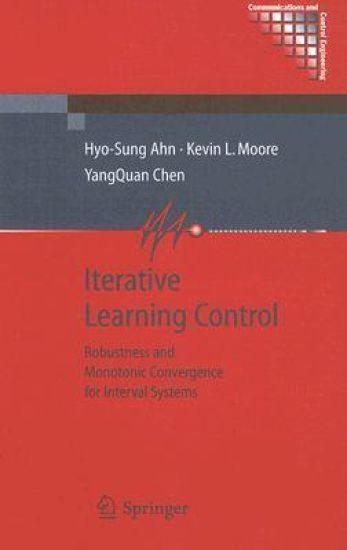
This monograph studies the design of robust, monotonically-convergent it- ative learning controllers for discrete-time systems. Iterative learning control (ILC) is well-recognized as an e?cient method that o?ers signi?cant p- formance improvement for systems that operate in an iterative or repetitive fashion (e. g. , robot arms in manufacturing or batch processes in an industrial setting). Though the fundamentals of ILC design have been well-addressed in the literature, two key problems have been the subject of continuing - search activity. First, many ILC design strategies assume nominal knowledge of the system to be controlled. Only recently has a comprehensive approach to robust ILC analysis and design been established to handle the situation where the plant model is uncertain. Second, it is well-known that many ILC algorithms do not produce monotonic convergence, though in applications monotonic convergencecan be essential. This monograph addresses these two keyproblems by providingauni?ed analysisanddesignframeworkforrobust, monotonically-convergent ILC. The particular approach used throughout is to consider ILC design in the iteration domain, rather than in the time domain. Using a lifting technique, the two-dimensionalILC system, whichhas dynamics in both the time and - erationdomains,istransformedintoaone-dimensionalsystem,withdynamics only in the iteration domain. The so-called super-vector framework resulting from this transformation is used to analyze both robustness and monotonic convergence for typical uncertainty models, including parametric interval - certainties, frequency-like uncertainty in the iteration domain, and iterati- domain stochastic uncertainty.
Iterative Learning Control
Hyo-Sung Ahn; Kevin L. Moore; YangQuan Chen
Springer London Ltd
2007
sidottu
This monograph studies the design of robust, monotonically-convergent it- ative learning controllers for discrete-time systems. Iterative learning control (ILC) is well-recognized as an e?cient method that o?ers signi?cant p- formance improvement for systems that operate in an iterative or repetitive fashion (e. g. , robot arms in manufacturing or batch processes in an industrial setting). Though the fundamentals of ILC design have been well-addressed in the literature, two key problems have been the subject of continuing - search activity. First, many ILC design strategies assume nominal knowledge of the system to be controlled. Only recently has a comprehensive approach to robust ILC analysis and design been established to handle the situation where the plant model is uncertain. Second, it is well-known that many ILC algorithms do not produce monotonic convergence, though in applications monotonic convergencecan be essential. This monograph addresses these two keyproblems by providingauni?ed analysisanddesignframeworkforrobust, monotonically-convergent ILC. The particular approach used throughout is to consider ILC design in the iteration domain, rather than in the time domain. Using a lifting technique, the two-dimensionalILC system, whichhas dynamics in both the time and - erationdomains,istransformedintoaone-dimensionalsystem,withdynamics only in the iteration domain. The so-called super-vector framework resulting from this transformation is used to analyze both robustness and monotonic convergence for typical uncertainty models, including parametric interval - certainties, frequency-like uncertainty in the iteration domain, and iterati- domain stochastic uncertainty.