Kirjojen hintavertailu. Mukana 12 581 547 kirjaa ja 12 kauppaa.

Kirjailija

I. Bernard Cohen

Kirjat ja teokset yhdessä paikassa: 9 kirjaa, julkaisuja vuosilta 1950-2013, suosituimpien joukossa Science and the Founding Fathers. Vertaile teosten hintoja ja tarkista saatavuus suomalaisista kirjakaupoista.

Mukana myös kirjoitusasut: I Bernard Cohen

9 kirjaa

Kirjojen julkaisuhaarukka 1950-2013.

Ethan Allen Hitchcock: Soldier, Humanitarian, Scholar, Discoverer of the True Subject of the Hermetic Art
""Ethan Allen Hitchcock: Soldier, Humanitarian, Scholar, Discoverer Of The True Subject Of The Hermetic Art"" is a biography written by I. Bernard Cohen. The book follows the life of Ethan Allen Hitchcock, a prominent figure in American history who served as a soldier, diplomat, and scholar. The biography explores Hitchcock's military career, including his service in the Mexican-American War and the Civil War. It also delves into his humanitarian work, such as his efforts to improve the lives of Native Americans and his advocacy for prison reform. The book also discusses Hitchcock's scholarly pursuits, including his discovery of the true subject of the Hermetic Art, an ancient practice of alchemy. Overall, ""Ethan Allen Hitchcock"" provides a comprehensive look at the life and accomplishments of this fascinating historical figure.Proceedings Of The American Antiquarian Society For April 1951.This scarce antiquarian book is a facsimile reprint of the old original and may contain some imperfections such as library marks and notations. Because we believe this work is culturally important, we have made it available as part of our commitment for protecting, preserving, and promoting the world's literature in affordable, high quality, modern editions, that are true to their original work.
The Triumph of Numbers

The Triumph of Numbers

I. Bernard Cohen

WW Norton Co
2006
nidottu
A history of numbers and statistics cites the origins of numerical analysis during the scientific revolution of the seventeenth century, tracing how numbers have assumed a leading role in science, government, marketing, and other aspects of daily life. Reprint.
Science and the Founding Fathers

Science and the Founding Fathers

I. Bernard Cohen

WW Norton Co
1997
nidottu
Thomas Jefferson was the only president who could read and understand Newton's Principia. Benjamin Franklin is credited with establishing the science of electricity. John Adams had the finest education in science that the new country could provide, including "Pnewmaticks, Hydrostaticks, Mechanicks, Staticks, Opticks." James Madison, chief architect of the Constitution, peppered his Federalist Papers with references to physics, chemistry, and the life sciences. For these men science was an integral part of life—including political life. This is the story of their scientific education and of how they employed that knowledge in shaping the political issues of the day, incorporating scientific reasoning into the Constitution.
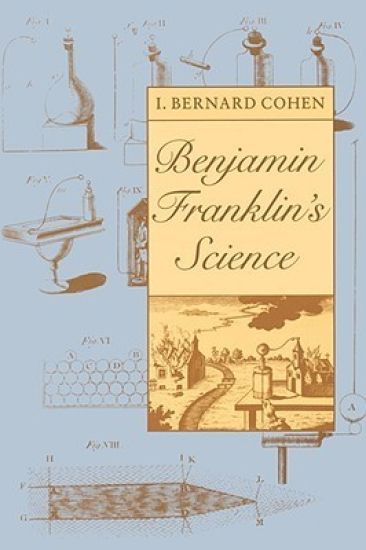
Benjamin Franklin's Science

Benjamin Franklin's Science

I. Bernard Cohen

Harvard University Press
1996
nidottu
Benjamin Franklin is well known to most of us, yet his fundamental and wide-ranging contributions to science are still not adequately understood. Until now he has usually been incorrectly regarded as a practical inventor and tinkerer rather than a scientific thinker. He was elected to membership in the elite Royal Society because his experiments and original theory of electricity had made a science of that new subject. His popular fame came from his two lightning experiments—the sentry-box experiment and the later and more famous experiment of the kite—which confirmed his theoretical speculations about the identity of electricity and provided a basis for the practical invention of the lightning rod. Franklin advanced the eighteenth-century understanding of all phenomena of electricity and provided a model for experimental science in general.I. Bernard Cohen, an eminent historian of science and the principal elucidator of Franklin’s scientific work, examines his activities in fields ranging from heat to astronomy. He provides masterful accounts of the theoretical background of Franklin’s science (especially his study of Newton), the experiments he performed, and their influence throughout Europe as well as the United States. Cohen emphasizes that Franklin’s political and diplomatic career cannot be understood apart from his scientific activities, which established his reputation and brought him into contact with leaders of British and European society. A supplement by Samuel J. Edgerton considers Franklin’s attempts to improve the design of heating stoves, another practical application that arose from theoretical interests.This volume will be valuable to all readers wanting to learn more about Franklin and to gain a deeper appreciation of the development of science in America.
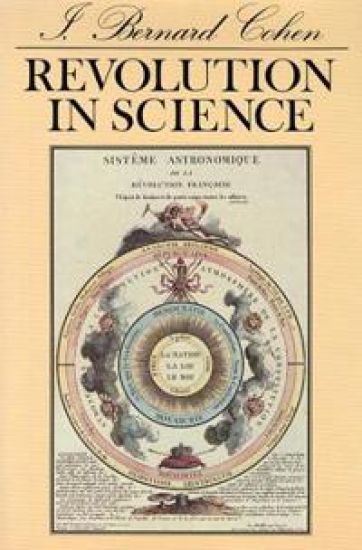
Revolution in Science

Revolution in Science

I. Bernard Cohen

The Belknap Press
1987
nidottu
Only a scholar as rich in learning as I. Bernard Cohen could do justice to a theme so subtle and yet so grand. Spanning five centuries and virtually all of scientific endeavor, Revolution in Science traces the nuances that differentiate both scientific revolutions and human perceptions of them, weaving threads of detail from physics, mathematics, behaviorism, Freud, atomic physics, and even plate tectonics and molecular biology, into the larger fabric of intellectual history.How did “revolution,” a term from the physical sciences, meaning a turning again and implying permanence and recurrence—the cyclical succession of the seasons, the “revolutions” of the planets in their orbits—become transformed into an expression for radical change in political and socioeconomic affairs, then become appropriated once again to the sciences?How have political revolutions—French, American, Bolshevik—and such intellectual forces as Darwinism further modified the concept, from revolution in science as a dramatic break with the past to the idea that science progresses by the slow accumulation of knowledge? And what does each transformation in each historical period tell us about the deep conceptual changes in our image of the scientist and scientific activity?Cohen’s exploration seeks to uncover nothing less than the nature of all scientific revolutions, the stages by which they occur, their time scale, specific criteria for determining whether or not there has been a revolution, and the creative factors in producing a revolutionary new idea. His book is a probing analysis of the history of an idea and one of the most impressive surveys of the history of science ever undertaken.
The Newtonian Revolution

The Newtonian Revolution

I. Bernard Cohen

Cambridge University Press
1983
pokkari
This volume presents Professor Cohen's original interpretation of the revolution that marked the beginnings of modern science and set Newtonian science as the model for the highest level of achievement in other branches of science. It shows that Newton developed a special kind of relation between abstract mathematical constructs and the physical systems that we observe in the world around us by means of experiment and critical observation. The heart of the radical Newtonian style is the construction on the mind of a mathematical system that has some features in common with the physical world; this system s then modified when the deductions and conclusions drawn from it are tested against the physical universe. Using this system Newton was able to make his revolutionary innovations in celestial mechanics and, ultimately, create a new physics of central forces and the law of universal gravitation. Building on his analysis of Newton's methodology, Professor Cohen explores the fine structure of revolutionary change and scientific creativity in general. This is done by developing the concept of scientific change as a series of transformations of ecxisting ideas. It is shown that such transformation is characteristic of many aspects of the sciences and that the concept of scientific change by transformation suggests a new way of examining the very nature of scientific creativity.