Kirjojen hintavertailu. Mukana 12 595 353 kirjaa ja 12 kauppaa.
Kirjailija
I.M. Gelfand
Kirjat ja teokset yhdessä paikassa: 13 kirjaa, julkaisuja vuosilta 1957-2016, suosituimpien joukossa Representations of the Rotation and Lorentz Groups and Their Applications. Vertaile teosten hintoja ja tarkista saatavuus suomalaisista kirjakaupoista.
Mukana myös kirjoitusasut: I. M. Gelfand, I M Gelfand
After reading the manuscript, some biologists inquired why, on the basis of the broad experimental material presented in this book, we had not come up with a model describing the operation of the cerebellum. To answer this question, we decided to write a preface to our book. How the nervous system copes with the complexity of the world is one of the central problems of neurophys iology. The question was clearly formulated for the frrst time by N. A. Bernstein. Considering the problem of motor control, he pointed out that the main objective of motor coordination is to overcome the redundant number of degrees of freedom of the motor apparatus or, in other words, to diminish the number of independent variables which control the movement (Bernstein 1967). These I. M. Gelfand and M. L. Zetlin ideas were further developed by (Gelfand and Zetlin 1966). They proposed, in particular, the "non-individualized" ("non-addressed") mode of control in complex systems, where only the highest levels of the system have the full notion about the fmal task while the main "effectors" act on the basis of very limited information. These propositions were made by Gelfand and Zetlin in a very general form, but, nevertheless, proved to be fruitful in determining the direction of experimental research. For instance, the discovery of the "locomotory region" of the brain stem (Shik et al.
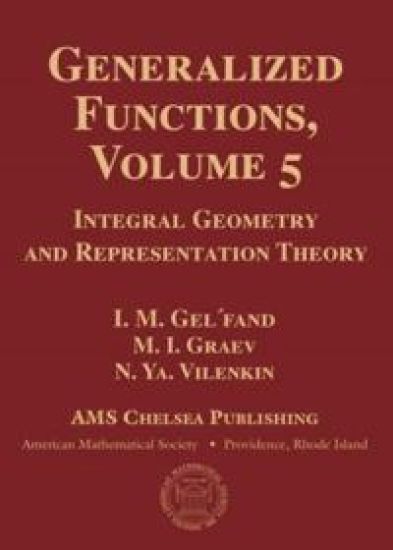
The miracle of integral geometry is that it is often possible to recover a function on a manifold just from the knowledge of its integrals over certain submanifolds. The founding example is the Radon transform, introduced at the beginning of the 20th century. Since then, many other transforms were found, and the general theory was developed. Moreover, many important practical applications were discovered. The best known, but by no means the only one, being to medical tomography. This book is a general introduction to integral geometry, the first from this point of view for almost four decades. The authors, all leading experts in the field, represent one of the most influential schools in integral geometry.The book presents in detail basic examples of integral geometry problems, such as the Radon transform on the plane and in space, the John transform, the Minkowski-Funk transform, integral geometry on the hyperbolic plane and in the hyperbolic space, the horospherical transform and its relation to representations of $SL(2,\mathbb C)$, integral geometry on quadrics, etc.The study of these examples allows the authors to explain important general topics of integral geometry, such as the Cavalieri conditions, local and nonlocal inversion formulas, and overdetermined problems in integral geometry. Many of the results in the book were obtained by the authors in the course of their career-long work in integral geometry. This book is suitable for graduate students and researchers working in integral geometry and its applications.
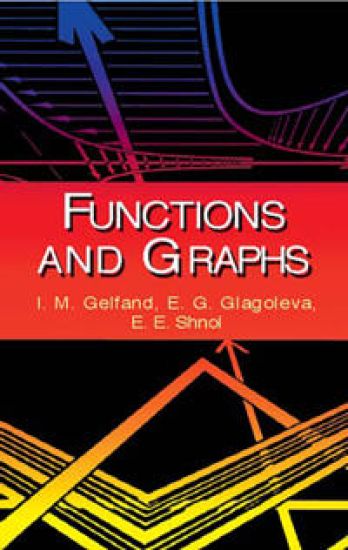
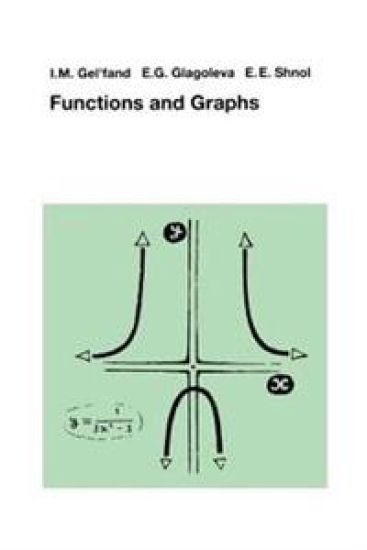
This volume presents students with problems and exercises designed to illuminate the properties of functions and graphs. The 1st part of the book employs simple functions to analyze the fundamental methods of constructing graphs. The 2nd half deals with more complicated and refined questions concerning linear functions, quadratic trinomials, linear fractional functions, power functions, and rational functions. 1969 edition.
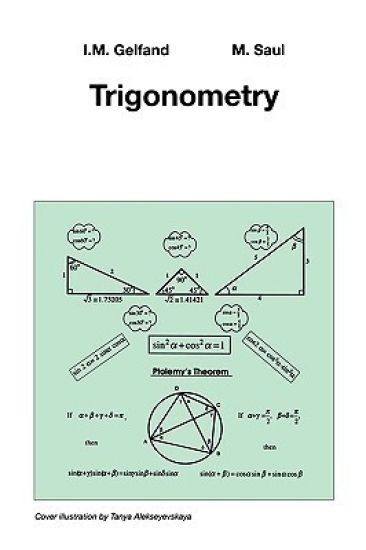
In a sense, trigonometry sits at the center of high school mathematics. It originates in the study of geometry when we investigate the ratios of sides in similar right triangles, or when we look at the relationship between a chord of a circle and its arc. It leads to a much deeper study of periodic functions, and of the so-called transcendental functions, which cannot be described using finite algebraic processes. It also has many applications to physics, astronomy, and other branches of science. It is a very old subject. Many of the geometric results that we now state in trigonometric terms were given a purely geometric exposition by Euclid. Ptolemy, an early astronomer, began to go beyond Euclid, using the geometry of the time to construct what we now call tables of values of trigonometric functions. Trigonometry is an important introduction to calculus, where one stud ies what mathematicians call analytic properties of functions. One of the goals of this book is to prepare you for a course in calculus by directing your attention away from particular values of a function to a study of the function as an object in itself. This way of thinking is useful not just in calculus, but in many mathematical situations. So trigonometry is a part of pre-calculus, and is related to other pre-calculus topics, such as exponential and logarithmic functions, and complex numbers.
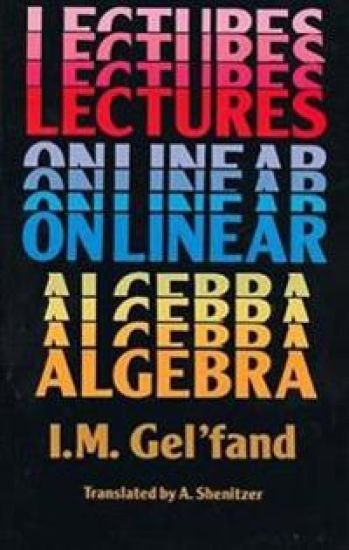
This book is about algebra. This is a very old science and its gems have lost their charm for us through everyday use. We have tried in this book to refresh them for you. The main part of the book is made up of problems. The best way to deal with them is: Solve the problem by yourself - compare your solution with the solution in the book (if it exists) - go to the next problem. However, if you have difficulties solving a problem (and some of them are quite difficult), you may read the hint or start to read the solution. If there is no solution in the book for some problem, you may skip it (it is not heavily used in the sequel) and return to it later. The book is divided into sections devoted to different topics. Some of them are very short, others are rather long. Of course, you know arithmetic pretty well. However, we shall go through it once more, starting with easy things. 2 Exchange of terms in addition Let's add 3 and 5: 3+5=8. And now change the order: 5+3=8. We get the same result. Adding three apples to five apples is the same as adding five apples to three - apples do not disappear and we get eight of them in both cases. 3 Exchange of terms in multiplication Multiplication has a similar property. But let us first agree on notation.
The need for improved mathematics education at the high school and college levels has never been more apparent than in the 1990's. As early as the 1960's, I.M. Gelfand and his colleagues in the USSR thought hard about this same question and developed a style for presenting basic mathematics in a clear and simple form that engaged the curiosity and intellectual interest of thousands of high school and college students. These same ideas, this same content, unchanged by over thirty years of experience and mathematical development, are available in the following books to any student who is willing to read, to be stimulated, and to learn. "Functions and Graphs" provides instruction in transferring formulas and data into geometrical form. Thus, drawing graphs is shown to be one way to "see" formulas and functions and to observe the ways in which they change. This skill is fundamental to the study of calculus and other mathematical topics. Teachers of mathematics will find here a fresh understanding of the subject and a valuable path to the training of students in mathematical concepts and skills.
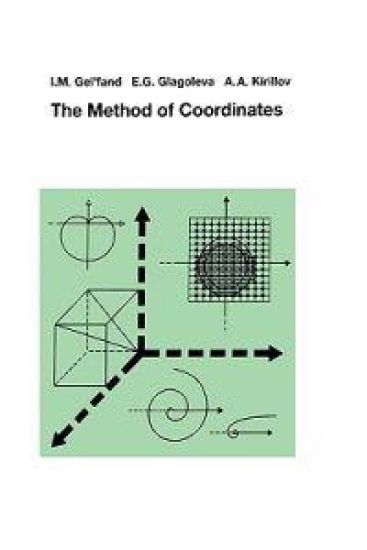
The need for improved mathematics education at the high school and college levels has never been more apparent than in the 1990s. As early as the 1960s, I. M. Gel'fand and his colleagues in the USSR thought hard about this same question and developed a style for presenting basic mathematics in a clear and simple form that engaged the curiosity and intellectual interest of thousands of high school and college students. These same ideas, this same content, unchanged by over thirty years of experience and mathematical development, are available in the present books to any student who is willing to read, to be stimulated and to learn. "The Method of Coordinates" is a way of transferring geometric images into formulas, a method for describing pictures by numbers and letters denoting constants and variables. It is fundamental to the study of calculus and other mathematical topics. Teachers of mathematics will find here a fresh understanding of the subject and a valuable path to the training of students in mathematical concepts and skills.