Kirjailija
Ian Hudson
Kirjat ja teokset yhdessä paikassa: 16 kirjaa, julkaisuja vuosilta 2008-2025, suosituimpien joukossa Social Murder and Other Shortcomings of Conservative Economics. Vertaile teosten hintoja ja tarkista saatavuus suomalaisista kirjakaupoista.
16 kirjaa
Kirjojen julkaisuhaarukka 2008-2025.
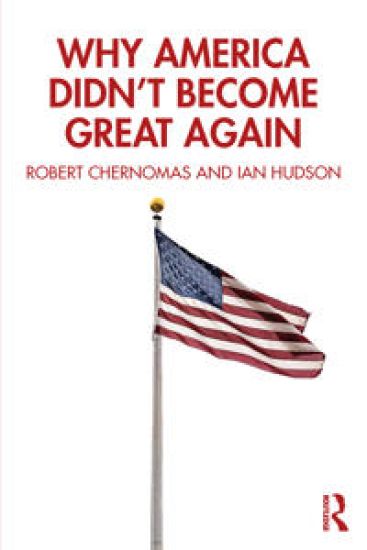
Examining the conditions that not only blocked attempts to make America great again but also actively made the country worse, Why America Didn’t Become Great Again identifies those organizations, institutions, politicians, and prominent characters in the forefront of the economic and social policies – ultimately asking who is responsible.The period from the late 1970s to 2020s became the best of times for America’s corporate class. As profits grew along with the wealth and income that they delivered for their stockholders and management, their goal was to set new rules for the rest of us to live by with a clear class agenda. Institutions have been organized, government policies reoriented, and economists, journalists, and politicians recruited, funded, and promoted. And so it has not been the best of times for working families, as inequality, stagnant wages, debt, and ever longer working hours became their fate. This book critically analyzes those who very deliberately set out to implement policies enacted at the state and federal level in order to redistribute wealth and income upwards and change the balance of power in the United States in response to the class, gender, and racial challenges that resulted in compressed income and wealth differentials before the 1980s.An essential book on contemporary inequality in America, Why America Didn’t Become Great Again surveys the past near half century that resulted in American economic instability and inequality, environmental crisis, a crumbling physical and harmful social infrastructure, among the very worst health outcomes, child poverty, food insecurity, and social mobility of the industrialized countries culminating in a Trump regime and the road to further ruin.


Biological justification for all forms of inequality has a long history, with the claim that particular groups suffer disproportionately from inherited flaws of ability and character used to explain a remarkably wide variety of inequalities.Providing an important critique of that biodeterminist history and how the Human Genome Project has inspired some contemporary scientists and economists to follow a similar path of ascribing socioeconomic outcomes to genetic inheritance, The American Gene details new research that suggests that the social and economic environment can affect how genes express themselves in specific human traits and social outcomes. Using the three cases of the American white working class, Black Americans and American women, the authors demonstrate that relying on nature as an explanation is seriously flawed – showing that the socioeconomic inheritance created by the conditions in which these populations worked and lived offer a far better explanation than nature for the stratified results.This book is the story of an American history rife with unnecessary misery and the waste of human potential, along with the liberating effect of understanding the degree to which its citizens are the product of social inheritance and the potential power of a nurturing economy and society that equality promises.
Consumption used to be a disease. Now it is the dominant manner in which most people meet their most basic needs and – if they can afford the price – their wildest desires. In this new book, Ian and Mark Hudson critically examine how consumption has been understood in economic theory before analyzing its centrality to our social lives and function in contemporary capitalism. They also outline the consequences it has for people and nature, consequences routinely made invisible in the shopping mall or online catalogue. Hudson and Hudson show, in an approachable manner, how patterns of consumption are influenced by cultures, individual preferences and identity formation before arguing that underlying these determinants is the unavoidable need within capitalism to realize profit. This accessible and comprehensive book will be essential reading for students and scholars of political economy, economics and economic sociology, as well as any reader who wants to confront their own practices of consumption in a meaningful way.
This book is about the transformation of America that has occurred over the past thirty-five years, as capitalist logic has expanded into previously protected spheres of life. This expansion has had devastating effects on the potential for human development. Looking at how human beings create themselves and their worlds on material foundations of health and the natural environment, through work and politics, the book chronicles how neoliberalism has limited human potential. At a time when neoliberalism’s effects are stirring various forms of popular resistance and opposition, this is a manifesto of sorts for the range of processes that need to be confronted if human potential is to be freed from the increasingly cramped quarters to which neoliberalism has confined it.
The economics profession has a lot to answer for. After the late 1970s, the ideas of influential economists have justified policies that have made the world more prone to economic crisis, remarkably less equal, more polluted and less secure than it might be. How could ideas and policies that proved to be such an abject failure come to dominate the economic landscape? By critically examining the work of the most famous economists of the neoliberal period including Alan Greenspan, Milton Friedman, and Robert Lucas, the authors Robert Chernomas and Ian Hudson demonstrate that many of those who rose to prominence did so primarily because of their defence of, and contribution to, rising corporate profits and not their ability to predict or explain economic events. An important and controversial book, The Profit Doctrine exposes the uses and abuses of mainstream economic canons, identify those responsible and reaffirm the primacy of political economy.
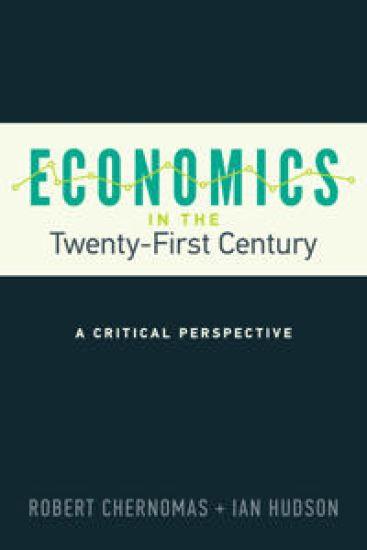
Economics in the Twenty-First Century
Robert Chernomas; Ian Hudson
University of Toronto Press
2016
pokkari
Economics has always been nicknamed the “dismal science,” but today the field seems a little more dismal than usual as governments, social movements, and even students complain that the discipline is failing to make sense of the major economic problems of the day. In Economics in the Twenty-First Century, Robert Chernomas and Ian Hudson demonstrate how today’s top young economists continue to lead the field in the wrong direction. The recent winners of the John Bates Clark medal, economics’s “baby Nobel,” have won that award for studying important issues such as economic development, income inequality, crime, and health. Examining their research, Chernomas and Hudson show that this work focuses on individual choice, ignores the systematic role of power in the economic system, and leads to solutions that are of limited effectiveness at best and harmful at worst. An accessible summary of the latest debates in economics, Economics in the Twenty-First Century takes on what is missing from mainstream economics, why it matters, and how the discipline can better address the key concerns of our era.
Greatly expanding on his blockbuster 1421, distinguished historian Gavin Menzies uncovers the complete untold history of how mankind came to the Americas-offering new revelations and a radical rethinking of the accepted historical record in Who Discovered America? The iconoclastic historian's magnum opus, Who Discovered America? calls into question our understanding of how the American continents were settled, shedding new light on the well-known "discoveries" of European explorers, including Christopher Columbus. In Who Discovered America? he combines meticulous research and an adventurer's spirit to reveal astounding new evidence of an ancient Asian seagoing tradition-most notably the Chinese-that dates as far back as 130,000 years ago. Menzies offers a revolutionary new alternative to the "Beringia" theory of how humans crossed a land bridge connecting Asia and North America during the last Ice Age, and provides a wealth of staggering claims, that hold fascinating and astonishing implications for the history of mankind.
Reviled as one of the worst healthcare providers in the world, the United States has among the worst indicators of health in the industrialised world, whilst paradoxically spending significantly more on its health care system than any other industrial nation. Economists Robert Chernomas and Ian Hudson explain this contradictory phenomenon as the product of the unique brand of capitalism that has developed in the US. It is this particular form of capitalism that analogously created social and economic conditions that influence health, such as, highly industrialised labour that produced chronic disease amongst the labouring classes, alongside an inefficient, unpopular and inaccessible health care system that is incapable of dealing with those same patients. In order to improve health in America, the authors argue that a change is required in the conditions in the capitalist system in which people live and work, as well as a restructured health care system.
The New York Times is possibly the most influential newspaper in the world. Because of this, it has become the topic of much debate about media bias, with some claiming that it is liberal and others that it is conservative. The Gatekeeper argues that this debate is misleading and that the New York Times can more accurately be characterised as supporting the interests of US corporations, which involves both liberal and conservative positions. Through examining the paper's coverage of key issues, including the 2008-2009 economic crisis, The Gatekeeper reframes the debate about the most venerable institution in US journalism.
Social Murder and Other Shortcomings of Conservative Economics
Robert Chernomas; Ian Hudson
Arp Books
2008
pokkari
Corporate power is one of the strongest forces shaping our world. More than half of the top 100 economic entities today are private corporations. With their immense size comes commensurate influence, to the point where corporations are able to wreak social and environmental destruction with few serious consequences. Yet, amazingly, this subject is essentially absent from the study of economics. The conservative economic theory that dominates the profession is based on the core belief that as little as possible should interfere with businesses' pursuit of profit. This approach to economics ignores history, politics, poverty, the natural environment, and social class, among other inconvenient realities. Conservative economics would almost be laughable--were it not for the fact that this way of thinking helps prop up the worst excesses of capitalism.