Kirjojen hintavertailu. Mukana 12 390 323 kirjaa ja 12 kauppaa.

Kirjailija

Ian Lerche

Kirjat ja teokset yhdessä paikassa: 9 kirjaa, julkaisuja vuosilta 1995-2024, suosituimpien joukossa Impact of Natural Hazards on Oil and Gas Extraction. Vertaile teosten hintoja ja tarkista saatavuus suomalaisista kirjakaupoista.

9 kirjaa

Kirjojen julkaisuhaarukka 1995-2024.

Analytic Methodsfor Nonlinear Equations
While the general theory of linear equations (both integral and differential) is well understood regrettably the same cannot be said of nonlinear equations. The basic problem is one of finding methods for obtaining exact solutions for nonlinear equations, assuming there are such methods, or of showing there is no method and so no exact analytical solution. Because of high speed and powerful computers there is a regrettable tendency to slam any old equation directly into the computer and claim the resulting output is the solution desired. But such feats of legerdemain do not consider several factors: How accurate is the numerical procedure? That it is precise is clear for a computer produces precise answers but that they are accurate and represent the desired solution to the equation programmed is rarely tested, if at all. Accuracy can best be tested against a known analytic solution and there, of course, lies the rub for one goes full circle if not careful. A further, often major, problem is that nonlinear equations often contain parameters, and so numerical methods must usually undergo trial and error searches for values (or domains) of parameters where solutions can be obtained (if at all) and this problem can be extremely time-consuming with numerical procedures particularly when several or many parameters are involved. There are, to be sure, nonlinear minimization procedures available to help but such involve running a program many times that can be difficult if the program takes, say, one hour for one iteration. But it can also be that there are no acceptable solutions when a parameter is in some domain and to find that domain numerically is often itself difficult. Even if one has found such a domain there is no guarantee that solutions exist satisfying required boundary or initial conditions in the residual domains. One has only the knowledge that there are no solutions in the specific domain. For all these reasons it is more than relevant to see if analytic solutions are available to nonlinear equations.
Hydrodynamics of Oil and Gas

Hydrodynamics of Oil and Gas

Ian Lerche; R.O. Thomsen

Springer-Verlag New York Inc.
2013
nidottu
There has long been interest in the flow of fluids through permeable aqui­ fers. Stratigraphic trapping of oil and gas by permeability changes in an aquifer and the amounts of hydrocarbons so trapped are major concerns to the oil industry. The variations of aquifer width and geometry and of the positions in an aquifer where hydrocarbons can be trapped by hydro­ dynamic forces are intimately intertwined in determining the shape, and thus the volume, of hydrocarbons. Perhaps the seminal work in this area is reflected by King Hubbert's massive review paper "Entrapment of Petroleum under Hydrodynamic Conditions" (Am. Assoc. Pet. Geol. Bull. 37(8), 1954-2026, 1953), in which a wide variety of effects, such as capillarity, buoyancy, surface tension, and salinity of water, are incorporated as basic factors influenc­ ing the positioning and shaping of hydrocarbon masses in hydrodynami­ cally active aquifers. In those days, while the basic physics could readily be appreciated, development of a detailed quantitative understanding of the interplay of the various factors in controlling or modulating hydro­ dynamic shapes was severely limited by computer abilities. Indeed, Hub­ bert actually constructed and photographed physical models, using alcohol and water, to illustrate basic concepts. It is difficult to obtain an appreciation of the behavior of flow geometries from such experiments when all factors are permitted to vary simultaneously.
Impact of Natural Hazards on Oil and Gas Extraction

Impact of Natural Hazards on Oil and Gas Extraction

Ian Lerche; Elchin Bagirov

Springer-Verlag New York Inc.
2010
nidottu
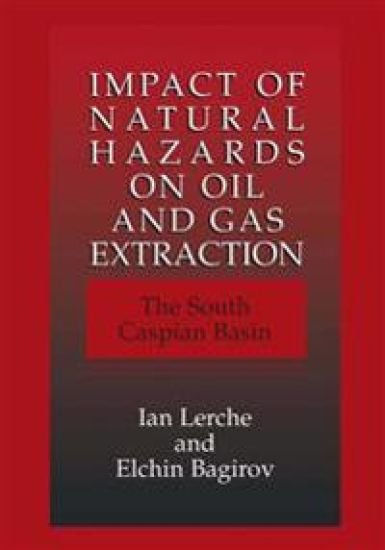
Since the dissolution of the Soviet Union almost a decade ago, there has been rapid evolution of interactions between the Western nations and individual countries of the former Soviet Union. As part of that interaction, the autonomous independent Republic of Azerbaijan through its scientific arm, the Geological Institute of the Azerbaijan Academy of Sciences under the Directorship of Academician Akif Ali-Zadeh and Deputy Director Ibrahim Guliev, arranged for personnel to be seconded to the University of South Carolina. The idea here was to see to what extent a quantitative understanding could be achieved of the evolution of the Azerbaijan part of the South Caspian Basin from dynamical, thermal and hydrocarbon perspectives. The Azeris brought with them copious amounts of data collected over decades which, together with the quantitative numerical codes available at USC, enabled a concerted effort to be put forward, culminating in two large books (Evolution of the South Caspian Basin: Geological Risks and Probable Hazards, 675 pps; and The South Caspian Basin: Stratigraphy, Geochemistry, and Risk Analysis, of which were published by the Azerbaijan Academy of 472 pps. ) both Sciences, and also many scientific papers. Thus, over the last four to five years an integrated comprehensive start has been made to understand the hydrocarbon proneness of the South Caspian Basin. In the course of the endeavor to understand the basinal evolution, it became clear that a variety of natural hazards occur in the Basin.
Environmental Risk Assessment

Environmental Risk Assessment

Ian Lerche; Walter Glaesser

Springer-Verlag Berlin and Heidelberg GmbH Co. K
2010
nidottu
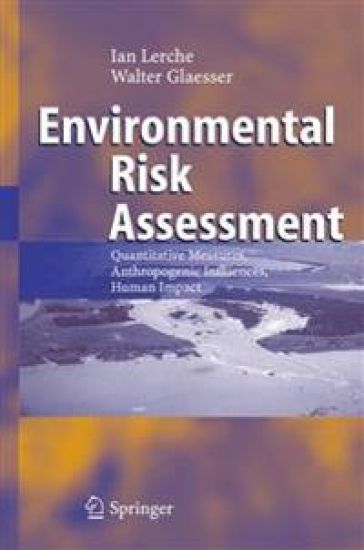
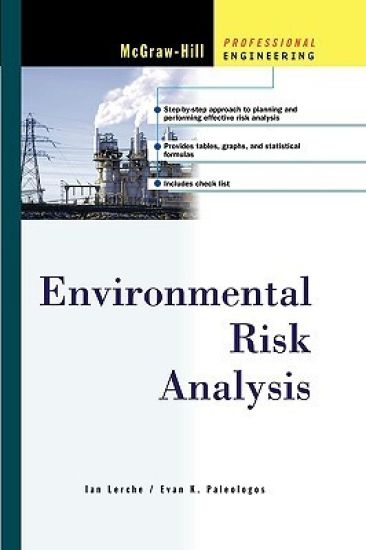
The world is a dirty place and getting dirtier all the time. The reasons for this ever-increasing lack of cleanliness are not hard to find, being basically caused by the actions of the six billion people who inhabit the planet. The needs of the people for air, water, food, housing, clothing, heating, materials, oil, gas, minerals, metals, chemicals, and so forth have, over the centuries, given rise to a variety of environmental problems that have been exacerbated or been newly created by the industrialization of the world, the increase in population, and the increase in longevity of the population. The costs of cleaning even fractions of the known environmental problems are truly enormous, as detailed in the volume Environmental Risk Analysis (I. Lerche and E. Paleologos, 2001, McGraw-Hill). The chances of causing new environmental problems, and their associated costs of clean up, are equally challenging in terms of anthropogenic influences and also of the natural environmental problems that can be triggered by humanity. This volume discusses many examples of environmental problems that have occurred and that are still ongoing. The volume also considers the effects in terms of sickness and death of fractions of the population of the planet caused by such environmental problems.
Environmental Risk Assessment

Environmental Risk Assessment

Ian Lerche; Walter Glaesser

Springer-Verlag Berlin and Heidelberg GmbH Co. K
2006
sidottu
The world is a dirty place and getting dirtier all the time. The reasons for this ever-increasing lack of cleanliness are not hard to find, being basically caused by the actions of the six billion people who inhabit the planet. The needs of the people for air, water, food, housing, clothing, heating, materials, oil, gas, minerals, metals, chemicals, and so forth have, over the centuries, given rise to a variety of environmental problems that have been exacerbated or been newly created by the industrialization of the world, the increase in population, and the increase in longevity of the population. The costs of cleaning even fractions of the known environmental problems are truly enormous, as detailed in the volume Environmental Risk Analysis (I. Lerche and E. Paleologos, 2001, McGraw-Hill). The chances of causing new environmental problems, and their associated costs of clean up, are equally challenging in terms of anthropogenic influences and also of the natural environmental problems that can be triggered by humanity. This volume discusses many examples of environmental problems that have occurred and that are still ongoing. The volume also considers the effects in terms of sickness and death of fractions of the population of the planet caused by such environmental problems.
Impact of Natural Hazards on Oil and Gas Extraction

Impact of Natural Hazards on Oil and Gas Extraction

Ian Lerche; Elchin Bagirov

Kluwer Academic/Plenum Publishers
1999
sidottu
Since the dissolution of the Soviet Union almost a decade ago, there has been rapid evolution of interactions between the Western nations and individual countries of the former Soviet Union. As part of that interaction, the autonomous independent Republic of Azerbaijan through its scientific arm, the Geological Institute of the Azerbaijan Academy of Sciences under the Directorship of Academician Akif Ali-Zadeh and Deputy Director Ibrahim Guliev, arranged for personnel to be seconded to the University of South Carolina. The idea here was to see to what extent a quantitative understanding could be achieved of the evolution of the Azerbaijan part of the South Caspian Basin from dynamical, thermal and hydrocarbon perspectives. The Azeris brought with them copious amounts of data collected over decades which, together with the quantitative numerical codes available at USC, enabled a concerted effort to be put forward, culminating in two large books (Evolution of the South Caspian Basin: Geological Risks and Probable Hazards, 675 pps; and The South Caspian Basin: Stratigraphy, Geochemistry, and Risk Analysis, of which were published by the Azerbaijan Academy of 472 pps. ) both Sciences, and also many scientific papers. Thus, over the last four to five years an integrated comprehensive start has been made to understand the hydrocarbon proneness of the South Caspian Basin. In the course of the endeavor to understand the basinal evolution, it became clear that a variety of natural hazards occur in the Basin.
Salt and Sediment Dynamics

Salt and Sediment Dynamics

Ian Lerche; Kenneth Petersen

CRC Press Inc
1995
sidottu
Salt and Sediment Dynamics presents a thorough treatment of salt and sediment interactions and the implications of such interactions for sub-salt exploration. The book emphasizes and utilizes recent discoveries on many aspects of salt and sediment interactions, provides the theoretical framework for interpreting the increasing amount of available data on salt and sediments, and develops a self-consistent dynamical evolution model of salt structures and their interaction with surrounding sediments. The model developed in the text consists of an evolving salt structure that influences sediment motion with self-consistent evolution of sediments and salt shape. The resulting stress and strain in the sediments and the thermal focusing effects of the salt are evaluated. The salt and sediments in the model are consistent with observed geometries, a result of having freely adjustable, observation-controlled model parameters. In addition, the book describes case histories in a variety of geological settings, thus explaining aspects of the genesis and development of salt structures, of their impact on sedimentary structural evolution, and of the impact of sediments on salt masses. The techniques developed by the authors expand the current state of knowledge regarding the evolution and dynamics of salt structures and increase the potential for effective sub-salt hydrocarbon exploration.
Hydrodynamics of Oil and Gas

Hydrodynamics of Oil and Gas

Ian Lerche; R.O. Thomsen

Kluwer Academic/Plenum Publishers
1995
sidottu
There has long been interest in the flow of fluids through permeable aqui­ fers. Stratigraphic trapping of oil and gas by permeability changes in an aquifer and the amounts of hydrocarbons so trapped are major concerns to the oil industry. The variations of aquifer width and geometry and of the positions in an aquifer where hydrocarbons can be trapped by hydro­ dynamic forces are intimately intertwined in determining the shape, and thus the volume, of hydrocarbons. Perhaps the seminal work in this area is reflected by King Hubbert's massive review paper "Entrapment of Petroleum under Hydrodynamic Conditions" (Am. Assoc. Pet. Geol. Bull. 37(8), 1954-2026, 1953), in which a wide variety of effects, such as capillarity, buoyancy, surface tension, and salinity of water, are incorporated as basic factors influenc­ ing the positioning and shaping of hydrocarbon masses in hydrodynami­ cally active aquifers. In those days, while the basic physics could readily be appreciated, development of a detailed quantitative understanding of the interplay of the various factors in controlling or modulating hydro­ dynamic shapes was severely limited by computer abilities. Indeed, Hub­ bert actually constructed and photographed physical models, using alcohol and water, to illustrate basic concepts. It is difficult to obtain an appreciation of the behavior of flow geometries from such experiments when all factors are permitted to vary simultaneously.