Kirjojen hintavertailu. Mukana 12 246 027 kirjaa ja 12 kauppaa.

Kirjailija

Ian Mason

Kirjat ja teokset yhdessä paikassa: 7 kirjaa, julkaisuja vuosilta 1977-2016, suosituimpien joukossa Transitivity in Translating. Vertaile teosten hintoja ja tarkista saatavuus suomalaisista kirjakaupoista.

7 kirjaa

Kirjojen julkaisuhaarukka 1977-2016.

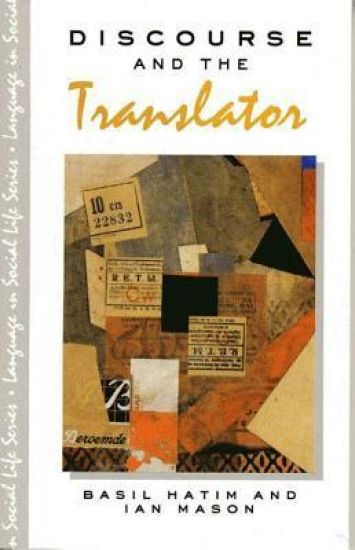
Discourse and the Translator

Discourse and the Translator

B. Hatim; Ian Mason

Routledge
2016
sidottu
Discourse and the Translator both incorporates and moves beyond previous studies of translation. Its logical and informative approach to the problems of translation ensures that it will be essential for all those who work with languages 'in contact'. Incorporating research in sociolinguistics, discourse studies, pragmatics and semiotics, the authors analyse the process and product of translation in their social contexts. Through this analysis, the book emphasises the importance of the translator as a mediator between cultures.
Transitivity in Translating

Transitivity in Translating

Maria Calzada-Perez; Ian Mason

Verlag Peter Lang
2006
nidottu
This book proposes an overall framework of communication (including translation) that follows CDA (Critical Discourse Analysis)/CL (Critical Linguistics) principles; it devises an analytic tool for the study of transitivity in translation along Hallidayian-functionalist lines; and it incorporates a contrastive corpus of 52 speeches made before the European Parliament in English and Spanish on 9th March 1993 together with their corresponding translations. Both sentence and textual levels become units of analysis. Also, quantitative and qualitative methods are applied. The author analyses the various types of transitivity shifts at sentence level. She also shows that these shifts have contextual effects. Another focus of this study is to present how certain transitivity shifts group together.
Dialogue Interpreting

Dialogue Interpreting

Ian Mason

St Jerome Publishing
1999
nidottu
Dialogue interpreting includes what is variously referred to in English as Community, Public Service, Liaison, Ad Hoc or Bilateral Interpreting - the defining characteristic being interpreter-mediated communication in spontaneous face-to-face interaction. Included under this heading are all kinds of professional encounters: police, immigration and welfare services interviews, doctor-patient interviews, business negotiations, political interviews, lawyer-client and courtroom interpreting and so on. Whereas research into conference interpreting is now well established, the investigation of dialogue interpreting as a professional activity is still in its infancy, despite some highly promising publications in recent years. This special issue of The Translator, guest-edited by one of the leading scholars in translation studies, provides a forum for bringing together separate strands within this developing field and should create an impetus for further research.Viewing the interpreter as a gatekeeper, coordinator and negotiator of meanings within a three-way interaction, the descriptive studies included in this volume focus on issues such as role-conflict, in-group loyalties, participation status, relevance and the negotiation of face, thus linking the observation of interpreting practice to pragmatic constraints such as power, distance and face-threat and to semiotic constraints such as genres and discourses as socio-textual practices of particular cultural communities.
The Translator As Communicator

The Translator As Communicator

Basil Hatim; Ian Mason

Routledge
1996
sidottu
By taking an integrated approach to the practice of translation, Hatim and Mason provide a refreshingly unprejudiced contribution to translation theory. They argue that the division of the subject into literary and non-literary, technical and non-technical and so on, is unhelpful and misleading. Instead of dwelling on these differentials, the authors focus on what common ground exists between these distinctions. The proposed model is presented through a series of case studies, each of which has as its focus one particular feature of text constitution, while not losing sight of how this contributes to the whole analytic apparatus. Topics covered include: * a comprehensive description of the interpreting process * power and ideology in translation * discourse errors * curriculum design for translator training
The Translator As Communicator

The Translator As Communicator

Basil Hatim; Ian Mason

Routledge
1996
nidottu
By taking an integrated approach to the practice of translation, Hatim and Mason provide a refreshingly unprejudiced contribution to translation theory. They argue that the division of the subject into literary and non-literary, technical and non-technical and so on, is unhelpful and misleading. Instead of dwelling on these differentials, the authors focus on what common ground exists between these distinctions. The proposed model is presented through a series of case studies, each of which has as its focus one particular feature of text constitution, while not losing sight of how this contributes to the whole analytic apparatus. Topics covered include: * a comprehensive description of the interpreting process * power and ideology in translation * discourse errors * curriculum design for translator training
Discourse and the Translator

Discourse and the Translator

Hatim B.; Ian Mason

Longman
1990
nidottu
Discourse and the Translator both incorporates and moves beyond previous studies of translation. Its logical and informative approach to the problems of translation ensures that it will be essential for all those who work with languages 'in contact'. Incorporating research in sociolinguistics, discourse studies, pragmatics and semiotics, the authors analyse the process and product of translation in their social contexts. Through this analysis, the book emphasises the importance of the translator as a mediator between cultures.
The Semantics Of Destructive Lisp

The Semantics Of Destructive Lisp

Ian Mason

University of Chicago Press
1977
sidottu
While the semantics of 'pure' lisp is well understood, the same cannot be said for the lisp that people actually use, due to the presence of so-called 'destructive operations' in programs, operations like RPLACA and RPLACD that destructively manipulate data. Such destructive operations have caused considerable difficulty in bridging the gap between theory program verification, and program transformation. In this book, Ian A. Mason aims at squaring theory with practice by first developing a theory that respects practice and then improving practice within this theory. Mason's theory is based on a new notion of memory structure that is adequate to model such destructive operations. Within this framework, he investigates various equivalence relations between expressions in first order lisp. This fragment of lisp includes the destructive operations of RPLACA and RPLACD. Mason then defines some important equivalence relations in lisp programs within this model theoretic framework. Throughout the work, Mason makes a distinction between intensional relations and extensional relations.