Kirjojen hintavertailu. Mukana 12 390 323 kirjaa ja 12 kauppaa.

Kirjailija

Ian Shapiro

Kirjat ja teokset yhdessä paikassa: 18 kirjaa, julkaisuja vuosilta 1986-2026, suosituimpien joukossa The Wolf at the Door. Vertaile teosten hintoja ja tarkista saatavuus suomalaisista kirjakaupoista.

18 kirjaa

Kirjojen julkaisuhaarukka 1986-2026.

The Wolf at the Door

The Wolf at the Door

Michael J. Graetz; Ian Shapiro

Harvard University Press
2021
nidottu
“Deep, informed, and reeks of common sense.”—Norman Ornstein“It is now beyond debate that rising inequality is not only leaving millions of Americans living on a sharp edge but also is threatening our democracy…For activists and scholars alike who are struggling to create a more equitable society, this is an essential read.”—David GergenWe are in an age of crisis. That much we can agree on. But a crisis of what, exactly? And how do we get out of it?In a follow up to their influential and much debated Death by a Thousand Cuts, Michael Graetz and Ian Shapiro focus on what really worries people: not what the rich are making or the government is taking from them but their own insecurity. Americans are worried about losing their jobs, their status, and the safety of their communities. They fear the wolf at the door. The solution is not protectionism or class warfare but better jobs, higher wages, greater protection for families suffering from unemployment, better health insurance, and higher quality childcare. And it turns out those goals are more achievable than you might think. The Wolf at the Door is one of those rare books that doesn’t just diagnose our problems, it shows how to address them.“This is a terrific book, original, erudite, and superbly well-informed, and full of new wisdom about what might and what might not help the majority of Americans who have not shared in our growing prosperity, but are left facing the wolf at the door…Everyone interested in public policy should read this book.”—Angus Deaton, Princeton University“Graetz and Shapiro wrestle with a fundamental question of our day: How do we address a system that makes too many Americans anxious that economic security is slipping out of reach? Their cogent call for sensible and achievable policies…should be read by progressives and conservatives alike.”—Jacob J. Lew, former Secretary of the Treasury

After the Fall: From the End of History to the Crisis of Democracy, How Politicians Broke Our World
A renowned political scientist's searing explanation for the rightward turn of global politics since the end of the Cold War The collapse of the Berlin Wall in 1989 ushered in an era of tremendous political optimism: communism was receding and democracy was on the march in Eastern Europe, Latin America, and much of Asia. Even surviving communist regimes were adopting capitalism, and the stagflation of the 1970s and industrial strife of the 1980s were in the rearview mirror. Four decades later, euphoria has given way to resentment and pessimism. Britain left the EU, Donald Trump's populist crusade gained him the White House not once, but twice, and right-wing parties have gained power across Europe and other parts of the world on a scale not seen since the 1930s. What happened? In After the Fall, pre-eminent political scientist Ian Shapiro argues that the current crisis was far from inevitable. Politicians made consistently bad choices on topics ranging from NATO's future to the War on Terror to humanitarian intervention and the governance of their economies. In doing so, they fostered a crisis of confidence in political institutions, empowered anti-system parties and candidates, and produced a new Cold War as dangerous as the last. By scrutinizing the roads not taken by politicians in the past, Shapiro maps out what better futures might still be possible.
Uncommon Sense

Uncommon Sense

Ian Shapiro

YALE UNIVERSITY PRESS
2024
pokkari
A spirited defense of the Enlightenment against assaults from both the left and the right that explains its urgent implications for our contemporary politics Ours is an age when optimism about politics is hard to come by. Ian Shapiro explains why this is so and, without minimizing the daunting challenges, spells out an appropriate response. Written in the indomitable spirit exemplified by Tom Paine, Uncommon Sense is a rich source of insight and inspiration in dark political times. The Enlightenment commitments to reason and science are under assault from the Postmodern Left and the Authoritarian Right. Shapiro explains why the attacks are misguided and politically destructive. He agrees with the critics that there are no universal principles of justice that transcend political battles and no fair, impartial rules to govern the distribution of income, wealth, rights, or opportunities. But abandoning the search for them as futile does not mean junking the Enlightenment’s core political goal: to deploy the tools of reason and science to fight domination. Democracy is essential to vindicating that goal, yet citizens in many democracies are profoundly alienated and many democracies are in danger of failing. Shapiro explains what has gone wrong, debunks ill-considered remedies, and spells out better ones—deepening and extending his previous writing on political theory and democratic politics.
Uncommon Sense

Uncommon Sense

Ian Shapiro

YALE UNIVERSITY PRESS
2024
sidottu
A spirited defense of the Enlightenment against assaults from both the left and the right that explains its urgent implications for our contemporary politics Ours is an age when optimism about politics is hard to come by. Ian Shapiro explains why this is so and, without minimizing the daunting challenges, spells out an appropriate response. Written in the indomitable spirit exemplified by Tom Paine, Uncommon Sense is a rich source of insight and inspiration in dark political times. The Enlightenment commitments to reason and science are under assault from the Postmodern Left and the Authoritarian Right. Shapiro explains why the attacks are misguided and politically destructive. He agrees with the critics that there are no universal principles of justice that transcend political battles and no fair, impartial rules to govern the distribution of income, wealth, rights, or opportunities. But abandoning the search for them as futile does not mean junking the Enlightenment’s core political goal: to deploy the tools of reason and science to fight domination. Democracy is essential to vindicating that goal, yet citizens in many democracies are profoundly alienated and many democracies are in danger of failing. Shapiro explains what has gone wrong, debunks ill-considered remedies, and spells out better ones—deepening and extending his previous writing on political theory and democratic politics.
Responsible Parties

Responsible Parties

Frances McCall Rosenbluth; Ian Shapiro

Yale University Press
2020
pokkari
How popular democracy has paradoxically eroded trust in political systems worldwide, and how to restore confidence in democratic politics Democracies across the world are adopting reforms to bring politics closer to the people. Parties have turned to primaries and local caucuses to select candidates. Ballot initiatives and referenda allow citizens to enact laws directly. Many democracies now use proportional representation, encouraging smaller, more specific parties rather than two dominant ones. Yet voters keep getting angrier. There is a steady erosion of trust in politicians, parties, and democratic institutions, culminating most recently in major populist victories in the United States, the United Kingdom, and elsewhere. Frances Rosenbluth and Ian Shapiro argue that devolving power to the grass roots is part of the problem, not the solution. Efforts to decentralize political decision-making make governments and especially political parties less effective and less able to address constituents’ long-term interests. To revive confidence in governance, we must restructure our political systems to restore power to the core institution of representative democracy: the political party.
Politics against Domination

Politics against Domination

Ian Shapiro

The Belknap Press
2018
nidottu
Ian Shapiro makes a compelling case that the overriding purpose of politics should be to combat domination. Moreover, he shows how to put resistance to domination into practice at home and abroad. This is a major work of applied political theory, a profound challenge to utopian visions, and a guide to fundamental problems of justice and distribution.“Shapiro’s insights are trenchant, especially with regards to the Citizens United decision, and his counsel on how the ‘status-quo bias’ in national political institutions favors the privileged. After more than a decade of imperial overreach, his restrained account of foreign policy should likewise find support.”—Scott A. Lucas, Los Angeles Review of Books“Shapiro has a brief and compelling section on the importance of hope in his first chapter. This book enacts and encourages hope, with its analytical clarity, deep engagement of complicated political issues that resist easy theorizing, and emphasis on the politically possible.”—Kathleen Tipler, Political Science Quarterly“Offers important insights for thinking about democracy’s prospects.”—Christopher Hobson, Perspectives on Politics
Politics against Domination

Politics against Domination

Ian Shapiro

The Belknap Press
2016
sidottu
Ian Shapiro makes a compelling case that the overriding purpose of politics should be to combat domination. Moreover, he shows how to put resistance to domination into practice at home and abroad. This is a major work of applied political theory, a profound challenge to utopian visions, and a guide to fundamental problems of justice and distribution.Shapiro builds his case from the ground up, but he also spells out its implications for pressing debates about electoral systems, independent courts, money in politics, minimum wages, and the vulnerabilities of minorities. He takes up debates over international institutions and world government, intervention to prevent genocide and ethnic cleansing, and the challenges of fostering democracy abroad. Shapiro is brutally realistic in his assessments of politics and power, yet he makes an inspiring case that we can reasonably hope to devise ways to combat domination and act on them. Gleaning insights from the battle against slavery, the creation of modern welfare states, the civil rights movement, Occupy Wall Street, the Tea Party, and the worldwide campaign against sweatshops, among other sources, Shapiro explains the ingredients of effective coalitions for political change and how best to press them into the service of resisting domination.Politics against Domination ranges over political science, psychology, economics, history, sociology, and law. It will be of interest to seasoned veterans of political theory in all these disciplines. But it is written in the lucid and penetrating style for which Shapiro is widely known, making it readily accessible to newcomers.
The Moral Foundations of Politics

The Moral Foundations of Politics

Ian Shapiro

Yale University Press
2012
pokkari
When do governments merit our allegiance, and when should they be denied it? Ian Shapiro explores this most enduring of political dilemmas in this innovative and engaging book. Building on his highly popular Yale courses, Professor Shapiro evaluates the main contending accounts of the sources of political legitimacy. Starting with theorists of the Enlightenment, he examines the arguments put forward by utilitarians, Marxists, and theorists of the social contract. Next he turns to the anti-Enlightenment tradition that stretches from Edmund Burke to contemporary post-modernists. In the last part of the book Shapiro examines partisans and critics of democracy from Plato’s time until our own. He concludes with an assessment of democracy’s strengths and limitations as the font of political legitimacy. The book offers a lucid and accessible introduction to urgent ongoing conversations about the sources of political allegiance.
The Real World of Democratic Theory

The Real World of Democratic Theory

Ian Shapiro

Princeton University Press
2010
pokkari
In this book, Ian Shapiro develops and extends arguments that have established him as one of today's leading democratic theorists. Shapiro is hardheaded about the realities of politics and power, and the difficulties of fighting injustice and oppression. Yet he makes a compelling case that democracy's legitimacy depends on pressing it into the service of resisting domination, and that democratic theorists must rise to the occasion of fashioning the necessary tools. That vital agenda motivates the arguments of this book. Tracing modern democracy's roots to John Locke and the American founders, Shapiro shows that they saw more deeply into the dynamics of democratic politics than have many of their successors. Drawing on Lockean and Madisonian insights, Shapiro evaluates democracy's changing global fortunes over the past two decades. He also shows how elusive democracy can be by exploring the contrast between its successful establishment in South Africa and its failures elsewhere - particularly the Middle East. Shapiro spells out the implications of his account for long-standing debates about public opinion, judicial review, abortion, and inherited wealth - as well as more recent preoccupations with globalization, national security, and international terrorism. Scholars, students, and democratic activists will all learn from Shapiro's trenchant account of democracy's foundations, its history, and its contemporary challenges. They will also find his distinctive democratic vision both illuminating and appealing.
Containment

Containment

Ian Shapiro

Princeton University Press
2008
pokkari
In this powerfully argued book, Ian Shapiro shows that the idea of containment offers the best hope for protecting Americans and their democracy into the future. His bold vision for American security in the post-September 11 world is reminiscent of George Kennan's historic "Long Telegram," in which the containment strategy that won the Cold War was first developed. The Bush Doctrine of preemptive war and unilateral action has been marked by incompetence--missed opportunities to capture Osama bin Laden, failures of postwar planning for Iraq, and lack of an exit strategy. But Shapiro contends that the problems run deeper. He explains how the Bush Doctrine departs from the best traditions of American national-security policy and accepted international norms, and renders Americans and democratic values less safe. He debunks the belief that containment is obsolete. Terror networks might be elusive, but the enabling states that make them dangerous can be contained. Shapiro defends containment against charges of appeasement, arguing that force against a direct threat will be needed. He outlines new approaches to intelligence, finance, allies, diplomacy, and international institutions. He explains why containment is the best alternative to a misguided agenda that naively assumes democratic regime change is possible from the barrel of an American gun. President Bush has defined the War on Terror as the decisive ideological struggle of our time. Shapiro shows what a self-defeating mistake that is. He sets out a viable alternative that offers real security to Americans, reclaims America's international stature, and promotes democracy around the world.
The Flight from Reality in the Human Sciences

The Flight from Reality in the Human Sciences

Ian Shapiro

Princeton University Press
2007
pokkari
In this captivating yet troubling book, Ian Shapiro offers a searing indictment of many influential practices in the social sciences and humanities today. Perhaps best known for his critique of rational choice theory, Shapiro expands his purview here. In discipline after discipline, he argues, scholars have fallen prey to inward-looking myopia that results from--and perpetuates--a flight from reality. In the method-driven academic culture we inhabit, argues Shapiro, researchers too often make display and refinement of their techniques the principal scholarly activity. The result is that they lose sight of the objects of their study. Pet theories and methodological blinders lead unwelcome facts to be ignored, sometimes not even perceived. The targets of Shapiro's critique include the law and economics movement, overzealous formal and statistical modeling, various reductive theories of human behavior, misguided conceptual analysis in political theory, and the Cambridge school of intellectual history. As an alternative to all of these, Shapiro makes a compelling case for problem-driven social research, rooted in a realist philosophy of science and an antireductionist view of social explanation. In the lucid--if biting--prose for which Shapiro is renowned, he explains why this requires greater critical attention to how problems are specified than is usually undertaken. He illustrates what is at stake for the study of power, democracy, law, and ideology, as well as in normative debates over rights, justice, freedom, virtue, and community. Shapiro answers many critics of his views along the way, securing his position as one of the distinctive social and political theorists of our time.
Death by a Thousand Cuts

Death by a Thousand Cuts

Michael J. Graetz; Ian Shapiro

Princeton University Press
2006
pokkari
This fast-paced book by Yale professors Michael Graetz and Ian Shapiro unravels the following mystery: How is it that the estate tax, which has been on the books continuously since 1916 and is paid by only the wealthiest two percent of Americans, was repealed in 2001 with broad bipartisan support? The mystery is all the more striking because the repeal was not done in the dead of night, like a congressional pay raise. It came at the end of a multiyear populist campaign launched by a few individuals, and was heralded by its supporters as a signal achievement for Americans who are committed to the work ethic and the American Dream. Graetz and Shapiro conducted wide-ranging interviews with the relevant players: members of congress, senators, staffers from the key committees and the Bush White House, civil servants, think tank and interest group representatives, and many others. The result is a unique portrait of American politics as viewed through the lens of the death tax repeal saga. Graetz and Shapiro brilliantly illuminate the repeal campaign's many fascinating and unexpected turns--particularly the odd end result whereby the repeal is slated to self-destruct a decade after its passage. They show that the stakes in this fight are exceedingly high; the very survival of the long standing American consensus on progressive taxation is being threatened. Graetz and Shapiro's rich narrative reads more like a political drama than a conventional work of scholarship. Yet every page is suffused by their intimate knowledge of the history of the tax code, the transformation of American conservatism over the past three decades, and the wider political implications of battles over tax policy.
The State of Democratic Theory

The State of Democratic Theory

Ian Shapiro

Princeton University Press
2006
pokkari
What should we expect from democracy, and how likely is it that democracies will live up to those expectations? In The State of Democratic Theory, Ian Shapiro offers a critical assessment of contemporary answers to these questions, lays out his distinctive alternative, and explores its implications for policy and political action. Some accounts of democracy's purposes focus on aggregating preferences; others deal with collective deliberation in search of the common good. Shapiro reveals the shortcomings of both, arguing instead that democracy should be geared toward minimizing domination throughout society. He contends that Joseph Schumpeter's classic defense of competitive democracy is a useful starting point for achieving this purpose, but that it stands in need of radical supplementation--both with respect to its operation in national political institutions and in its extension to other forms of collective association. Shapiro's unusually wide-ranging discussion also deals with the conditions that make democracy's survival more and less likely, with the challenges presented by ethnic differences and claims for group rights, and with the relations between democracy and the distribution of income and wealth. Ranging over politics, philosophy, constitutional law, economics, sociology, and psychology, this book is written in Shapiro's characteristic lucid style--a style that engages practitioners within the field while also opening up the debate to newcomers.
Democratic Justice

Democratic Justice

Ian Shapiro

Yale University Press
2001
pokkari
Democracy and justice are often mutually antagonistic ideas, but in this innovative book Ian Shapiro shows how and why they should be pursued together. Justice must be sought democratically if it is to garner legitimacy in the modern world, he claims, and democracy must be justice-promoting if it is to sustain allegiance over time. Democratic Justice meets these criteria, offering an attractive vision of a practical path to a better future. Wherever power is exercised in human affairs, Shapiro argues, the lack of democracy will be experienced as injustice. The challenge is to democratize social relations so as to diminish injustice, but to do this in ways that are compatible with people’s values and goals. Shapiro shows how this can be done in different phases of the human life cycle, from childhood through the adult worlds of work and domestic life, retirement, old age, and approaching death. He spells out the implications for pressing debates about authority over children, the law of marriage and divorce, population control, governing the firm, basic income guarantees, health insurance, retirement policies, and decisions made by and for the infirm elderly. This refreshing encounter between political philosophy and practical politics will interest all those who aspire to bequeath a more just world to our children than the one we have inherited.
Democracy's Place

Democracy's Place

Ian Shapiro

Cornell University Press
1996
pokkari
One of our nation's most prolific and widely discussed political theorists, Ian Shapiro speaks with a distinctive voice. His work is Deweyan in its inspiration, cosmopolitan in its concerns, and practical in its referents. In this book, he provides his first extended statement on contemporary democratic politics. Democracy's Place includes seven essays in which Shapiro carefully integrates the theoretical and the applied. Four deal principally with democratic theory and its link to problems of social justice; the other three detail applications in the United States, the postcommunist world, and the author's native South Africa. All advance a view of democratic politics which rests on principled, yet nuanced, suspicion of hierarchical social arrangements and of political blueprints. Shapiro's writing is unified as well by a pervasive concern with the relations between the requirements of democracy and those of social justice. These themes, substantiated by complex yet accessible arguments, offer a constructive democratic perspective on contemporary debates about liberalism, communitarianism, and distributive justice.
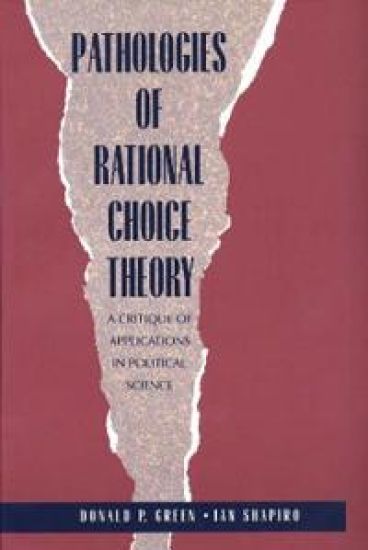
Pathologies of Rational Choice Theory

Pathologies of Rational Choice Theory

Donald Green; Ian Shapiro

Yale University Press
1996
pokkari
This is the first comprehensive critical evaluation of the use of rational choice theory in political science. Writing in an accessible and nontechnical style, Donald P. Green and Ian Shapiro assess rational choice theory where it is reputed to be most successful: the study of collective action, the behavior of political parties and politicians, and such phenomena as voting cycles and Prisoner's Dilemmas. In their hard-hitting critique, Green and Shapiro demonstrate that the much heralded achievements of rational choice theory are in fact deeply suspect and that fundamental rethinking is needed if rational choice theorists are to contribute to the understanding of politics. In their final chapters, they anticipate and respond to a variety of possible rational choice responses to their arguments, thereby initiating a dialogue that is bound to continue for some time.
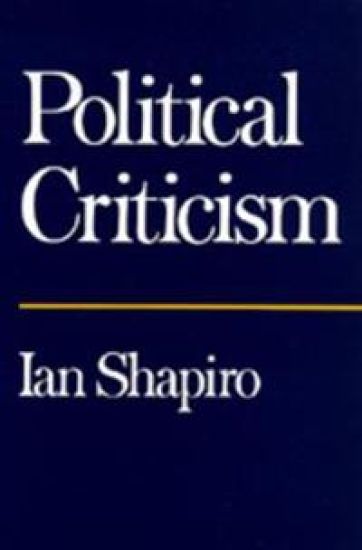
Political Criticism

Political Criticism

Ian Shapiro

University of California Press
1992
pokkari
Since the 1960s, a resurgence of interest in the moral foundations of politics has fueled debates about the appropriate sources of our political judgments. Ian Shapiro analyzes and advances these debates, discussing them in an accessibly style. He defends a view of politics called critical naturalism as a third way between the neo-Kantian theory of John Rawl's and the contextual arguments of Richard Rorty, Michael Walzer, Alasdair MacIntyre and others. He formulates a new justification for democratic politics and an innovative account of the nature of political argument.
The Evolution of Rights in Liberal Theory

The Evolution of Rights in Liberal Theory

Ian Shapiro

Cambridge University Press
1986
pokkari
In this book Ian Shapiro offers a systematic comparative evaluation of the writings of contemporary liberal rights theorists and those of their seventeenth-century predecessors. He shows how contemporary arguments about rights and justice evolved out of the contractarian tradition of the seventeenth century but he argues that they are lethal mutation of that tradition. Some of the deepest difficulties of contemporary rights theories derive from the appropriation of parts of the older tradition without the unifying assumptions about knowledge and science that gave the seventeenth-century arguments their underlying coherence. Those assumptions are no longer available to us, making it impossible for us to return to the internally more consistent philosophies of the liberal past. Shapiro draws out the implications of his analysis for current disputes within liberalism between rights theorists and utilitarians and for disputes between liberals and communitarians, arguing that the communitarian critics of liberalism are in danger of incorporating its most serious weaknesses.