Kirjojen hintavertailu. Mukana 12 595 353 kirjaa ja 12 kauppaa.

Kirjailija

Ian Steedman

Kirjat ja teokset yhdessä paikassa: 7 kirjaa, julkaisuja vuosilta 1979-2021, suosituimpien joukossa Consumption Takes Time. Vertaile teosten hintoja ja tarkista saatavuus suomalaisista kirjakaupoista.

7 kirjaa

Kirjojen julkaisuhaarukka 1979-2021.

From Exploitation To Altruism

From Exploitation To Altruism

Ian Steedman

Routledge
2021
nidottu
This book is concerned with issues in classical political economy, particularly that of David Ricardo and Karl Marx, discussing P. H. Wicksteed's work in political economy and his 1884 Jevonian critique of Marx. It focuses on the relations between rationality and altruism.
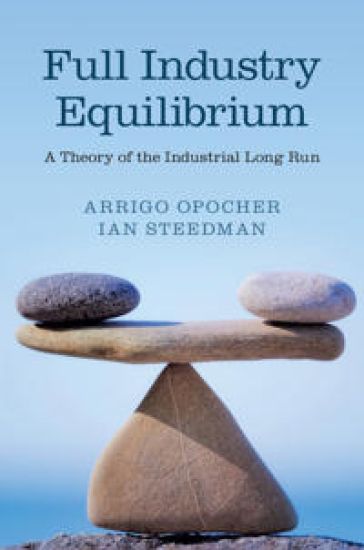
Full Industry Equilibrium

Full Industry Equilibrium

Arrigo Opocher; Ian Steedman

Cambridge University Press
2020
pokkari
This highly original book develops a systematic zero-net-profit comparative statics theory of the firm that challenges many widely held views in microeconomics. It builds a bridge between the marginalist long-run theory of the firm and Sraffian theory to create a unified theoretical framework that explains how firms react to exogenous shocks resulting in new equilibrium positions of the whole economy. The central message of the book is that too often economists expect more from the microeconomic laws of input demand and output supply than they can really give. The authors show that the zero-net-profit condition requires a more articulated analysis that sometimes yields qualitative results contrary to those of familiar economic laws. Written for academic researchers and graduate students, the book will be of particular interest to those working on the microeconomics of industry equilibrium, comparative statics and Sraffian economics.
From Exploitation To Altruism

From Exploitation To Altruism

Ian Steedman

Routledge
2019
sidottu
"Ricardo, Marx, Jevons and Wicksteed all feature prominently in the following twelve essays - and, indeed, a number of other economists of the past, from Cantillon onwards, will be found to play a role. Nevertheless, these essays do not, for the most part, constitute history of thought for the genuine historian of thought; they are, rather, attempts to broach more general issues via a tolerably close study of particular texts. The first six essays concern issues in classical political economy, particularly - though not exclusively - that of Ricardo and Marx. The previously unpublished essay 7 provides a bridge to the second half of the volume, discussing Wicksteed's first work in political economy, his 1884 J evonian critique of Marx, and some of the debates which that work provoked. Jevons and Wicksteed are also central to essays 8-10. The final three essays (of which 10 and 11 were previously not readily available) are all concerned with various aspects of preferences and of the complex motivations lying behind economic actions. Are the following essays, then, to be classified as 'history of economic thought' or as 'economic theory'? No, they are not: such classification would be futile. What matters is whether or not they are honest in the rendering of other writers' works, accurate in reasoning and both stimulating and enjoyable to read."
Full Industry Equilibrium

Full Industry Equilibrium

Arrigo Opocher; Ian Steedman

Cambridge University Press
2015
sidottu
This highly original book develops a systematic zero-net-profit comparative statics theory of the firm that challenges many widely held views in microeconomics. It builds a bridge between the marginalist long-run theory of the firm and Sraffian theory to create a unified theoretical framework that explains how firms react to exogenous shocks resulting in new equilibrium positions of the whole economy. The central message of the book is that too often economists expect more from the microeconomic laws of input demand and output supply than they can really give. The authors show that the zero-net-profit condition requires a more articulated analysis that sometimes yields qualitative results contrary to those of familiar economic laws. Written for academic researchers and graduate students, the book will be of particular interest to those working on the microeconomics of industry equilibrium, comparative statics and Sraffian economics.
Consumption Takes Time

Consumption Takes Time

Ian Steedman

Routledge
2006
nidottu
Standard economic theory of consumer behaviour considers consumers' preferences, their incomes and commodity prices to be the determinants of consumption. However, consumption takes time and no consumer has more - or less - than 168 hours per week. This simple fact is almost invisible in standard theory, and takes the centre stage in this book.
Consumption Takes Time

Consumption Takes Time

Ian Steedman

Routledge
2001
sidottu
Standard economic theory of consumer behaviour considers consumers' preferences, their incomes and commodity prices to be the determinants of consumption. However, consumption takes time and no consumer has more - or less - than 168 hours per week. This simple fact is almost invisible in standard theory, and takes the centre stage in this book. Whether one is 'money-rich but time-poor' or is 'money-poor and killing time', both money and time considerations matter. Recognition that consumers are subject to both time and expenditure constraints makes a real difference to the economic theory of consumption. 'Two-constraint' theory is genuinely different in various respects from the familiar one-constraint theory. Income effects, substitution effects etc. have to be reconsidered, expenditure functions have to be redefined, and the results are sometimes surprising. It is not only the positive theory of consumption and labour supply that must be reworked, welfare economics too changes significantly when time constraints on consumption are given their proper due. The focus on time not only changes the comparative states of consumer theory, but it also overcomes some of the more artificial barriers between social theory and practical, everyday matters of altruism and interpersonal decision taking.