Kirjojen hintavertailu. Mukana 12 595 353 kirjaa ja 12 kauppaa.

Kirjailija

Iasson Karafyllis

Kirjat ja teokset yhdessä paikassa: 6 kirjaa, julkaisuja vuosilta 2011-2025, suosituimpien joukossa Robust Adaptive Control. Vertaile teosten hintoja ja tarkista saatavuus suomalaisista kirjakaupoista.

6 kirjaa

Kirjojen julkaisuhaarukka 2011-2025.

Robust Adaptive Control

Robust Adaptive Control

Iasson Karafyllis; Miroslav Krstic

SOCIETY FOR INDUSTRIAL APPLIED MATHEMATICS,U.S.
2025
sidottu
The book presents a solution to a problem in adaptive control design that was open for 40 years: robustification of disturbances without compromising asymptotic performance. This original methodology builds on foundational ideas, such as the use of a deadzone in the update law and nonlinear damping in the controller, and advances the tools for and the theory behind designing robust adaptive controllers, thus guaranteeing robustness properties stronger than previously achieved. Numerous examples provide detailed analyses of the new methodology. The authors present all stability notions that are useful in adaptive control, provide examples of all robustness problems (e.g. parameter drift), and analyze all approaches to robustification of adaptive controllers that have appeared in the literature; develop the Deadzone-Adapted Disturbance Suppression (DADS) control, a novel adaptive control scheme, and construct a novel robust identifier that can work in parallel with every direct adaptive controller (not only DADS);present the wing rock instability problem, an application of the DADS control scheme, solved with the DADS controller; and provide ideas for the extension of the control scheme to cases not studied in the book.
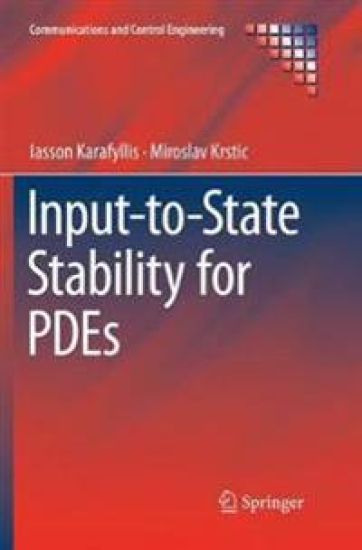
Input-to-State Stability for PDEs

Input-to-State Stability for PDEs

Iasson Karafyllis; Miroslav Krstic

Springer Nature Switzerland AG
2019
nidottu
This book lays the foundation for the study of input-to-state stability (ISS) of partial differential equations (PDEs) predominantly of two classes—parabolic and hyperbolic. This foundation consists of new PDE-specific tools. In addition to developing ISS theorems, equipped with gain estimates with respect to external disturbances, the authors develop small-gain stability theorems for systems involving PDEs. A variety of system combinations are considered: PDEs (of either class) with static maps;PDEs (again, of either class) with ODEs;PDEs of the same class (parabolic with parabolic and hyperbolic with hyperbolic); andfeedback loops of PDEs of different classes (parabolic with hyperbolic). In addition to stability results (including ISS), the text develops existence and uniqueness theory for all systems that are considered. Many of these results answer for the first time the existence and uniqueness problems for many problems that have dominated the PDE control literature of the last two decades, including—for PDEs that include non-local terms—backstepping control designs which result in non-local boundary conditions. Input-to-State Stability for PDEs will interest applied mathematicians and control specialists researching PDEs either as graduate students or full-time academics. It also contains a large number of applications that are at the core of many scientific disciplines and so will be of importance for researchers in physics, engineering, biology, social systems and others.
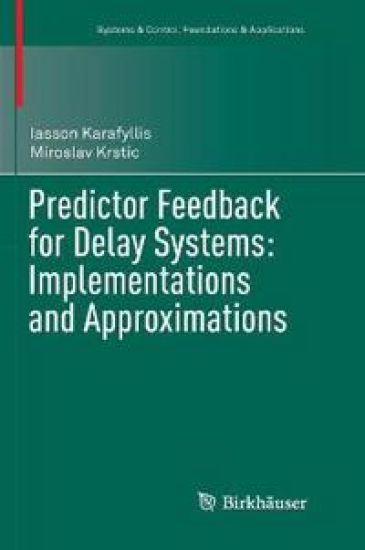
Predictor Feedback for Delay Systems: Implementations and Approximations

Predictor Feedback for Delay Systems: Implementations and Approximations

Iasson Karafyllis; Miroslav Krstic

Birkhauser Verlag AG
2018
nidottu
This monograph bridges the gap between the nonlinear predictor as a concept and as a practical tool, presenting a complete theory of the application of predictor feedback to time-invariant, uncertain systems with constant input delays and/or measurement delays. It supplies several methods for generating the necessary real-time solutions to the systems’ nonlinear differential equations, which the authors refer to as approximate predictors.Predictor feedback for linear time-invariant (LTI) systems is presented in Part I to provide a solid foundation on the necessary concepts, as LTI systems pose fewer technical difficulties than nonlinear systems. Part II extends all of the concepts to nonlinear time-invariant systems. Finally, Part III explores extensions of predictor feedback to systems described by integral delay equations and to discrete-time systems.The book’s core is the design of control and observer algorithms with which global stabilization, guaranteed in the previous literature with idealized (but non-implementable) predictors, is preserved with approximate predictors developed in the book.An applications-driven engineer will find a large number of explicit formulae, which are given throughout the book to assist in the application of the theory to a variety of control problems. A mathematician will find sophisticated new proof techniques, which are developed for the purpose of providing global stability guarantees for the nonlinear infinite-dimensional delay system under feedback laws employing practically implementable approximate predictors.Researchers working on global stabilization problems for time-delay systems will find this monograph to be a helpful summary of the state of the art, while graduate students in the broad field of systems and control will advance their skills in nonlinear control design and the analysis of nonlinear delay systems.
Input-to-State Stability for PDEs

Input-to-State Stability for PDEs

Iasson Karafyllis; Miroslav Krstic

Springer International Publishing AG
2018
sidottu
This book lays the foundation for the study of input-to-state stability (ISS) of partial differential equations (PDEs) predominantly of two classes—parabolic and hyperbolic. This foundation consists of new PDE-specific tools. In addition to developing ISS theorems, equipped with gain estimates with respect to external disturbances, the authors develop small-gain stability theorems for systems involving PDEs. A variety of system combinations are considered: PDEs (of either class) with static maps;PDEs (again, of either class) with ODEs;PDEs of the same class (parabolic with parabolic and hyperbolic with hyperbolic); andfeedback loops of PDEs of different classes (parabolic with hyperbolic). In addition to stability results (including ISS), the text develops existence and uniqueness theory for all systems that are considered. Many of these results answer for the first time the existence and uniqueness problems for many problems that have dominated the PDE control literature of the last two decades, including—for PDEs that include non-local terms—backstepping control designs which result in non-local boundary conditions. Input-to-State Stability for PDEs will interest applied mathematicians and control specialists researching PDEs either as graduate students or full-time academics. It also contains a large number of applications that are at the core of many scientific disciplines and so will be of importance for researchers in physics, engineering, biology, social systems and others.
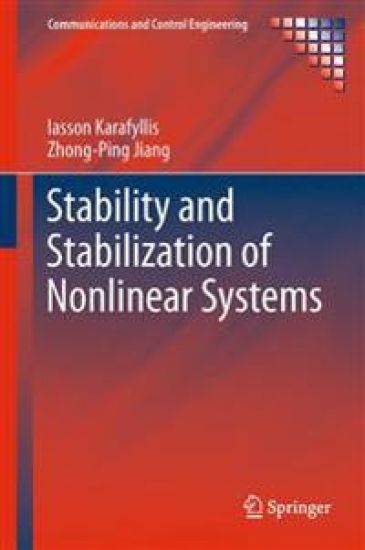
Stability and Stabilization of Nonlinear Systems

Stability and Stabilization of Nonlinear Systems

Iasson Karafyllis; Zhong-Ping Jiang

Springer London Ltd
2013
nidottu
Recently, the subject of nonlinear control systems analysis has grown rapidly and this book provides a simple and self-contained presentation of their stability and feedback stabilization which enables the reader to learn and understand major techniques used in mathematical control theory. In particular: the important techniques of proving global stability properties are presented closely linked with corresponding methods of nonlinear feedback stabilization; a general framework of methods for proving stability is given, thus allowing the study of a wide class of nonlinear systems, including finite-dimensional systems described by ordinary differential equations, discrete-time systems, systems with delays and sampled-data systems; approaches to the proof of classical global stability properties are extended to non-classical global stability properties such as non-uniform-in-time stability and input-to-output stability; and new tools for stability analysis and control design of a wide class of nonlinear systems are introduced. The presentational emphasis of Stability and Stabilization of Nonlinear Systems is theoretical but the theory’s importance for concrete control problems is highlighted with a chapter specifically dedicated to applications and with numerous illustrative examples. Researchers working on nonlinear control theory will find this monograph of interest while graduate students of systems and control can also gain much insight and assistance from the methods and proofs detailed in this book.
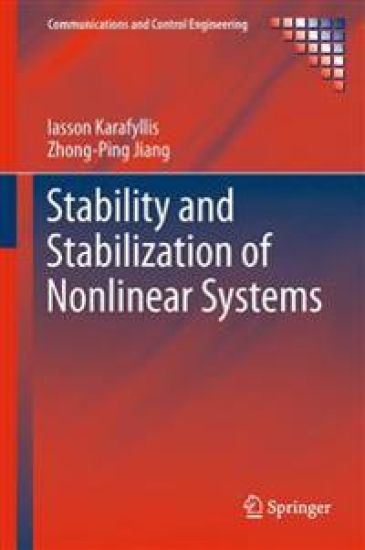
Stability and Stabilization of Nonlinear Systems

Stability and Stabilization of Nonlinear Systems

Iasson Karafyllis; Zhong-Ping Jiang

Springer London Ltd
2011
sidottu
Recently, the subject of nonlinear control systems analysis has grown rapidly and this book provides a simple and self-contained presentation of their stability and feedback stabilization which enables the reader to learn and understand major techniques used in mathematical control theory. In particular: the important techniques of proving global stability properties are presented closely linked with corresponding methods of nonlinear feedback stabilization; a general framework of methods for proving stability is given, thus allowing the study of a wide class of nonlinear systems, including finite-dimensional systems described by ordinary differential equations, discrete-time systems, systems with delays and sampled-data systems; approaches to the proof of classical global stability properties are extended to non-classical global stability properties such as non-uniform-in-time stability and input-to-output stability; and new tools for stability analysis and control design of a wide class of nonlinear systems are introduced. The presentational emphasis of Stability and Stabilization of Nonlinear Systems is theoretical but the theory’s importance for concrete control problems is highlighted with a chapter specifically dedicated to applications and with numerous illustrative examples. Researchers working on nonlinear control theory will find this monograph of interest while graduate students of systems and control can also gain much insight and assistance from the methods and proofs detailed in this book.