Kirjojen hintavertailu. Mukana 12 390 323 kirjaa ja 12 kauppaa.

Kirjailija

Ilan Kelman

Kirjat ja teokset yhdessä paikassa: 12 kirjaa, julkaisuja vuosilta 2011-2025, suosituimpien joukossa Catastrophe and Conflict. Vertaile teosten hintoja ja tarkista saatavuus suomalaisista kirjakaupoista.

12 kirjaa

Kirjojen julkaisuhaarukka 2011-2025.

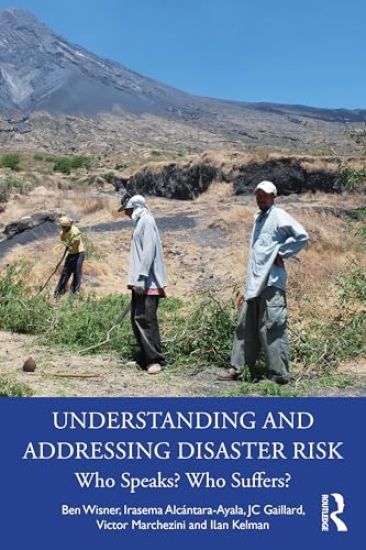
Understanding and Addressing Disaster Risk

Understanding and Addressing Disaster Risk

Ben Wisner; Irasema Alcántara-Ayala; JC Gaillard; Ilan Kelman; Victor Marchezini

TAYLOR FRANCIS LTD
2025
nidottu
In Understanding and Addressing Disaster Risk, the authors explain how people modify the environment and exert power over each other in ways that make nature potentially harmful and put people in harm’s way. Opportunities and challenges faced by those engaging with disaster risk are explored.Across 11 chapters, the authors show that disasters are not natural, are not events, and do not happen quickly. Instead, they are the result of chronic societal processes emerging from the creation and perpetuation of vulnerabilities and limitations on people’s abilities to respond to hazards. The book also explores the environmental component of disaster risk through the lens of different natural elements and phenomena, including biological-ecological and water-weather-climate processes as well as geological and outer space dynamics. The authors explain the mutual influence of the different components of disasters in creating disaster risk across diverse regions of the world. They critique attempts to reduce disaster risk through top-down, siloed assumptions, attitudes, and values. The value of people’s knowledge of hazards – often ignored or dismissed by authorities – is a central theme. This book is original because of how it re-interprets and advances understanding of the disaster process through the study of such societal processes of vulnerability, risk creation, and power imbalances. It is also unique in diving further into “root causes” of disaster in order to place them within local histories and colonial legacies as well as contemporary, typically misdirected, agendas while upending previous “solutions” which have been shown to do more harm than good.Understanding and Addressing Disaster Risk is useful for and useable by decision-makers, policy makers, researchers, and students to shatter the vicious cycle of repeating known mistakes which compound detrimental outcomes.The Open Access version of this book, available at www.taylorfrancis.com, has been made available under a Creative Commons Attribution-Non Commercial-No Derivatives (CC-BY-NC-ND) 4.0 International license.
Understanding and Addressing Disaster Risk

Understanding and Addressing Disaster Risk

Ben Wisner; Irasema Alcántara-Ayala; JC Gaillard; Ilan Kelman; Victor Marchezini

TAYLOR FRANCIS LTD
2025
sidottu
In Understanding and Addressing Disaster Risk, the authors explain how people modify the environment and exert power over each other in ways that make nature potentially harmful and put people in harm’s way. Opportunities and challenges faced by those engaging with disaster risk are explored.Across 11 chapters, the authors show that disasters are not natural, are not events, and do not happen quickly. Instead, they are the result of chronic societal processes emerging from the creation and perpetuation of vulnerabilities and limitations on people’s abilities to respond to hazards. The book also explores the environmental component of disaster risk through the lens of different natural elements and phenomena, including biological-ecological and water-weather-climate processes as well as geological and outer space dynamics. The authors explain the mutual influence of the different components of disasters in creating disaster risk across diverse regions of the world. They critique attempts to reduce disaster risk through top-down, siloed assumptions, attitudes, and values. The value of people’s knowledge of hazards – often ignored or dismissed by authorities – is a central theme. This book is original because of how it re-interprets and advances understanding of the disaster process through the study of such societal processes of vulnerability, risk creation, and power imbalances. It is also unique in diving further into “root causes” of disaster in order to place them within local histories and colonial legacies as well as contemporary, typically misdirected, agendas while upending previous “solutions” which have been shown to do more harm than good.Understanding and Addressing Disaster Risk is useful for and useable by decision-makers, policy makers, researchers, and students to shatter the vicious cycle of repeating known mistakes which compound detrimental outcomes.The Open Access version of this book, available at www.taylorfrancis.com, has been made available under a Creative Commons Attribution-Non Commercial-No Derivatives (CC-BY-NC-ND) 4.0 International license.
Katastrophen aus Menschenhand

Katastrophen aus Menschenhand

Ilan Kelman

Springer-Verlag Berlin and Heidelberg GmbH Co. KG
2024
nidottu
Ein Erdbeben erschüttert Haiti und ein Hurrikan wütet in Texas. Wir hören, dass die Natur wütet und versucht, uns durch diese "Naturkatastrophen" zu zerstören. Die Wissenschaft erzählt eine andere Geschichte: die unbequeme Wahrheit, dass Katastrophen nicht die Folge von natürlichen Ursachen sind, sondern die meisten "Naturkatastrophen" durch menschliche Entscheidungen verursacht werden.?In diesem Buch erfahren Sie, wie Katastrophen vermieden werden können und sollten. Menschen mit politischer Macht, Geld und Möglichkeiten, allen zu helfen, vermeiden aktiv, Katastrophen zu verhindern, wenn die Natur ihre Kräfte und Energien entfesselt. Sie werden von Beispielen für schreckliche Katastrophen wie Erdbeben und Hurrikane in Haiti lesen, neben inspirierenden Erfolgen im Umgang mit Waldbränden in Colorado und Überschwemmungen in Toronto und Bangladesch. Die Geschichten nehmen Sie mit auf eine Reise um die Welt und in die Vergangenheit, um die komplexen Faktoren zu erkunden, die Katastrophen verursachen. Die Politik diktiert, wo und was wir bauen, während sie Armut, Marginalisierung und Diskriminierung schafft und aufrechterhält. Wir sollten die Menschen, die diese Entscheidungen treffen, für Katastrophen verantwortlich machen. Doch stattdessen konzentrieren wir uns auf Umweltfaktoren oder Gottheiten, die Todesfälle, Schäden und Störungen "verursachen".Die Politik diktiert, wo und was wir bauen, während sie Armut, Marginalisierung und Diskriminierung schafft und aufrechterhält und wir konzentrieren uns auf Umweltfaktoren oder Gottheiten, die Todesfälle oder Schäden "verursachen". Dieses Buch handelt von der Unfähigkeit der Menschheit, mit der Umwelt und mit uns selbst, kollektiv und individuell, umzugehen. Es wird Sie dabei unterstützen, bessere Entscheidungen zu treffen, um zukünftig dazu beizutragen Katastrophen zu verhindern.
Environmental Hazards

Environmental Hazards

Keith Smith; Carina J. Fearnley; Deborah Dixon; Deanne K. Bird; Ilan Kelman

TAYLOR FRANCIS INC
2023
nidottu
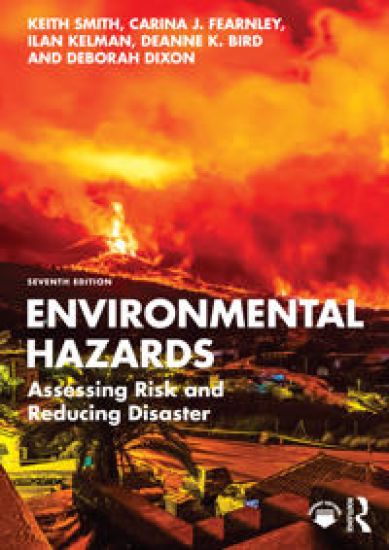
The seventh edition of Environmental Hazards provides a much expanded and fully up-to-date overview of all the extreme environmental events that threaten people and what they value in the 21st century globally. It integrates cutting-edge materials to provide an interdisciplinary approach to environmental hazards and their management, illustrating how natural and human systems interact to place communities of all sizes, and at all stages of economic development, at risk. Part 1 defines basic concepts of hazard, risk, vulnerability and disaster and explores the evolution of hazards theory. Part 2 employs a consistent chapter structure to demonstrate how individual hazards occur, their impacts and how the risks can be assessed and managed.This extensively revised edition includes:Fresh perspectives on the reliability of disaster data, disaster risk reduction, risk and disaster perception and communication, and new technologies available to assist with environmental hazard managementThe addition of several new environmental hazards including landslide and avalanches, cryospheric hazards, karst and subsidence hazards, and hazards of the AnthropoceneMore boxed sections with a focus on both generic issues and the lessons to be learned from a carefully selected range of up-to-date extreme eventsAn annotated list of key resources, including further reading and relevant websites, for all chaptersMore colour diagrams and photographs, and more than 1,000 references to some of the most significant and recent published materialNew exercises to assist teaching in the classroom, or self-learningThis carefully structured and balanced textbook captures the complexity and dynamism of environmental hazards and is essential reading for students across many disciplines including geography, environmental science, environmental studies and natural resources.
Environmental Hazards

Environmental Hazards

Keith Smith; Carina J. Fearnley; Deborah Dixon; Deanne K. Bird; Ilan Kelman

TAYLOR FRANCIS INC
2023
sidottu
The seventh edition of Environmental Hazards provides a much expanded and fully up-to-date overview of all the extreme environmental events that threaten people and what they value in the 21st century globally. It integrates cutting-edge materials to provide an interdisciplinary approach to environmental hazards and their management, illustrating how natural and human systems interact to place communities of all sizes, and at all stages of economic development, at risk. Part 1 defines basic concepts of hazard, risk, vulnerability and disaster and explores the evolution of hazards theory. Part 2 employs a consistent chapter structure to demonstrate how individual hazards occur, their impacts and how the risks can be assessed and managed.This extensively revised edition includes:Fresh perspectives on the reliability of disaster data, disaster risk reduction, risk and disaster perception and communication, and new technologies available to assist with environmental hazard managementThe addition of several new environmental hazards including landslide and avalanches, cryospheric hazards, karst and subsidence hazards, and hazards of the AnthropoceneMore boxed sections with a focus on both generic issues and the lessons to be learned from a carefully selected range of up-to-date extreme eventsAn annotated list of key resources, including further reading and relevant websites, for all chaptersMore colour diagrams and photographs, and more than 1,000 references to some of the most significant and recent published materialNew exercises to assist teaching in the classroom, or self-learningThis carefully structured and balanced textbook captures the complexity and dynamism of environmental hazards and is essential reading for students across many disciplines including geography, environmental science, environmental studies and natural resources.
Disaster by Choice

Disaster by Choice

Ilan Kelman

Oxford University Press
2022
nidottu
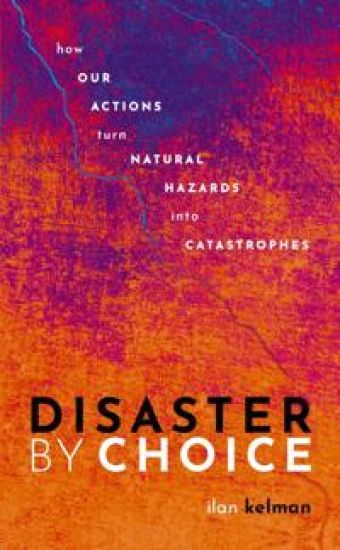
An earthquake shatters Haiti and a hurricane slices through Texas. We hear that nature runs rampant, seeking to destroy us through these 'natural disasters'. Science recounts a different story, however: disasters are not the consequence of natural causes; they are the consequence of human choices and decisions. We put ourselves in harm's way; we fail to take measures which we know would prevent disasters, no matter what the environment does. This can be both hard to accept, and hard to unravel. A complex of factors shape disasters. They arise from the political processes dictating where and what we build, and from social circumstances which create and perpetuate poverty and discrimination. They develop from the social preference to blame nature for the damage wrought, when in fact events such as earthquakes and storms are entirely commonplace environmental processes. We feel the need to fight natural forces, to reclaim what we assume is ours, and to protect ourselves from what we perceive to be wrath from outside our communities. This attitude distracts us from the real causes of disasters: humanity's decisions, as societies and as individuals. It stops us accepting the real solutions to disasters: making better decisions. This book explores stories of some of our worst disasters to show how we can and should act to stop people dying when nature unleashes its energies. The disaster is not the tornado, the volcanic eruption, or climate change, but the deaths and injuries, the loss of irreplaceable property, and the lack and even denial of support to affected people, so that a short-term interruption becomes a long-term recovery nightmare. But we can combat this, as Kelman shows, describing inspiring examples of effective human action that limits damage, such as managing flooding in Toronto and villages in Bangladesh, or wildfires in Colorado. Throughout, his message is clear: there is no such thing as a natural disaster. The disaster lies in our inability to deal with the environment and with ourselves.
Disaster Diplomacy

Disaster Diplomacy

Ilan Kelman

Routledge
2020
nidottu
When an earthquake hits a war zone or cyclone aid is flown in by an enemy, many ask: Can catastrophe bring peace? Disaster prevention and mitigation provide similar questions. Could setting up a flood warning system bring enemy countries together? Could a regional earthquake building code set the groundwork for wider regional cooperation?This book examines how and why disaster-related activities do and do not create peace and reduce conflict. Disaster-related activities refer to actions before a disaster such as prevention and mitigation along with actions after a disaster such as emergency response, humanitarian relief, and reconstruction. This volume investigates disaster diplomacy case studies from around the world, in a variety of political and disaster circumstances, from earthquakes in Greece and Turkey affecting these neighbours’ bilateral relations to volcanoes and typhoons influencing intra-state conflict in the Philippines. Dictatorships are amongst the case studies, such as Cuba and Burma, along with democracies such as the USA and India. No evidence is found to suggest that disaster diplomacy is a prominent factor in conflict resolution. Instead, disaster-related activities often influence peace processes in the short-term—over weeks and months—provided that a non-disaster-related basis already existed for the reconciliation. That could be secret negotiations between the warring parties or strong trade or cultural links. Over the long-term, disaster-related influences disappear, succumbing to factors such as a leadership change, the usual patterns of political enmity, or belief that an historical grievance should take precedence over disaster-related bonds.This is the first book on disaster diplomacy. Disaster-politics interactions have been studied for decades, but usually from a specific political framing, covering a specific geographical area, or from a specific disaster framing. As well, plenty of quantitative work has been completed, yet the data limitations are rarely admitted openly or thoroughly analysed. Few publications bring together the topics of disasters and politics in terms of a disaster diplomacy framework, yielding a grounded, qualitative, scientific point of view on the topic.
Catastrophe and Conflict

Catastrophe and Conflict

Ilan Kelman

BRILL
2016
nidottu
Catastrophe and Conflict: Disaster Diplomacy and Its Foreign Policy Implications examines how and why disaster-related activities (disaster response and disaster risk reduction) do and do not lead to diplomatic endeavours. With respect to foreign policy implications, the main question examined here is: Under what circumstances could disaster diplomacy be actively made to succeed or not to succeed? Previous case studies are summarised followed by new case studies of disease diplomacy and climate change diplomacy. From the case studies, disaster diplomacy could succeed when those in power decide that they want it to succeed and then use their power for that goal. This situation is not likely to arise because of only disaster-related activities. Instead, pre-existing interests supporting diplomacy are needed.
Disaster Diplomacy

Disaster Diplomacy

Ilan Kelman

Routledge
2011
sidottu
When an earthquake hits a war zone or cyclone aid is flown in by an enemy, many ask: Can catastrophe bring peace? Disaster prevention and mitigation provide similar questions. Could setting up a flood warning system bring enemy countries together? Could a regional earthquake building code set the groundwork for wider regional cooperation?This book examines how and why disaster-related activities do and do not create peace and reduce conflict. Disaster-related activities refer to actions before a disaster such as prevention and mitigation along with actions after a disaster such as emergency response, humanitarian relief, and reconstruction. This volume investigates disaster diplomacy case studies from around the world, in a variety of political and disaster circumstances, from earthquakes in Greece and Turkey affecting these neighbours’ bilateral relations to volcanoes and typhoons influencing intra-state conflict in the Philippines. Dictatorships are amongst the case studies, such as Cuba and Burma, along with democracies such as the USA and India. No evidence is found to suggest that disaster diplomacy is a prominent factor in conflict resolution. Instead, disaster-related activities often influence peace processes in the short-term—over weeks and months—provided that a non-disaster-related basis already existed for the reconciliation. That could be secret negotiations between the warring parties or strong trade or cultural links. Over the long-term, disaster-related influences disappear, succumbing to factors such as a leadership change, the usual patterns of political enmity, or belief that an historical grievance should take precedence over disaster-related bonds.This is the first book on disaster diplomacy. Disaster-politics interactions have been studied for decades, but usually from a specific political framing, covering a specific geographical area, or from a specific disaster framing. As well, plenty of quantitative work has been completed, yet the data limitations are rarely admitted openly or thoroughly analysed. Few publications bring together the topics of disasters and politics in terms of a disaster diplomacy framework, yielding a grounded, qualitative, scientific point of view on the topic.