Kirjojen hintavertailu. Mukana 12 595 353 kirjaa ja 12 kauppaa.
Kirjailija
Ilana Redstone
Kirjat ja teokset yhdessä paikassa: 5 kirjaa, julkaisuja vuosilta 2020-2025, suosituimpien joukossa Unassailable Ideas. Vertaile teosten hintoja ja tarkista saatavuus suomalaisista kirjakaupoista.
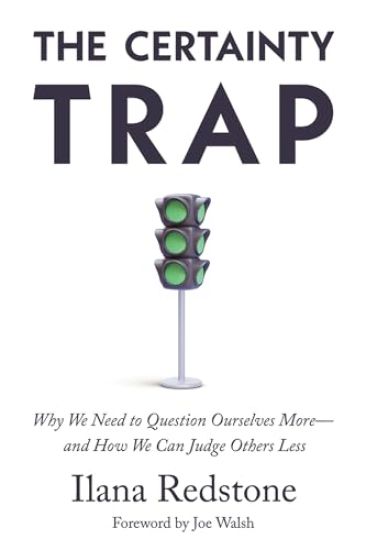
When we’re in the Certainty Trap, we tend to view people who disagree with us as hateful, ignorant, or just plain stupid. When it comes to heated social and political issues in particular, many of us know this feeling well— a consuming state of righteous indignation and moral outrage. And this response makes sense because our very certainty tells us that there are simple and obvious causes and solutions to the hot-button issues we care about most. But the things we care about the most are— far more often than not— morally and ethically complex. If the problems that divide us are inherently complicated, then a sense that the answers are obvious— and that anyone who disagrees must be deficient in some way— is misplaced. It's an oversimplification that both leads to and reflects faulty thinking. When we’ re certain, we not only fail to recognize the possibility that we’ re wrong but also fail to be clear about the principles and values that drive our disagreement in the first place. By committing to challenging and clarifying our thinking— by avoiding the trap certainty sets for us— we can increase social trust, reduce political polarization, and better address the world’s pressing challenges.
Why do we disagree about the causes of and solutions to social inequality? What explains our different viewpoints on Black Lives Matter, #MeToo, income inequality, and immigration? In this tightly argued book, John Iceland, Eric Silver, and Ilana Redstone show how two clashing worldviews – one emphasizing Social Justice and another Social Order – are preventing Americans from solving their most pressing social problems. The authors show how each worldview provides a different understanding of human nature, morality, social change, and the wisdom of the past. They argue that, before Americans can find lasting solutions to today’s seemingly intractable societal challenges, they will need to recognize that each side possesses a wisdom the other lacks. Only then can we achieve the common ground and consensus we seek.
Why do we disagree about the causes of and solutions to social inequality? What explains our different viewpoints on Black Lives Matter, #MeToo, income inequality, and immigration? In this tightly argued book, John Iceland, Eric Silver, and Ilana Redstone show how two clashing worldviews – one emphasizing Social Justice and another Social Order – are preventing Americans from solving their most pressing social problems. The authors show how each worldview provides a different understanding of human nature, morality, social change, and the wisdom of the past. They argue that, before Americans can find lasting solutions to today’s seemingly intractable societal challenges, they will need to recognize that each side possesses a wisdom the other lacks. Only then can we achieve the common ground and consensus we seek.
Open inquiry and engagement with a diverse range of views are long-cherished and central tenets of higher education and are pivotal to innovation and knowledge creation. Yet, free inquiry on American campuses is hampered by a climate that constrains teaching, research, and overall discourse. In Unassailable Ideas, Ilana Redstone and John Villasenor examine the dominant belief system on American campuses, its uncompromising enforcement through social media, and the consequences for higher education. They argue that two trends in particular--the emergent role of social media in limiting academic research and knowledge discovery and a campus culture increasingly intolerant to diverse views and open inquiry--are fundamentally reshaping higher education. Redstone and Villasenor further identify and explain how three well-intentioned unwritten rules regarding identity define the current campus climate. They present myriad case studies illustrating the resulting impact on education, knowledge creation-and, increasingly the world beyond campus. They also provide a set of recommendations to build a new campus climate that would be more tolerant toward diverse perspectives and open inquiry. An insightful analysis of the current state of academia, Unassailable Ideas highlights an environment in higher education that forecloses entire lines of research, entire discussions, and entire ways of conducting classroom teaching.