Kirjojen hintavertailu. Mukana 12 595 353 kirjaa ja 12 kauppaa.

Kirjailija

Ingo Gildenhard

Kirjat ja teokset yhdessä paikassa: 21 kirjaa, julkaisuja vuosilta 2010-2020, suosituimpien joukossa The Classical Tradition. Vertaile teosten hintoja ja tarkista saatavuus suomalaisista kirjakaupoista.

21 kirjaa

Kirjojen julkaisuhaarukka 2010-2020.

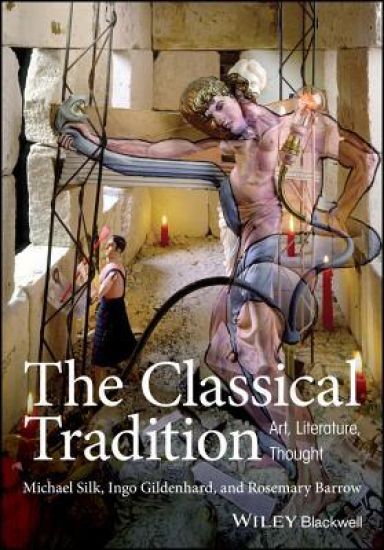
The Classical Tradition

The Classical Tradition

Michael Silk; Ingo Gildenhard; Rosemary Barrow

Wiley-Blackwell (an imprint of John Wiley Sons Ltd)
2017
nidottu
'Reorganizes the field and challenges our preconceptions in both familiar areas and in disciplines that are not usually treated in studies on the classical tradition. A must read.' - Craig Kallendorf, Texas A&M University 'An exciting read: energetic, considered, sparklingly written. One gets the feeling that all angles have been properly covered. An ambitious project brilliantly realized.' - Matthew Bell, King's College London 'The authors have pulled off the seemingly impossible task of fusing their three voices into a single, urgently argued discourse, and for that reason among many others, this will be a wonderful book to read and to use, for all kinds of readers.' - Terence Cave, St John's College, Oxford 'I found the text very readable and I particularly enjoyed the post-postmodernist take on many issues. It is hugely stimulating and intriguing throughout.' - Deborah Howard, University of Cambridge 'I think this is an absolutely splendid text, unique in conception, elegant and ingenious in design, and extremely ???user-friendly??? in styling and presentation.' - David Hopkins, University of Bristol 'A prodigiously ambitious, cornucopian book . . . so rich that no review will do it justice.' - Paul Barolsky, University of Virginia, Arion 'Impressive power and learning.' - Justus Cobet, Universität Duisburg-Essen, Sehepunkte 'Succeeds in providing an overarching account of a huge sweep of cultural history without losing sight of the host of nuances and particularities associated with such an overwhelmingly large topic.' - Pablo Maurette, University of Chicago, Comparative Critical Studies 'Highly innovative...engrossing...the book is marvellously packed throughout with insights and provocations. It conducts, to its great benefit and ours, a properly theoretical enquiry.' - Charles Martindale, University of Bristol, Translation and Literature The classical tradition – the legacy of Ancient Greece and Rome – is a large, diverse, and important field that continues to shape human endeavour and engender wide public interest. The Classical Tradition: Art, Literature, Thought presents an original, coherent, and wide-ranging guide to the afterlife of Greco-Roman antiquity in later Western cultures and a ground-breaking reinterpretation of large aspects of Western culture as a whole – English-speaking, French, German, and Italian – from a classical perspective. Encompassing almost two millennia of developments in art, literature, and thought, the authors provide an overview of the field, a concise point of reference, and a critical review of selected examples, from Titian to T. S. Eliot, from the hero to concepts of government. They engage in current theoretical debate on various fronts, from hermeneutics to gender. Themes explored include the Western languages and their continuing engagement with Latin and Greek; the role of translation; the intricate relationship of pagan and Christian; the ideological implications of the classical tradition; the interplay between the classical tradition and the histories of scholarship and education; the relation between high and low culture; and the myriad complex relationships – comparative, contrastive, and interactive – between art, literature, and thought themselves. Authoritative and accessible, The Classical Tradition: Art, Literature, Thought offers new insights into the powerful legacy of the ancient world from the Middle Ages and the Renaissance to the present day.
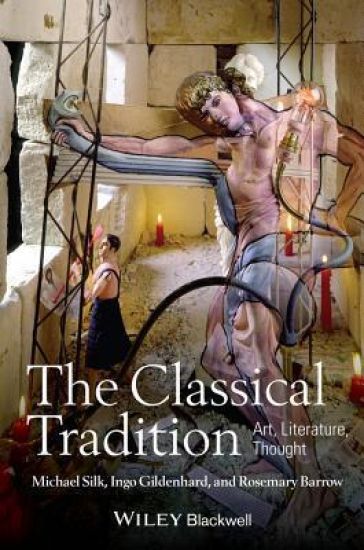
The Classical Tradition

The Classical Tradition

Michael Silk; Ingo Gildenhard; Rosemary Barrow

Wiley-Blackwell (an imprint of John Wiley Sons Ltd)
2014
sidottu
The Classical Tradition: Art, Literature, Thought presents an authoritative, coherent, and wide-ranging guide to the afterlife of Greco-Roman antiquity in later Western cultures and a ground-breaking reinterpretation of large aspects of Western culture as a whole from a classical perspective. The authors provide an overview of developments in the English-speaking, French, German and Italian traditions, a critical review of selected examples and a concise point of reference, engaging in current theoretical debate on various fronts, from hermeneutics to gender.
Creative Eloquence

Creative Eloquence

Ingo Gildenhard

Oxford University Press
2010
sidottu
The statesman Cicero (106-43 BC) left behind a corpus of about 50 orations, all designed as interventions in the legal and political struggles that marked the final decades of the Roman republic. Ever since their publication during his lifetime they have functioned as models of eloquence. However, they also contain profound philosophical thoughts on the question of being human, on politics, society, and culture, and on the sphere of the divine. Now, for the first time, Ingo Gildenhard systematically analyses this dimension of Cicero's oratory and, in so doing, touches upon many key issues and concepts that still preoccupy us today, such as the ethics of happiness or the notion of conscience, the distinction between civilization and barbarity, or the problem of divine justice.
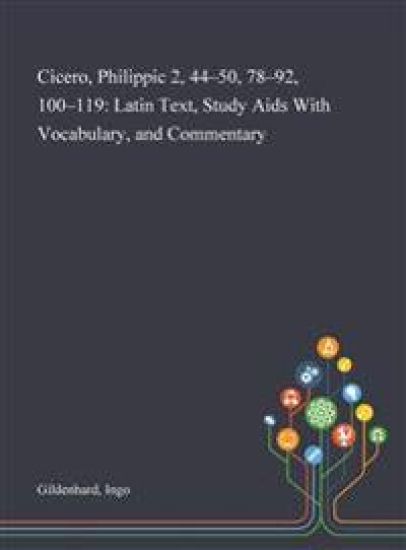
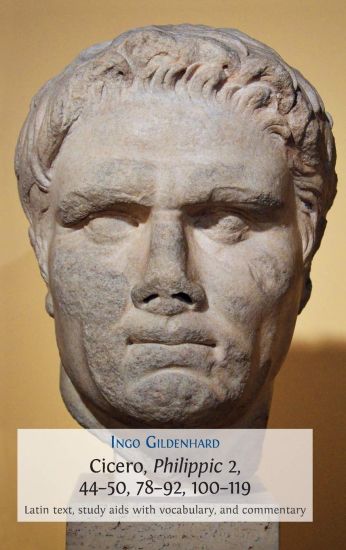
Cicero, Philippic 2, 44-50, 78-92, 100-119

Cicero, Philippic 2, 44-50, 78-92, 100-119

Ingo Gildenhard

Open Book Publishers
2018
sidottu
Cicero composed his incendiary Philippics only a few months after Rome was rocked by the brutal assassination of Julius Caesar. In the tumultuous aftermath of Caesar's death, Cicero and Mark Antony found themselves on opposing sides of an increasingly bitter and dangerous battle for control. Philippic 2 was a weapon in that war.Conceived as Cicero's response to a verbal attack from Antony in the Senate, Philippic 2 is a rhetorical firework that ranges from abusive references to Antony's supposedly sordid sex life to a sustained critique of what Cicero saw as Antony's tyrannical ambitions. Vituperatively brilliant and politically committed, it is both a carefully crafted literary artefact and an explosive example of crisis rhetoric. It ultimately led to Cicero's own gruesome death.This course book offers a portion of the original Latin text, vocabulary aids, study questions, and an extensive commentary. Designed to stretch and stimulate readers, Ingo Gildenhard's volume will be of particular interest to students of Latin studying for A-Level or on undergraduate courses. It extends beyond detailed linguistic analysis to encourage critical engagement with Cicero, his oratory, the politics of late-republican Rome, and the transhistorical import of Cicero's politics of verbal (and physical) violence.
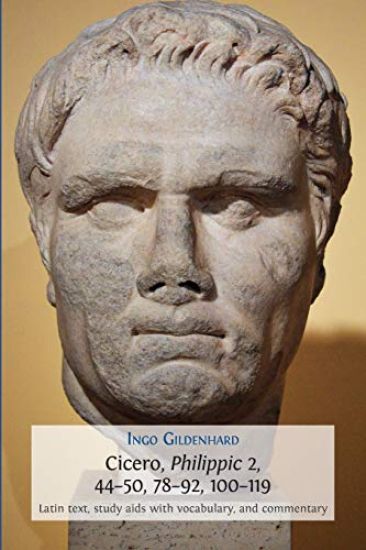
100-119 Cicero, Philippic 2, 44-50, 78-92

100-119 Cicero, Philippic 2, 44-50, 78-92

Ingo Gildenhard

Open Book Publishers
2018
sidottu
Cicero composed his incendiary Philippics only a few months after Rome was rocked by the brutal assassination of Julius Caesar. In the tumultuous aftermath of Caesar's death, Cicero and Mark Antony found themselves on opposing sides of an increasingly bitter and dangerous battle for control. Philippic 2 was a weapon in that war.Conceived as Cicero's response to a verbal attack from Antony in the Senate, Philippic 2 is a rhetorical firework that ranges from abusive references to Antony's supposedly sordid sex life to a sustained critique of what Cicero saw as Antony's tyrannical ambitions. Vituperatively brilliant and politically committed, it is both a carefully crafted literary artefact and an explosive example of crisis rhetoric. It ultimately led to Cicero's own gruesome death.This course book offers a portion of the original Latin text, vocabulary aids, study questions, and an extensive commentary. Designed to stretch and stimulate readers, Ingo Gildenhard's volume will be of particular interest to students of Latin studying for A-Level or on undergraduate courses. It extends beyond detailed linguistic analysis to encourage critical engagement with Cicero, his oratory, the politics of late-republican Rome, and the transhistorical import of Cicero's politics of verbal (and physical) violence.