Kirjojen hintavertailu. Mukana 12 595 353 kirjaa ja 12 kauppaa.
Kirjailija
Ingo Müller
Kirjat ja teokset yhdessä paikassa: 22 kirjaa, julkaisuja vuosilta 2001-2025, suosituimpien joukossa Jahreslosung 2026 - Stundenentwurf und Postkarten (10 Ex.) für Teens und junge E. Vertaile teosten hintoja ja tarkista saatavuus suomalaisista kirjakaupoista.
Standardverket om det tyska rättssystemet under nazisterna och hur följsamt det var och hur lite motstånd det erbjöd. En klassiker som klart och begripligt för lekmannen beskriver hela det tyska rättssystemets elände på 1900-talet.
Der vollständig aktualisierte Ratgeber ermöglicht einen schnellen Zugriff auf die wichtigsten Akteure, verfahrensrelevante Themen und mögliche Strafen der Strafjustiz. Damit sollen u.a. Schöffen auf das staatspolitisch bedeutende Amt vorbereitet werden. Das Buch vermittelt aber auch dem Laien in einer für ihn verständlichen Form die Grundlagen des materiellen und prozessualen Strafrechts und stellt die historischen sowie kriminologischen Hintergründe des Strafrechts dar. Der Ratgeber dient zudem als Hilfsmittel für Lehrer, Gerichtshelfer und Bewährungshelfer bei ihrer täglichen Arbeit.Der InhaltKriminalität und Gesellschaft ? Vom Sinn der Strafe ? Das Strafverfahren ? Strafen und Maßnahmen bei erwachsenen Straftätern ? Strafen und Maßnahmen bei Jugendlichen und Heranwachsenden ? Verfahrenssichernde Maßnahmen im Vorverfahren ? Die Problematik der Straßenkinder ? Ausländerfeindliche Gewalt – Das Beispiel Rostock-Lichtenhagen ? Straftaten von und zu Lasten vonFlüchtlingen (Asylsuchenden) ? Sonderregelungen für das SchöffenamtDie ZielgruppenSchöffen ? Pädagogen ? Gerichtshelfer ? Bewährungshelfer ? SozialarbeiterDie AutorenDr. jur. Albrecht Lüthke war seit 1969 Jugendrichter beim Amtsgericht Bremen und zwischen 1992 -2002 beim Amtsgericht Rostock. Er arbeitete von 2003 bis 2015 als Strafverteidiger und Opferanwalt.Dr. phil., Dr. jur. Ingo Müller ist pensionierter Professor für Strafrecht und Strafprozessrecht an der Polizeihochschule in Hamburg.
Physicists firmly believe that the differential equations of nature should be hyperbolic so as to exclude action at a distance; yet the equations of irreversible thermodynamics - those of Navier-Stokes and Fourier - are parabolic. This incompatibility between the expectation of physicists and the classical laws of thermodynamics has prompted the formulation of extended thermodynamics. After describing the motifs and early evolution of this new branch of irreversible thermodynamics, the authors apply the theory to mon-atomic gases, mixtures of gases, relativistic gases, and "gases" of phonons and photons. The discussion brings into perspective the various phenomena called second sound, such as heat propagation, propagation of shear stress and concentration, and the second sound in liquid helium. The formal mathematical structure of extended thermodynamics is exposed and the theory is shown to be fully compatible with the kinetic theory of gases. The study closes with the testing of extended thermodynamics through the exploitation of its predictions for measurements of light scattering and sound propagation.
Experiments with rubber balloons and rubber sheets have led to surprising observations, some of them hitherto unknown or not previously described in the literature. In balloons, these phenomena are due to the non-monotonic pressure-radius characteristic which makes balloons a subject of interest to physicists engaged in stability studies. Here is a situation in which symmetry breaking and hysteresis may be studied analytically, because the stress-stretch relations of rubber - and its non-convex free energy - can be determined explicitly from the kinetic theory of rubber and from non-linear elasticity. Since rubber elasticity and the elasticity of gases are both entropy-induced, a rubber balloon represents a compromise between the entropic tendency of a gas to expand and the entropic tendency of rubber to contract. Thus rubber and rubber balloons furnish instructive paradigms of thermodynamics. This monograph treats the subject at a level appropriate for post-graduate studies.
Thermodynamics is the much abused slave of many masters • physicists who love the totally impractical Carnot process, • mechanical engineers who design power stations and refrigerators, • chemists who are successfully synthesizing ammonia and are puzzled by photosynthesis, • meteorologists who calculate cloud bases and predict föhn, boraccia and scirocco, • physico-chemists who vulcanize rubber and build fuel cells, • chemical engineers who rectify natural gas and distil f- mented potato juice, • metallurgists who improve steels and harden surfaces, • - trition counselors who recommend a proper intake of calories, • mechanics who adjust heat exchangers, • architects who construe – and often misconstrue – ch- neys, • biologists who marvel at the height of trees, • air conditioning engineers who design saunas and the ventilation of air plane cabins, • rocket engineers who create supersonic flows, et cetera. Not all of these professional groups need the full depth and breadth of ther- dynamics. For some it is enough to consider a well-stirred tank, for others a s- tionary nozzle flow is essential, and yet others are well-served with the partial d- ferential equation of heat conduction. It is therefore natural that thermodynamics is prone to mutilation; different group-specific meta-thermodynamics’ have emerged which serve the interest of the groups under most circumstances and leave out aspects that are not often needed in their fields.
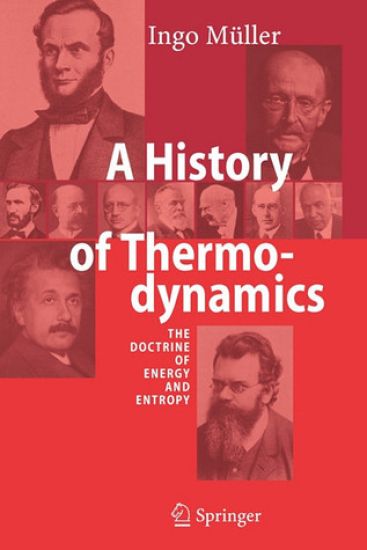
The most exciting and significant episode of scientific progress is the development of thermodynamics and electrodynamics in the 19th century and early 20th century. The nature of heat and temperature was recognized, the conservation of energy was discovered, and the realization that mass and energy are equivalent provided a new fuel, – and unlimited power. Much of this occurred in unison with the rapid technological advance provided by the steam engine, the electric motor, internal combustion engines, refrigeration and the rectification processes of the chemical industry. The availability of cheap power and cheap fuel has had its impact on society: Populations grew, the standard of living increased, the envir- ment became clean, traffic became easy, and life expectancy was raised. Knowledge fairly exploded. The western countries, where all this happened, gained in power and influence, and western culture – scientific culture – spread across the globe, and is still spreading. At the same time, thermodynamics recognized the stochastic and probabilistic aspect of natural processes. It turned out that the doctrine of energy and entropy rules the world; the first ingredient – energy – is deterministic, as it were, and the second – entropy – favours randomness. Both tendencies compete, and they find the precarious balance needed for stability and change alike.
Die Arbeit erschliesst erstmals das spanische Anwaltshaftungsrecht in deutscher Sprache und setzt sich zugleich mit der spanischen Doktrin kritisch auseinander. Im Mittelpunkt der Bearbeitung steht die besonders praxisrelevante zivilrechtliche Haftung des Rechtsanwalts, die eine umfassende Eroerterung erfahrt. Erganzend werden ausserdem die Grundlagen seiner disziplinar- und strafrechtlichen Haftung dargestellt. Die Untersuchung zeigt, dass den strukturellen Gemeinsamkeiten mit dem deutschen Recht auch erhebliche Unterschiede gegenuberstehen, von der Zweiteilung des Anwaltsberufs bis zur Ersatzfahigkeit von Chancen, die der Mandant durch die Pflichtverletzung des Anwalts verloren hat. Praxisnahe Erlauterungen zu Haftungsvereinbarungen und zur Berufshaftpflichtversicherung runden die Arbeit ab.
Thermodynamics is the much abused slave of many masters • physicists who love the totally impractical Carnot process, • mechanical engineers who design power stations and refrigerators, • chemists who are successfully synthesizing ammonia and are puzzled by photosynthesis, • meteorologists who calculate cloud bases and predict föhn, boraccia and scirocco, • physico-chemists who vulcanize rubber and build fuel cells, • chemical engineers who rectify natural gas and distil f- mented potato juice, • metallurgists who improve steels and harden surfaces, • - trition counselors who recommend a proper intake of calories, • mechanics who adjust heat exchangers, • architects who construe – and often misconstrue – ch- neys, • biologists who marvel at the height of trees, • air conditioning engineers who design saunas and the ventilation of air plane cabins, • rocket engineers who create supersonic flows, et cetera. Not all of these professional groups need the full depth and breadth of ther- dynamics. For some it is enough to consider a well-stirred tank, for others a s- tionary nozzle flow is essential, and yet others are well-served with the partial d- ferential equation of heat conduction. It is therefore natural that thermodynamics is prone to mutilation; different group-specific meta-thermodynamics’ have emerged which serve the interest of the groups under most circumstances and leave out aspects that are not often needed in their fields.
The most exciting and significant episode of scientific progress is the development of thermodynamics and electrodynamics in the 19th century and early 20th century. The nature of heat and temperature was recognized, the conservation of energy was discovered, and the realization that mass and energy are equivalent provided a new fuel, – and unlimited power. Much of this occurred in unison with the rapid technological advance provided by the steam engine, the electric motor, internal combustion engines, refrigeration and the rectification processes of the chemical industry. The availability of cheap power and cheap fuel has had its impact on society: Populations grew, the standard of living increased, the envir- ment became clean, traffic became easy, and life expectancy was raised. Knowledge fairly exploded. The western countries, where all this happened, gained in power and influence, and western culture – scientific culture – spread across the globe, and is still spreading. At the same time, thermodynamics recognized the stochastic and probabilistic aspect of natural processes. It turned out that the doctrine of energy and entropy rules the world; the first ingredient – energy – is deterministic, as it were, and the second – entropy – favours randomness. Both tendencies compete, and they find the precarious balance needed for stability and change alike.
"Entropy and Energy- a Universal Competition" is a students textbook as well as a scientific monograph. The concepts of entropy and energy embody the effects of random walk in a body and of deterministic strife respectively, and are therefore often in competition. The book gives instructive examples from elementary thermodynamics and physico-chemistry and extrapolates the notion to non-standard thermodynamic subjects like shape memory, dissipation of the earth's atmosphere, and sociology. The works of the thermodynamic pioneers are presented, in particular Clausius, Carathéodory, Boltzmann, Gibbs, and Planck. The laws of thermodynamics and their limitations are discussed; also the pertinacious Gibbs paradox. The reader has numerous possibilities to influence the programs and thus develop an understanding for the thermodynamic principles.