Kirjojen hintavertailu. Mukana 12 657 676 kirjaa ja 12 kauppaa.

Kirjailija

Ingrid Tieken-Boon van Ostade

Kirjat ja teokset yhdessä paikassa: 8 kirjaa, julkaisuja vuosilta 1987-2022, suosituimpien joukossa In Search of Jane Austen. Vertaile teosten hintoja ja tarkista saatavuus suomalaisista kirjakaupoista.

8 kirjaa

Kirjojen julkaisuhaarukka 1987-2022.

Describing Prescriptivism

Describing Prescriptivism

Ingrid Tieken-Boon van Ostade

TAYLOR FRANCIS LTD
2022
nidottu
Describing Prescriptivism provides a topical and thought-provoking analysis of linguistic prescriptivism in British and American English, from a historical as well as present-day perspective. Focusing on usage guides and usage problems, the book takes a three-fold approach to present an in-depth analysis of the topic, featuring: a detailed study of the advice provided in usage guides over the years;an authoritative comparison of this advice with actual usage as recorded in British and American corpora, including the HUGE (Hyper Usage Guide of English) database – developed specifically to enable this line of study – as well as more mainstream corpora such as COCA, COHA and the BNC;a close analysis of the attitudes to particular usage problems among the general public, based on surveys distributed online through the "Bridging the Unbridgeable" research project’s blog.*With extensive case studies to illustrate and support claims throughout, this comprehensive study is key reading for students and researchers of prescriptivism, the history of English and sociolinguistics.*Found at https://bridgingtheunbridgeable.com/
Describing Prescriptivism

Describing Prescriptivism

Ingrid Tieken-Boon van Ostade

Routledge
2019
sidottu
Describing Prescriptivism provides a topical and thought-provoking analysis of linguistic prescriptivism in British and American English, from a historical as well as present-day perspective. Focusing on usage guides and usage problems, the book takes a three-fold approach to present an in-depth analysis of the topic, featuring: a detailed study of the advice provided in usage guides over the years; an authoritative comparison of this advice with actual usage as recorded in British and American corpora, including the HUGE (Hyper Usage Guide of English) database – developed specifically to enable this line of study – as well as more mainstream corpora such as COCA, COHA and the BNC; a close analysis of the attitudes to particular usage problems among the general public, based on surveys distributed online through the "Bridging the Unbridgeable" research project’s blog.*With extensive case studies to illustrate and support claims throughout, this comprehensive study is key reading for students and researchers of prescriptivism, the history of English and sociolinguistics.*Found at https://bridgingtheunbridgeable.com/
In Search of Jane Austen

In Search of Jane Austen

Ingrid Tieken-Boon van Ostade

Oxford University Press Inc
2014
sidottu
Along with Shakespeare, Jane Austen (1775-1817) can be said to be the most widely studied author in the history of English literature. But unlike Shakespeare, her language has received little scholarly attention. This is especially true for the language of her letters. Jane Austen's letters, mostly addressed to her sister Cassandra but to various other people as well, have been described as the equivalent of telephone conversations, and if you read them, you can almost hear her speak. We do not have access to actual speech from the time in which she lived, but the letters take us as close to the spoken language of the period as you might hope to get. They are therefore a veritable linguistic goldmine. This study, for the first time, offers a detailed sociolinguistic account of all aspects of the language of her letters: spelling, vocabulary and grammar. It also produces some evidence of pronunciation as well as of local dialectal usage. The analysis shows Jane Austen to be rather idiosyncratic in her language use: she was consistent in her spelling (though she had unusual spelling preferences), not very innovative in her vocabulary (though she did coin a few new words), and not quite representative of grammatical developments of the times (though her usage differed depending on who she wrote to, her sister, her publisher or her nieces and nephews). This study of Jane Austen's private language use shows the extent to which she varied in her language use, just like any of us do today, while is also provides evidence both for a date of her unfinished novel The Watsons (for the first time on linguistic grounds) and for the interplay there must have been between the editors of her novels and her own linguistic preferences, in the field of spelling and otherwise.
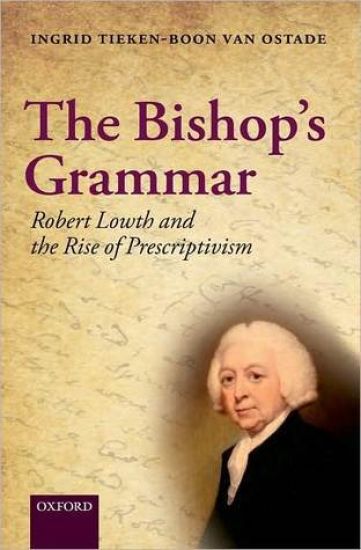
The Bishop's Grammar

The Bishop's Grammar

Ingrid Tieken-Boon van Ostade

Oxford University Press
2010
sidottu
This spirited account of the life and times of one of the seminal figures in history of English grammar dispels the myth of Lowth as the icon of prescriptivism, and establishes him as the most important figure in eighteenth-century English grammar. Ingrid Tieken-Boon van Ostade reexamines the life and work of Robert Lowth (1710-1787), founder of the grammatical prescriptivism so deprecated by modern linguists and educational theorists. She considers Lowth and his grammar in the context of his times and from the perspective of his aims and readership. She shows that, once the grammar had been accepted for publication, it developed into a publishers' project similar to Samuel Johnson's Dictionary of the English Language to which it was intended as a complement. Professor Tieken draws on contemporary sources, including Lowth's extensive correspondence and unpublished memoir, to explore the social networks, aspirations, beliefs, and reading habits that informed and shaped his grammar and ideas on language. (She notes that Lowth's own language often falls short of the norms and strictures advanced in his book.) By comparing the grammar - in particular the problems of usage dealt with in its sections on syntax - with guides from the nineteenth and twentieth centuries, she redefines Lowth's seminal position in the history of handbooks for correct usage, as well as his role in the establishment of the canon of prescriptivism. This book will appeal to all those interested in the history of English, the role of language in the Enlightenment, and the long-running debate on linguistic correctness and the merits or otherwise of prescriptive rules in the teaching and use of English.
An Introduction to Late Modern English

An Introduction to Late Modern English

Ingrid Tieken-Boon van Ostade

Edinburgh University Press
2009
sidottu
Some twenty years ago it was widely believed that nothing much happened to the English language since the beginning of the eighteenth century. Recent research has shown that this is far from true, and this book offers an introduction to a period that forms the tail end of the standardisation process (codification and prescription), during which important social changes such as the Industrial Revolution are reflected in the language. Late Modern English is currently receiving a lot of scholarly attention, mainly as a result of new developments in sociohistorical linguistics and corpus linguistics. By drawing on such research the present book offers a much fuller account of the language of the period than was previously possible. It is designed for students and beginning scholars interested in Late Modern English. The volume includes: *a basis in recent research by which sociolinguistic models are applied to earlier stages of the language (1700-1900) *a focus on people as speakers (wherever possible) and writers of English *research questions aimed at acquiring skills at working with important electronic research tools such as Eighteenth Century Collections Online (ECCO), the Oxford English Dictionary and the Oxford Dictionary of National Biography *reference to electronically available texts and databases such as Martha Ballard's Diary, the Proceedings of the Old Bailey and Mrs Beeton's Book of Household Management.
An Introduction to Late Modern English

An Introduction to Late Modern English

Ingrid Tieken-Boon van Ostade

Edinburgh University Press
2009
nidottu
Some twenty years ago it was widely believed that nothing much happened to the English language since the beginning of the eighteenth century. Recent research has shown that this is far from true, and this book offers an introduction to a period that forms the tail end of the standardisation process (codification and prescription), during which important social changes such as the Industrial Revolution are reflected in the language. Late Modern English is currently receiving a lot of scholarly attention, mainly as a result of new developments in sociohistorical linguistics and corpus linguistics. By drawing on such research the present book offers a much fuller account of the language of the period than was previously possible. It is designed for students and beginning scholars interested in Late Modern English. The volume includes: *a basis in recent research by which sociolinguistic models are applied to earlier stages of the language (1700-1900) *a focus on people as speakers (wherever possible) and writers of English *research questions aimed at acquiring skills at working with important electronic research tools such as Eighteenth Century Collections Online (ECCO), the Oxford English Dictionary and the Oxford Dictionary of National Biography *reference to electronically available texts and databases such as Martha Ballard's Diary, the Proceedings of the Old Bailey and Mrs Beeton's Book of Household Management.
The Two Versions of Malory's Morte Darthur

The Two Versions of Malory's Morte Darthur

Ingrid Tieken-Boon van Ostade

D.S. Brewer
1995
sidottu
Analysis of the relationship between the Winchester manuscript and Caxton's edition. Detailed linguistic analysis of the two versions of the Morte Darthur, charting important changes in the development of the English language. Malory's Morte Darthursurvives in two versions: the Winchester manuscript, which has been dated 1469-70, and the edition Caxton published in 1485. These versions were thought to be collaterally related through a common source to an original lost manuscript, until in 1977 new evidence suggested a linear descent. Dr Tieken-Boon van Ostade's study supports this argument, first through a detailed refutation of Vinaver's arguments for collateral descent,then through an analysis of the incidence of multiple negation in both versions of the Morte Darthurand the conclusions to be drawn from it. A reconstruction of the events leading to Caxton's publication of the text at a politically hazardous time completes the volume.Dr INGRID TIEKEN-BOON VAN OSTADEis lecturer in English at the University of Leiden. Two books already published centre on the history of the English language.