Kirjojen hintavertailu. Mukana 12 595 353 kirjaa ja 12 kauppaa.

Kirjailija

Ioan Toma

Kirjat ja teokset yhdessä paikassa: 3 kirjaa, julkaisuja vuosilta 2011-2020, suosituimpien joukossa Knowledge Graphs. Vertaile teosten hintoja ja tarkista saatavuus suomalaisista kirjakaupoista.

3 kirjaa

Kirjojen julkaisuhaarukka 2011-2020.

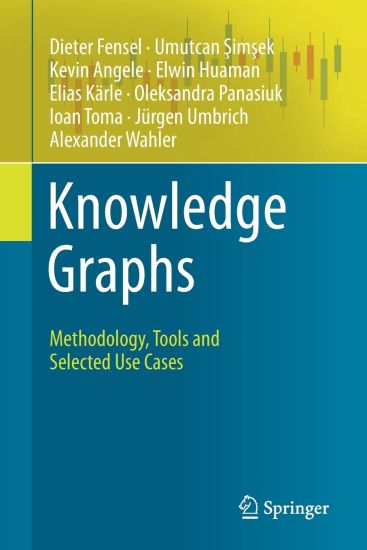
Knowledge Graphs

Knowledge Graphs

Dieter Fensel; Umutcan Simsek; Kevin Angele; Elwin Huaman; Elias Kärle; Oleksandra Panasiuk; Ioan Toma; Jürgen Umbrich; Alexander Wahler

Springer Nature Switzerland AG
2020
nidottu
This book describes methods and tools that empower information providers to build and maintain knowledge graphs, including those for manual, semi-automatic, and automatic construction; implementation; and validation and verification of semantic annotations and their integration into knowledge graphs. It also presents lifecycle-based approaches for semi-automatic and automatic curation of these graphs, such as approaches for assessment, error correction, and enrichment of knowledge graphs with other static and dynamic resources.Chapter 1 defines knowledge graphs, focusing on the impact of various approaches rather than mathematical precision. Chapter 2 details how knowledge graphs are built, implemented, maintained, and deployed. Chapter 3 then introduces relevant application layers that can be built on top of such knowledge graphs, and explains how inference can be used to define views on such graphs, making it a useful resource for open and service-oriented dialog systems. Chapter 4 discusses applications of knowledge graph technologies for e-tourism and use cases for other verticals. Lastly, Chapter 5 provides a summary and sketches directions for future work. The additional appendix introduces an abstract syntax and semantics for domain specifications that are used to adapt schema.org to specific domains and tasks.To illustrate the practical use of the approaches presented, the book discusses several pilots with a focus on conversational interfaces, describing how to exploit knowledge graphs for e-marketing and e-commerce. It is intended for advanced professionals and researchers requiring a brief introduction to knowledge graphs and their implementation.
Semantic Web Services

Semantic Web Services

Dieter Fensel; Federico Michele Facca; Elena Simperl; Ioan Toma

Springer-Verlag Berlin and Heidelberg GmbH Co. K
2014
nidottu
A paradigm shift is taking place in computer science: one generation ago, we learned to abstract from hardware to software, now we are abstracting from software to serviceware implemented through service-oriented computing. Yet ensuring interoperability in open, heterogeneous, and dynamically changing environments, such as the Internet, remains a major challenge for actual machine-to-machine integration. Usually significant problems in aligning data, processes, and protocols appear as soon as a specific piece of functionality is used within a different application context. The Semantic Web Services (SWS) approach is about describing services with metadata on the basis of domain ontologies as a means to enable their automatic location, execution, combination, and use. Fensel and his coauthors provide a comprehensive overview of SWS in line with actual industrial practice. They introduce the main sociotechnological components that ground the SWS vision (like Web Science, Service Science, and service-oriented architectures) and several approaches that realize it, e.g. the Web Service Modeling Framework, OWL-S, and RESTful services. The real-world relevance is emphasized through a series of case studies from large-scale R&D projects and a business-oriented proposition from the SWS technology provider Seekda.Each chapter of the book is structured according to a predefined template, covering both theoretical and practical aspects, and including walk-through examples and hands-on exercises. Additional learning material is available on the book website www.swsbook.org. With its additional features, the book is ideally suited as the basis for courses or self-study in this field, and it may also serve as a reference for researchers looking for a state-of-the-art overview of formalisms, methods, tools, and applications related to SWS.
Semantic Web Services

Semantic Web Services

Dieter Fensel; Federico Michele Facca; Elena Simperl; Ioan Toma

Springer-Verlag Berlin and Heidelberg GmbH Co. K
2011
sidottu
A paradigm shift is taking place in computer science: one generation ago, we learned to abstract from hardware to software, now we are abstracting from software to serviceware implemented through service-oriented computing. Yet ensuring interoperability in open, heterogeneous, and dynamically changing environments, such as the Internet, remains a major challenge for actual machine-to-machine integration. Usually significant problems in aligning data, processes, and protocols appear as soon as a specific piece of functionality is used within a different application context. The Semantic Web Services (SWS) approach is about describing services with metadata on the basis of domain ontologies as a means to enable their automatic location, execution, combination, and use. Fensel and his coauthors provide a comprehensive overview of SWS in line with actual industrial practice. They introduce the main sociotechnological components that ground the SWS vision (like Web Science, Service Science, and service-oriented architectures) and several approaches that realize it, e.g. the Web Service Modeling Framework, OWL-S, and RESTful services. The real-world relevance is emphasized through a series of case studies from large-scale R&D projects and a business-oriented proposition from the SWS technology provider Seekda.Each chapter of the book is structured according to a predefined template, covering both theoretical and practical aspects, and including walk-through examples and hands-on exercises. Additional learning material is available on the book website www.swsbook.org. With its additional features, the book is ideally suited as the basis for courses or self-study in this field, and it may also serve as a reference for researchers looking for a state-of-the-art overview of formalisms, methods, tools, and applications related to SWS.