Kirjojen hintavertailu. Mukana 12 390 323 kirjaa ja 12 kauppaa.

Kirjailija

Ioannis Kokkoris

Kirjat ja teokset yhdessä paikassa: 9 kirjaa, julkaisuja vuosilta 2010-2024, suosituimpien joukossa EU Merger Control. Vertaile teosten hintoja ja tarkista saatavuus suomalaisista kirjakaupoista.

9 kirjaa

Kirjojen julkaisuhaarukka 2010-2024.

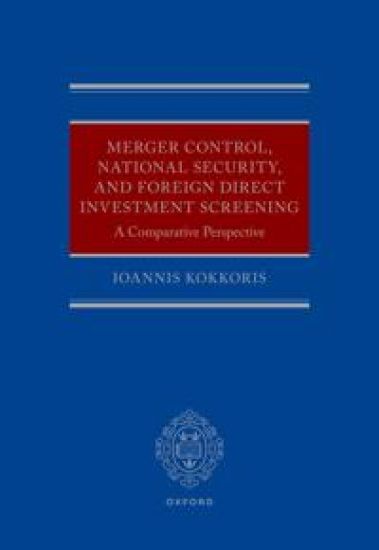
Merger Control, National Security, and Foreign Direct Investment Screening
The Covid-19 pandemic, the significant expansion of the Chinese investment abroad, and recent geo-political tensions have all served to strengthen national security considerations in merger control and foreign direct investment (FDI) processes. Against this backdrop, Merger Control, National Security, and Foreign Direct Investment Screening: A Comparative Perspective provides a comprehensive exploration of the intricate interplay between national security, foreign direct investment, and competition policy in an increasingly interconnected global economy. Central to the book's analysis is the exploration of FDI screening mechanisms from a national security perspective as they apply to Merger and Acquisition (M&A) transactions. Spanning a wide array of jurisdictions, industries, and policy contexts, including case studies from major economies such as the European Union, the United Kingdom, the United States, and China, the book examines how lawmakers navigate protecting their strategic sectors while promoting a welcoming environment for investors. It also showcases how competition authorities grapple with incorporating broader societal goals and national security concerns into merger control assessments. Merger Control, National Security, and Foreign Direct Investment Screening scrutinizes the challenges of balancing these objectives while maintaining the integrity of competition law principles and avoiding undue political influence. It offers a thought-provoking and timely guide for policymakers, practitioners, scholars, and stakeholders seeking to navigate the intricacies of global economic interdependence without dismissing national interests.
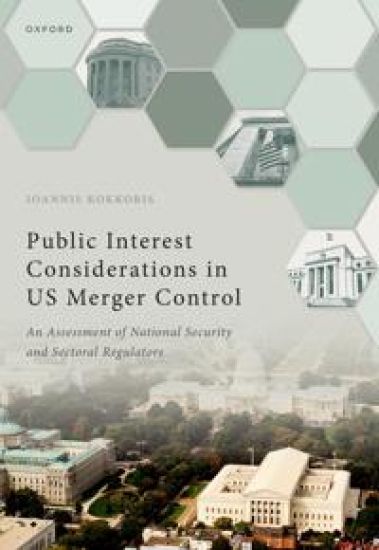
Public Interest Considerations in US Merger Control

Public Interest Considerations in US Merger Control

Ioannis Kokkoris

Oxford University Press
2024
sidottu
Public Interest Considerations in US Merger Control: An Assessment of National Security and Sectoral Regulators offers a detailed study of the enforcement goals and regulatory framework of merger control assessment in the US. Assessment approaches vary considerably across sectors and Kokkoris explores the different approaches adopted by a range of US regulatory authorities, including the Committee on Foreign Investment in the United States, the Federal Communications Commission, the Department of Transportation, and the Board of Governors of the Federal Reserve System. Kokkoris argues that US merger assessments can be convoluted as transactions can be assessed under a public interest test by one sectoral authority and under a competition test by the Federal Trade Commission or the Department of Justice. These overlapping approaches can lead to contradictory outcomes, resulting in ineffective competitive dynamics in the sectoral market. The book focuses on the composition, legislation, and the relevant public interest considerations of each regulatory authority and presents seminal cases that illustrate the different enforcement approaches as well as the possible discrepancies between competition law-based assessments and national security or public interest-based assessments. Distilling all these considerations, Public Interest Considerations in Merger Control suggests that the application of the varying shades of the public interest standard can result in a complex and inefficient merger review process and recommends new ways to address these inefficiencies.
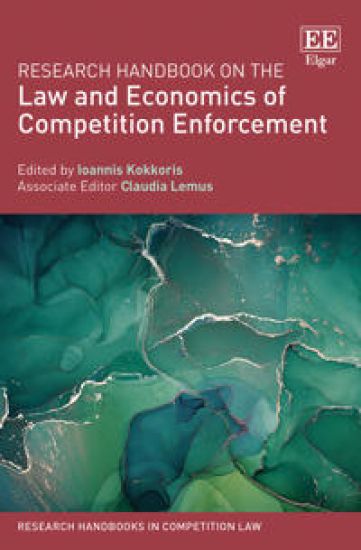
Research Handbook on the Law and Economics of Competition Enforcement

Research Handbook on the Law and Economics of Competition Enforcement

Ioannis Kokkoris; Claudia Lemus

EDWARD ELGAR PUBLISHING LTD
2022
sidottu
This incisive Research Handbook identifies and assesses the emerging trends in competition enforcement, investigating how such changes impact the enforcement approach of competition authorities and the behaviour of companies in an ever-evolving business and regulatory environment. This title contains one or more Open Access chapters.
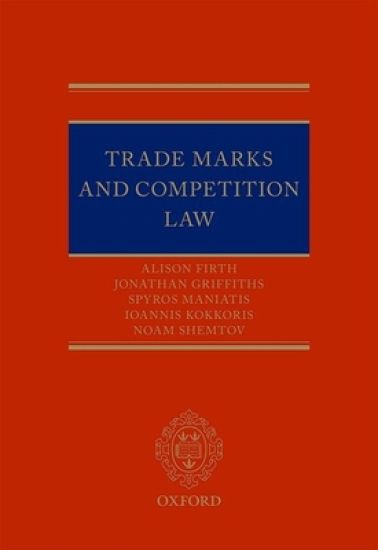
Trade Marks and Competition Law

Trade Marks and Competition Law

Alison Firth; Spyros Maniatis; Ioannis Kokkoris; Noam Shemtov; Apostolos Chronopoulos

Oxford University Press
2022
sidottu
This book provides a critical analysis of the interface between trade mark law and competition law through a combination of practice, doctrine, and policy. The two legal regimes are at opposite ends of the scale, with one promoting monopoly and the other competition; they operate at parallel levels, often without regard for the objectives and regulatory tools of the other. However, an increasing number of cases from the European Union (EU) and beyond cover the intersection of the two regimes. This book highlights the ways in which the fundamentals of trade mark law are being challenged from a competition law perspective, and how trade mark principles affect the development and application of competition law. It provides a detailed overview of jurisprudence from Europe, the United States, and Australia, adopting a comparative approach. The book explores three practical areas. Firstly, it considers the jurisprudence on how trade mark law internalises competition considerations. Secondly, it examines how competition law internalises trade mark considerations. Thirdly, it looks at the hierarchy of the direct relationship between trade mark law as a set of exclusionary rules that lead to market power on one hand and competition law as a set of rules targeting market power and its abuse on the other. The book then focuses on identifying and 'codifying' the judicial toolkit developed by the courts in all of these, and positions this against a theoretical justificatory background. Finally, it tests the sustainability of the toolkit against the 'competition plus' context and provides an appropriate policy framework for the balancing between trade mark rights and competition rules.
EU Merger Control

EU Merger Control

Ioannis Kokkoris; Howard Shelanski

Oxford University Press
2014
sidottu
Economic analysis plays a pivotal role in competition enforcement. Integrating an economic perspective on merger control with a legal perspective throughout, this is a comprehensive reference work on merger control in the EU. Each chapter includes an analysis of the economic methods that have been employed in merger cases or that can be employed in merger assessment, such as merger simulation and critical loss analysis. Whilst focusing on EU practice, the work also highlights key procedures and and case law across the member states. A comparison with US procedure is also considered. Analysing both substantive and procedural law in detail, this is the most comprehensive work on EU merger control and is invaluable for merger assessment.
Merger Control in Europe

Merger Control in Europe

Ioannis Kokkoris

Routledge
2012
nidottu
This book addresses the phenomenon of mergers that may result in non-coordinated effects in oligopolistic markets. Such cases are sometimes referred to as "non-collusive oligopolies", or "gap cases" and there is a concern that they might not be covered by the substantive test that some Member States use for merger assessment. Ioannis Kokkoris examines the argument that the European Community Merger Regulation (Regulation 4064/89) did not capture gap cases and considers the extent to which the revised substantive test in Regulation 139/2004 deals with the problem of non-collusive oligopolies. The author identifies actual examples of mergers that gave rise to a problem of non-coordinated effects in oligopolistic markets, both in the EU and in other jurisdictions, and analyses the way in which these cases were dealt with in practice. The book considers legal systems such as United Kingdom, United States, Australia and New Zealand. The book investigates whether there is any difference in the assessment of non-collusive oligopolies between the various substantive tests which have been adopted for merger assessment in various jurisdictions. The book also looks at the various methodological tools available to assist competition authorities and the professional advisers of merging firms to identify whether a particular merger might give rise to anticompetitive effects and explores the type of market structure in which a merger is likely to lead to non-coordinated effects in oligopolistic markets.
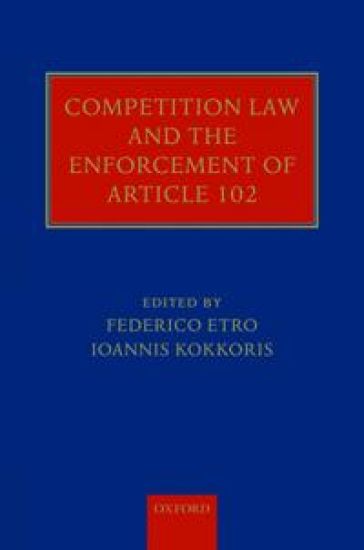
Competition Law and the Enforcement of Article 102

Competition Law and the Enforcement of Article 102

Ioannis Kokkoris

Oxford University Press
2010
sidottu
With incisive and thought-provoking contributions from both leading academics and practitioners, this book addresses in detail the major areas in relation to the Commission Guidance Paper on Applying Article 82 of the EC Treaty (now Article 102). The paper has been at the centre of much of the recent debate on antitrust policy in Europe and has generated significant controversy and intense debate. The authors contend that the guidance from the Commission is on the one hand entirely justifiable in its focus on consumer harm in identifying what constitutes an abuse, but that on the other is not consistent enough in its message, nor indeed does it offer enough structural guidance on the practical application of the approach. The book addresses all of these concerns, considers the reform of article 102, and identifies the challenges inherent in its enforcement, looking for instance at enforcement in certain sectors, such as the high tech sector. The book considers recent seminal antitrust cases such as the Microsoft case to illuminate and better understand abuse of dominance. It brings a line of clarity to often contradictory messages and in so doing provides invaluable practical guidance to enforcers and practitioners alike. The editors combine the insight of a leading international economist and an experienced antitrust scholar, and the contributions are linked by a common emphasis on a strong economic approach to antitrust enforcement.
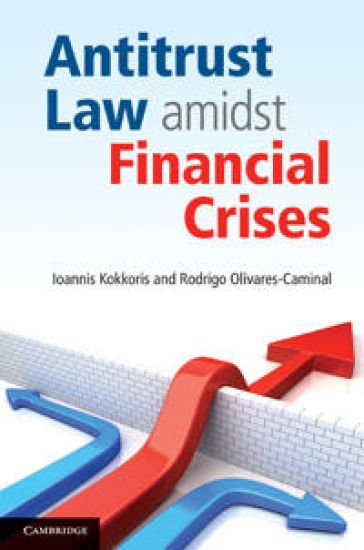
Antitrust Law amidst Financial Crises

Antitrust Law amidst Financial Crises

Ioannis Kokkoris; Rodrigo Olivares-Caminal

Cambridge University Press
2010
sidottu
The ultimate goal of competition law is to promote competition and, in most jurisdictions, to enhance consumer welfare. Competition policy may be set aside due to special and exceptional circumstances, such as a financial crisis that threatens the stability of an economy. It is therefore important to have a clear understanding of competition law and the exceptions to it. The key issue that this book addresses is whether a financial crisis can justify the adoption of a more lenient approach to established legal standards as a result of the risks of the systemic crisis to the entire market. It provides an analysis of exceptions to competition law and policy, particularly in the context of a financial crisis, explores the rationale of competition law in the light of conflicting interests, and serves as a valuable practical guide for policy makers as well as practitioners in the field.
Merger Control in Europe

Merger Control in Europe

Ioannis Kokkoris

Routledge
2010
sidottu
This book addresses the phenomenon of mergers that may result in non-coordinated effects in oligopolistic markets. Such cases are sometimes referred to as "non-collusive oligopolies", or "gap cases" and there is a concern that they might not be covered by the substantive test that some Member States use for merger assessment. Ioannis Kokkoris examines the argument that the European Community Merger Regulation (Regulation 4064/89) did not capture gap cases and considers the extent to which the revised substantive test in Regulation 139/2004 deals with the problem of non-collusive oligopolies. The author identifies actual examples of mergers that gave rise to a problem of non-coordinated effects in oligopolistic markets, both in the EU and in other jurisdictions, and analyses the way in which these cases were dealt with in practice. The book considers legal systems such as United Kingdom, United States, Australia and New Zealand. The book investigates whether there is any difference in the assessment of non-collusive oligopolies between the various substantive tests which have been adopted for merger assessment in various jurisdictions. The book also looks at the various methodological tools available to assist competition authorities and the professional advisers of merging firms to identify whether a particular merger might give rise to anticompetitive effects and explores the type of market structure in which a merger is likely to lead to non-coordinated effects in oligopolistic markets.